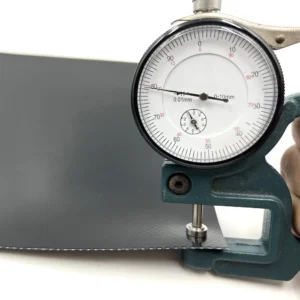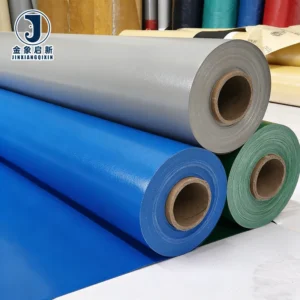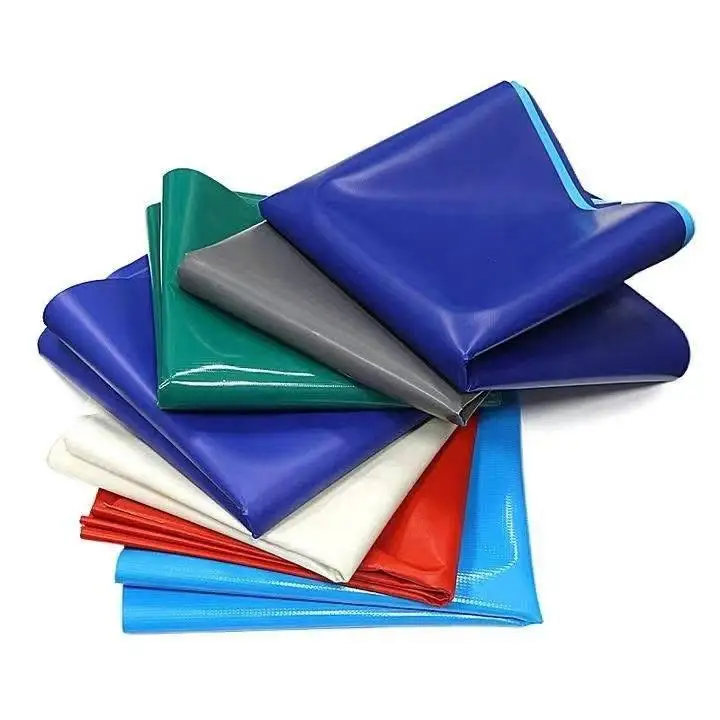
Batch-Consistent Coating Weight — Every roll of blue PVC knife coated tarpaulin ships with a pre-shipment inspection record confirming GSM and coating adhesion match the material specification sheet, protecting fleet buyers from under-weight delivery.
Technical Specifications
| Parameter | Value |
|---|---|
| Product Type | PVC Coated Tarpaulin Roll |
| Material | PVC knife coated fabric |
| Coating Method | Knife Coated |
| Waterproof Rating | Waterproof (grade not stated in source) |
| Flame Retardant Grade | Fire retardant (grade not stated in source) |
| UV Treatment | UV resistant (test basis not stated in source) |
| Anti-Mildew | Antibacterial and mildew proof |
| Chemical Resistance | Oil and stain resistance, acid and alkali resistance |
| Temperature Range | High temperature and cold resistance (specific values not stated in source) |
| Welding Options | HF, Hot Air, Sewing |
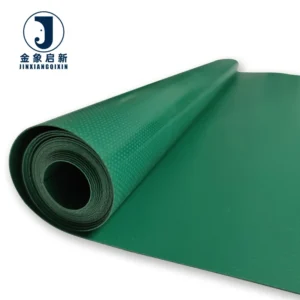
| Finish | Self-cleaning surface |
| Flexibility | Highly flexible, resistant to cracking |
| Key Features | Tensile, tearing and peeling resistance |
Application Suitability
| Application | Exposure & Requirement |
|---|---|
| Truck side curtain and trailer cover | Constant flexing at load points, road debris abrasion, UV and rain exposure, colour uniformity across panels |
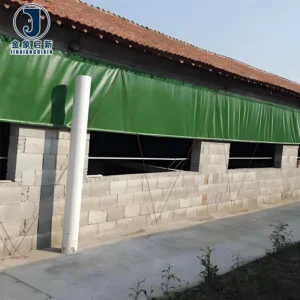
| Tensile structures and shade systems | Long-term sun exposure, wind load tension, weld integrity at stress points, self-cleaning surface for maintenance reduction |
| Portable storage structures and airport hangars | Wide-span fabric tension, fire retardant compliance for enclosed spaces, thermal expansion and contraction |
| Stadium architectural structures | High-profile visibility requiring colour consistency, large panel welding, UV and weather resistance |
| Industrial tarpaulin and equipment covers | Oil and chemical splash, mechanical abrasion, mildew in humid storage environments |
Why Welded Seams Fail Before the Fabric Does on Truck Covers
Seam failure is almost always a welding process mismatch, not a material defect.
When a PVC tarpaulin roll arrives at a fabrication shop, the most common failure point is not the body of the fabric but the weld line where two panels join. Fleet operators see this on truck side curtains that flex thousands of times per trip — the seam peels or cracks while the surrounding material remains intact. The root cause is usually a welding temperature or speed setting that does not match the coating thickness and formulation of the specific roll being used. Even a knife coated PVC tarpaulin roll with strong tensile and tear resistance will underperform if the HF or hot air parameters are set for a different coating weight [NEED_CITE: welding parameter alignment for PVC coated fabrics per fabrication best practice].
Matching Weld Method to Load Profile on Fleet Covers
Transport fleet operators and transport equipment builders need to select the seam method based on where the joint sits on the vehicle. High-frequency welding produces the strongest bond for seams that sit at flex points, such as the bottom edge of a side curtain where the fabric folds during loading. Hot air welding suits long straight seams on flat panels where continuous heat application ensures even adhesion. Sewing with sealed thread remains relevant for reinforcement patches and tie-down loops where mechanical fastening adds a secondary load path. This PVC tarpaulin roll aftermarket supplier supports all three methods, giving fabricators the freedom to match the seam type to the stress profile.
Colour Uniformity Across Multiple Rolls in One Shipment
When a fleet order requires ten or more rolls to cover an entire trailer set, visible colour variation between panels is a rejection-level defect. The knife coating process used on this blue PVC tarpaulin delivers pigment dispersion within the PVC layer itself rather than as a surface print, which reduces the risk of batch-to-batch shade drift. Rolls produced in the same production run are matched against a colour reference on the material specification sheet. For orders spanning multiple production batches, requesting a pre-shipment colour comparison panel helps catch variation before the container is sealed [NEED_CITE: colour consistency standards for PVC coated textiles in transport applications].
How Knife Coating Determines Real-World Performance
The knife coating method applies a controlled layer of PVC compound directly onto the base fabric under tension, producing a uniform coating thickness across the full roll width. This matters for truck cover fabric because uneven coating creates thin spots that crack first under repeated flexing and cold temperatures. The coating adhesion achieved through knife coating also determines how well the material holds together at welded seams — a peel strength that is consistent across the roll means fabricators can set their HF or hot air machines once and maintain those settings through the entire production run. The self-cleaning surface finish reduces dirt accumulation on installed truck covers, cutting down wash frequency for fleet operators.
What Happens When Roll GSM Does Not Match the Quotation
A recurring complaint among tarpaulin importers and fleet procurement teams is receiving rolls that feel noticeably lighter than the GSM stated on the purchase order. Under-weight material tears more easily at eyelet points and fails earlier under UV exposure because the coating layer is thinner than specified. With this PVC tarpaulin roll aftermarket supplier, every roll is weighed and measured during the 100% pre-shipment inspection, and the results are recorded on a roll-by-roll packing list. Buyers can cross-check the received weight against the inspection record upon container opening, eliminating disputes over whether the shortfall occurred at production or during transit [NEED_CITE: pre-shipment weight verification methods for coated fabric rolls].
Why Fabrication Capability Matters at the Source
Jinan Jinxiang operates three full production lines with 36 sets of professional equipment, which means PVC knife coated tarpaulin rolls move from coating to inspection without leaving the facility. The 10-person R&D team handles sample development for custom widths and colour matching, producing samples within days rather than weeks. Dedicated QA/QC runs at every stage — base fabric inspection, coating weight verification, adhesion testing, and final roll grading — so that the material arriving at a fabrication shop has already passed the checks that most buyers can only perform after delivery. This level of process control is what separates a roll that welds cleanly from one that delaminates at the seam.
Documentation & Verification
- Material specification sheet stating coating method, base fabric type, and colour reference per roll
- Fire retardant grade confirmation aligned with target market compliance — request test documentation
- UV resistance test report provided where treatment is specified for the order
- Roll-by-roll packing list with weight and dimension data for arrival verification
- Pre-shipment inspection record confirming GSM and coating adhesion match the quoted specification
- Certificate of origin and customs documentation for international shipment clearance
Fabrication, Handling & Storage
- Set HF welding temperature to match the knife coated PVC layer thickness for consistent seam peel strength
- Use hot air welding at reduced speed for long straight seams to ensure full coating fusion across the joint
- Store rolls upright on reinforced cores to prevent edge crushing that causes coating crease marks
- Allow cold-stored rolls to reach ambient temperature before unrolling to avoid cracking the PVC coating
- Clean the self-cleaning surface with mild detergent only — solvents may degrade the coating finish
- Plan panel cutting layout to place welded seams away from high-flex zones on truck side curtains
What to Include in Your Inquiry
Specify the truck or trailer model you are covering so that panel dimensions and seam placement can be matched to the vehicle profile. Confirm whether your target market requires a particular fire retardant grade for enclosed transport or architectural use. Indicate the roll width and annual volume you need, along with whether you require fabric only or finished cut-and-welded covers. If colour consistency across multiple rolls is critical for your application, request a pre-production sample for approval before the full order enters production.
Frequently Asked Questions
Q: How is roll GSM verified before shipment and on arrival?
A: Every roll undergoes weight measurement during the 100% pre-shipment inspection, with results recorded on a roll-by-roll packing list. On arrival, buyers can weigh a sample cut from the roll and compare it against the inspection record and the material specification sheet to confirm the coating weight matches the quoted GSM.
Q: What fire retardant test reports are available for this fabric?
A: Fire retardant treatment is available in multiple grades. The specific test report provided depends on the grade confirmed for your order. Buyers should state the compliance standard required in their target market so the correct grade and supporting documentation can be matched to the shipment.
Q: Can I get consistent blue colour across multiple rolls in one order?
A: Rolls produced within the same batch are matched against a shared colour reference. For orders requiring multiple batches, a colour comparison check is performed before dispatch. Requesting a pre-production sample allows you to approve the shade before the full quantity is coated.
Q: Which welding method works best for truck cover seams that flex constantly?
A: High-frequency welding produces the strongest bond at flex points such as side curtain edges. Hot air welding suits long straight seams on flat panels. The knife coated PVC construction on this roll supports HF, hot air, and sewing, so the method can be chosen based on the seam location and load profile.
Q: What custom widths and roll lengths are available for container loading?
A: Custom widths are available to match your fabrication cutting layout and reduce offcut waste. Roll length and core diameter can be specified to optimise container loading by roll count. Provide your target container type and required roll dimensions for a loading plan recommendation.