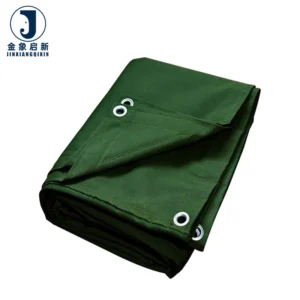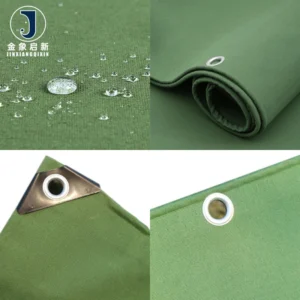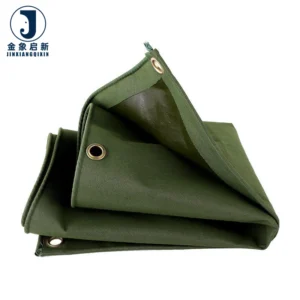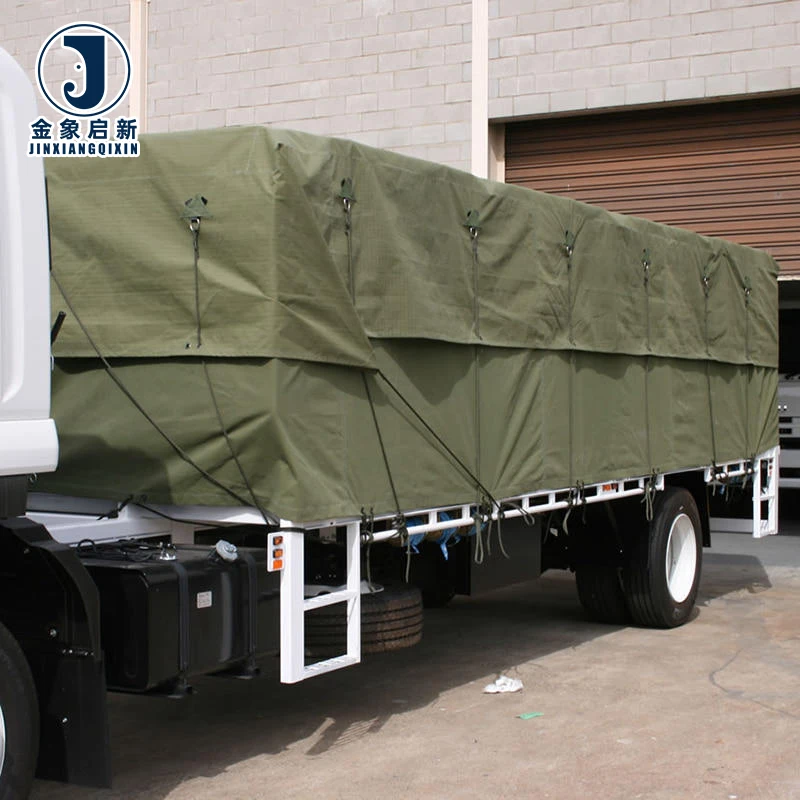
Poly-Rope Reinforced Hems — every fold and seam is welded and sewn around a poly-rope core to hold the tie-down load where truck tarps typically tear first.
Technical Specifications
| Parameter | Value |
|---|---|
| Product Type | Canvas Tarpaulin |
| Base Fabric | Polyester-cotton industrial textile, 8–12 strand fine cotton yarn weave |
| Coating | Silicone canvas material |
| Weight | 600gsm |
| Thickness | 0.5 mm / 0.6 mm / 0.7 mm |
| Roll Size | 2 m × 100 m |
| Finished Product Size | Custom cut to vehicle or load dimensions; stock sizes also available |
| Color | Army Green Camouflage / Custom |
| Edge Reinforcement | Rust-proof aluminum grommets every 1 m at corners and hem; folded, welded and sewn seams with poly-rope core |
| Water Resistance | Stated waterproof (hydrostatic head value not provided) |
| UV Resistance | Stated UV resistant (test basis not stated) |
| Key Features | Wear-resistant, corrosion-resistant, tensile-resistant, high- and low-temperature resistant, mold resistant |
| Standards | CE, ISO (specific standard numbers not stated in source) |
Application Suitability
| Application | Exposure & Requirement |
|---|---|
| Asphalt truck cover | Hot aggregate contact, constant road vibration, wind load on tie-downs, daily flexing at load edges |
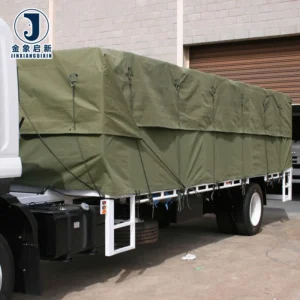
| Open-air cargo cover on flatbed trailers | Highway wind, rain ingress at seams, abrasion from shifting loads, UV exposure over multi-day transit |
| Construction site equipment cover | Ground moisture, dust and debris abrasion, UV exposure during long-term outdoor storage |
| Temporary shelter and field tent fabric | Repeated assembly and teardown stress at grommet and seam points, rain and sun exposure |
Why Generic-Size Tarps Fail on Moving Loads
A tarp cut to a standard rectangle will flutter, abrade and split at the hem long before the fabric itself gives way.
Fleet operators routinely replace covers not because the canvas wore through, but because the hem stitching unraveled under highway wind load, or the grommets pulled free from an unreinforced edge [NEED_CITE: typical failure modes in heavy-duty transport covers]. A Heavy Duty Canvas Tarpaulin for Truck Cover must match the exact load profile — including side drop, overhang and tie-down spacing — so that every grommet aligns with a D-ring or hook and every seam sits on a flat surface rather than a flex line. Generic sizing leaves excess fabric that flaps at speed, generating a sawing action against the load edge that cuts through stitching within weeks.
How Custom Fitment Eliminates Flutter and Edge Abrasion
This Heavy Duty Canvas Tarpaulin for Truck Cover is produced to the specific dimensions of your trailer bed, side curtain drop and overhang requirement. When the tarp lies flat against the load with no excess material, wind cannot get underneath to create the rapid flex cycle that destroys hem stitching. Each rust-proof aluminum grommet is positioned to match your vehicle’s tie-down points, distributing the securing load evenly across the reinforced poly-rope edge rather than concentrating stress at isolated holes.
Seam Construction at the Flex Points That Matter Most
The folded hem is first welded, then sewn around a poly-rope core — a dual-process approach that prevents the seam from becoming the weakest link in the cover assembly [NEED_CITE: weld-sewn seam construction for coated technical textiles]. On the road, the highest cyclic stress occurs where the tarp wraps over the load edge and where tie-down straps press against the fabric. The poly-rope core absorbs this point load and transfers it along the full hem length, so individual stitch holes are never carrying the full strap tension alone.
Reading the Weight and Weave Together
The 600gsm figure combines the polyester-cotton base fabric and the silicone coating applied to it. Base fabric weight, determined by the 8–12 strand yarn count and weave density, governs tensile and tear strength; coating weight governs waterproofing, abrasion resistance and surface durability. Two tarps can share the same GSM yet perform very differently if one achieves it with a heavier coating over a lighter base [NEED_CITE: relationship between base fabric density and coating weight in coated fabrics per ISO 1421]. When evaluating this canvas, request the base fabric weight and coating weight breakdown so you can assess whether the balance suits your application — a transport cover needs tear resistance at the base fabric level, while a static equipment cover may prioritize a thicker coating for weather sealing.
What Happens When the Hem Specification Is Underestimated
A cover specified on GSM alone, with standard punched grommets and single-stitch hems, will fail at the edge under sustained highway wind. The grommets tear through the fabric, the stitching unravels, and the cover flaps open — exposing the load to rain and debris. For asphalt transport, an open cover also means heat loss, causing the aggregate to cool below paving temperature before it reaches the job site [NEED_CITE: temperature retention requirements for hot-mix asphalt transport]. This is a specification problem, not a material problem, and it is solved at the design stage by confirming grommet spacing, hem reinforcement method and edge fold construction before production begins.
Why Source This Canvas Here
Three full production lines and 36 sets of professional equipment support roll-to-roll batch consistency, so colour and weight do not drift across a multi-roll order.
A 10-person R&D team handles custom sizing, pattern and colour development, producing finished samples within days for fitment confirmation before bulk cutting.
Dedicated QA/QC runs at every production stage with 100% inspection before dispatch, catching GSM deviations and hem defects before the roll ships.
Deep process control over coating weight and adhesion, built on nearly 30 years of focused coated-fabric production, ensures the silicone coating bonds fully to the polyester-cotton base.
ISO and CE certified production systems provide traceable quality documentation for compliance-sensitive transport and construction projects.
Documentation & Verification
- Material specification sheet confirming 600gsm weight, base fabric composition and silicone coating type for each roll
- Pre-shipment inspection record covering GSM check, grommet placement and seam integrity before dispatch
- Roll packing list with finished dimensions, eyelet spacing and colour reference per item
- UV and water resistance test reports available on request — confirm the test basis required for your market
- ISO and CE certificates on file for customs and project compliance submissions
- Certificate of origin and customs documentation included with every export shipment
Fabrication, Handling & Storage
- Weld-sewn seams with poly-rope core require compatible heat settings; confirm welder temperature for 600gsm silicone-coated canvas before production runs
- Rust-proof aluminum grommets are set every 1 m — verify tie-down strap spacing matches this pitch to avoid un-reinforced load points
- Store rolls upright on end-caps in a dry, shaded area to prevent compression creasing across the 2 m roll width
- Allow cold-stored rolls to reach ambient temperature before unrolling to prevent coating micro-cracking at low temperature
- Use mild, non-solvent cleaners on the silicone surface to preserve the coating bond and water resistance over repeated wash cycles
What to Include in Your Inquiry
Provide your trailer model, bed dimensions, side drop length and tie-down point layout so the tarp can be cut and grommeted to match. Confirm whether you need roll stock for your own fabrication or finished, cut-to-size covers with hems and grommets installed. Specify the target market’s compliance requirements — UV test basis, fire classification or any project-level material certification — so the correct documentation ships with your order.
Frequently Asked Questions
Q: How is the 600gsm weight verified on arrival to match the quotation?
A: Every roll undergoes a weight check during the 100% pre-shipment inspection. The result is recorded on the inspection report that ships with your order. If your receiving process requires independent verification, we recommend cutting a measured sample and weighing it on a calibrated scale to confirm the quoted specification.
Q: What is the UV resistance test basis for this canvas?
A: The material is stated UV resistant, but the specific test method and exposure duration are not documented in the source specification. If your application requires certified UV performance — for example, to meet a transport authority or construction project standard — request the test report and confirm the required exposure class before placing your order.
Q: How are welded seams and poly-rope hems tested at flex and abrasion points?
A: The dual weld-and-sew construction with poly-rope reinforcement is inspected for seam integrity during pre-shipment QC. For applications with high cyclic stress, such as highway transport covers, we can produce test panels for your own flex or peel testing before full production begins.
Q: Can the tarpaulin be cut and fitted to specific truck and trailer model dimensions?
A: Yes. Finished product sizes are made to customer drawings or vehicle model specifications. Provide the bed length, width, side drop and tie-down layout so the cover is cut with correct overhang and grommet alignment, eliminating the generic-size fitment gap that causes flutter and abrasion.
Q: What is the lead time and minimum order for custom sizes and colors?
A: Lead time and minimums depend on order volume, colour specification and whether you require roll stock or finished cut-to-size covers. Custom samples are developed within days. Contact our team with your quantity and specification for a confirmed schedule and production minimum.