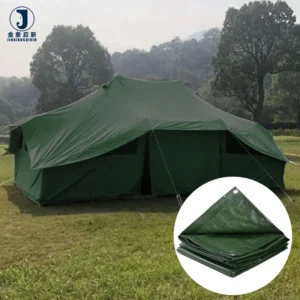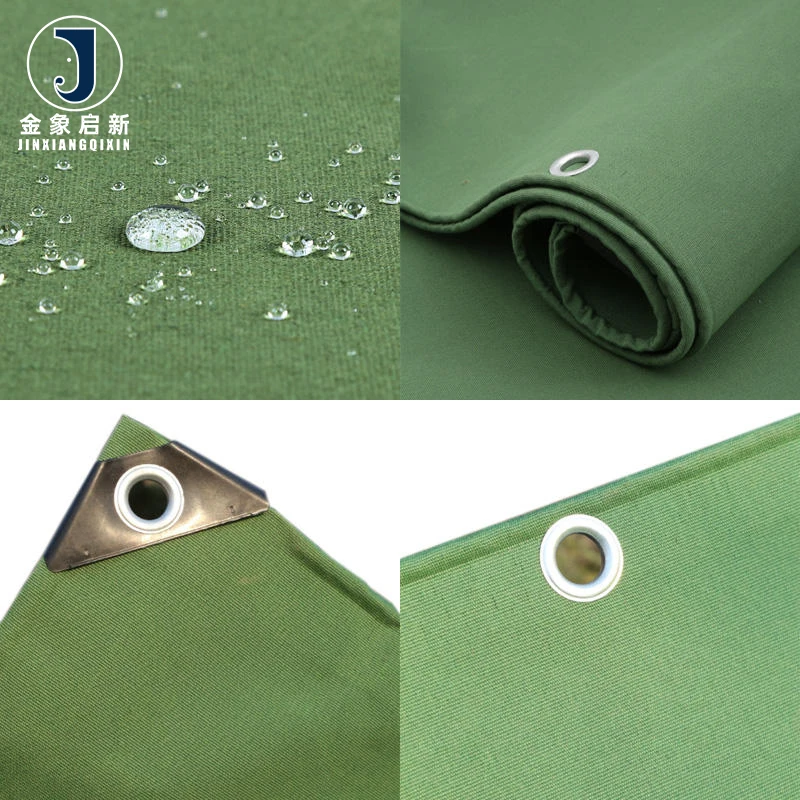
Deep Process Control Over Coating Weight and Adhesion — Every roll of this 600gsm canvas tarpaulin undergoes stage-by-stage QA to ensure the silicone coating penetrates the polyester-cotton base fabric uniformly before it leaves the line.
Technical Specifications
| Parameter | Value |
|---|---|
| Product Type | Canvas Tarpaulin |
| Base Fabric | Polyester cotton industrial textile with 8–12 strands of fine cotton yarn |
| Weight | 600gsm |
| Total Thickness | 0.5mm / 0.6mm / 0.7mm |
| Coating Material | Silicone canvas coating |
| Roll Width | 2m |
| Roll Length | 100m |
| Color | Army Green Camouflage / Custom |
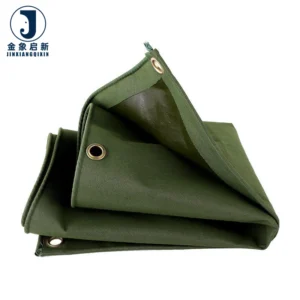
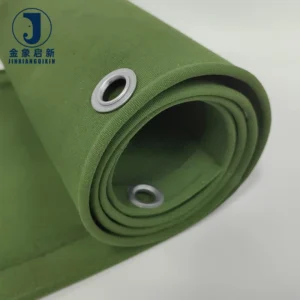
| Eyelet & Hem | Rustproof aluminum grommets every 1 meter at corners and hem; folded and sewn seams with poly ropes |
| Key Features | Waterproof, UV resistant, mold resistant, wear-resistant, corrosion-resistant, high- and low-temperature resistant |
| Waterproof Rating | Waterproof (test basis not stated) |
| UV Treatment | UV resistant (test basis not stated) |
| Flame Retardant Grade | Not stated — confirm the grade required for your market |
| Anti-Static | Not stated — available on request with certification |
| Standards | ISO, CE (specific certification numbers not stated) |
Application Suitability
| Application | Exposure & Requirement |
|---|---|
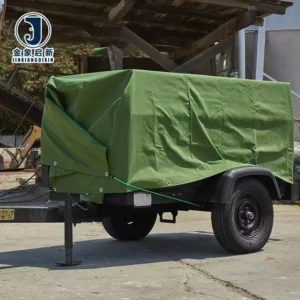
| Truck and trailer load covers | Road vibration, wind uplift, constant flexing at load edges, weather and UV exposure |
| Fleet side curtain systems | Repeated tie-down and release cycles, abrasion against cargo edges, highway-speed airflow |
| Transport equipment covers for construction plant | Dust ingress, impact from loose aggregate, prolonged outdoor standing |
| Open-bed transit protection for palletised goods | Rain ingress, strap abrasion, thermal cycling during multi-day hauls |
| Temporary site enclosures on transport yards | Wind loading, ground moisture, forklift contact |
Why Generic-Size Covers Fail Where Your Load Flexes Most
A canvas tarpaulin for truck and transport that does not match the exact trailer dimensions leaves unsealed edges and concentrates stress at points the generic pattern never accounted for.
The cover must be cut to the specific vehicle model, with seam reinforcement placed at the high-flex zones where the load shifts during braking and cornering.
Fleet operators who buy off-the-shelf sizes routinely find that the hem pulls away from the grommet line within the first season. The fabric itself may still be intact, but the cover no longer seals the load. On a 13.6-metre curtain-side trailer, even a 200mm gap at the rear quarter allows driven rain to reach the cargo on a motorway run [NEED_CITE: tensile and tear test methods for coated fabrics per ISO 1421]. Custom-cut canvas tarpaulin eliminates that gap and places the reinforced poly-rope hem exactly where your tie-down straps bear the most load.
Tie-Down Compatibility and Eyelet Spacing for Highway Transit
Rustproof aluminum grommets are punched every 1 meter along corners and the hem, matching the standard spacing that most ratchet strap and bungee systems require on articulated trailers. The aluminum alloy resists the salt and road-film corrosion that degrades steel eyelets over a single winter season. For fleet operators running high-wind routes or exposed coastal corridors, this spacing gives a secure anchor point within reach of any standard tie-down bar, and the Canvas Tarpaulin for Truck and Transport stays tensioned without slack zones that let wind get underneath the load.
Seam Construction at High-Stress Flex Zones
Where the cover wraps over the load edge and the fabric folds back on itself during braking, welded and sewn poly rope reinforcement distributes the point load across a wider seam allowance. A single-layer stitched hem concentrates stress into a needle-line perforation; the poly rope insert spreads that force and prevents the tear from propagating along the stitch row. This construction matters most on open-bed trailers carrying irregular loads such as machinery or timber packs, where the canvas tarpaulin must flex around protruding edges without splitting [NEED_CITE: seam failure modes in coated industrial textiles].
Reading the Specification Sheet Beyond the Weight
The 600gsm figure tells you the total coated weight per square metre, but on a canvas tarpaulin the base fabric construction matters equally. The polyester-cotton blend with 8–12 strand fine cotton yarn gives a tighter weave than a plain polyester scrim of the same weight, improving resistance to puncture from sharp cargo corners. Silicone canvas coating bonds into the yarn structure rather than sitting as a surface film, which maintains the fabric’s flexibility across the temperature swings a truck cover experiences between a cold start at dawn and a sun-heated load deck by midday. The 0.5mm to 0.7mm thickness range reflects the number of coating passes applied — a thicker build adds abrasion resistance at the cost of pack-down volume, so specifying the right thickness depends on whether the cover is handled daily or left in place for a full transit cycle.
The Hidden Cost of Skipping Pre-Shipment GSM Verification
A quotation that states 600gsm but delivers fabric weighing less means the base fabric was down-gauged or the coating passes were reduced. On a truck cover, lighter material tears faster at the grommet pull-out points and shows premature wear along the roof ridge where standing water pools. Batch-to-batch variation within a single order can also leave one panel noticeably lighter or stiffer than the next, visible once the cover is installed across a fleet [NEED_CITE: GSM verification methods for coated fabrics]. Requesting a pre-shipment inspection record that logs the measured weight of each cut piece closes this gap before the goods reach your depot.
What This Supply Chain Brings to Transport Cover Projects
Three full production lines running in parallel mean a fleet-sized order of custom-cut covers can move through cutting, grommeting, and inspection without queuing behind unrelated product runs. The 10-person R&D team develops fitment patterns against specific truck and trailer models — not generic rectangles — so the finished cover matches the vehicle profile. A dedicated QA stage checks grommet pull-out resistance and seam integrity on every piece before packing, rather than sampling a percentage. Samples for new vehicle models are developed within days, allowing a fleet operator to confirm the fit on one trailer before committing the full order. Material specification sheets accompany each shipment so your receiving team can verify the canvas tarpaulin on the dock against what was quoted.
Documentation & Verification
- Material specification sheet stating 600gsm weight, polyester-cotton base fabric, and silicone coating type
- Pre-shipment inspection record with measured GSM and dimensional check for each cut-to-size piece
- Grommet pull-out and seam integrity check logged per piece before packing
- Test basis documentation for waterproof and UV-resistant claims where applicable
- Roll packing list and certificate of origin for customs clearance
- ISO and CE compliance documentation included with the consignment
Fabrication, Handling & Storage
- Sew canvas tarpaulin with UV-stabilised polyester thread to match the silicone-coated surface durability
- Weld seams at minimum 25mm overlap to engage the poly rope reinforcement fully at flex zones
- Punch grommets with a backing washer to prevent pull-through on the 600gsm base fabric
- Store rolls upright on pallets to prevent flat-spot creasing across the 2m width
- Avoid dragging cut pieces over unpainted steel deck surfaces to protect the silicone coating finish
- Clean with mild detergent only — solvent-based cleaners degrade the silicone canvas coating bond
What We Need to Quote Your Fleet Cover Project
Provide the truck or trailer make, model, and year so we can confirm the exact cover dimensions against the vehicle profile. Share your tie-down system type — ratchet strap, bungee, or rope — so grommet spacing and hem reinforcement can be matched to the hardware. If you operate in a jurisdiction that requires flame retardant certification for transport covers, specify the grade and standard so we can source the correct treatment.
Frequently Asked Questions
Q: How do I specify the exact trailer dimensions for a custom-fit canvas truck cover?
A: Send us the trailer make, model, year, and any aftermarket modifications such as tail lifts or side-mounted toolboxes. We cross-reference these against our fitment pattern library and send a dimensional drawing for your approval before cutting. This ensures the canvas tarpaulin for truck and transport wraps the load correctly with no gap at the rear quarter or stress concentration at protruding hardware.
Q: What eyelet spacing and reinforcement options are available for high-wind transport routes?
A: Standard spacing is rustproof aluminum grommets every 1 meter along corners and hems. For high-wind corridors we can reduce spacing or add intermediate D-ring anchors welded to the silicone-coated fabric. The poly rope reinforced hem spreads the load across the full seam width so individual grommets do not carry the entire tie-down force during gusts.
Q: How is batch-to-batch colour consistency maintained across canvas tarpaulin orders?
A: Army Green Camouflage and custom colours are matched against a master reference swatch held from the original dye lot. Each production run is checked under controlled lighting against that reference before coating. If you are adding covers to an existing fleet over multiple orders, request a retained sample from your first batch so we can match subsequent deliveries to it.
Q: What GSM verification do you provide on arrival to confirm the quoted weight?
A: Every cut piece is weighed and logged during the pre-shipment inspection, and the record travels with the packing list. On arrival, you can cross-check the measured values against the stated 600gsm. Any piece falling outside tolerance is flagged before dispatch, so your receiving team never has to reject a cover after it has been shipped.
Q: What seam construction is used at the flex points where the load moves most during transit?
A: High-flex zones use welded and sewn seams with poly rope inserts. The rope spreads point load across the seam allowance instead of concentrating it on the needle line. This prevents tear propagation when the canvas tarpaulin wraps over irregular cargo edges during braking and cornering, keeping the seam intact through repeated flex cycles.