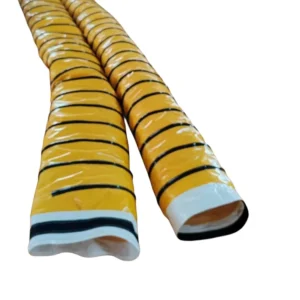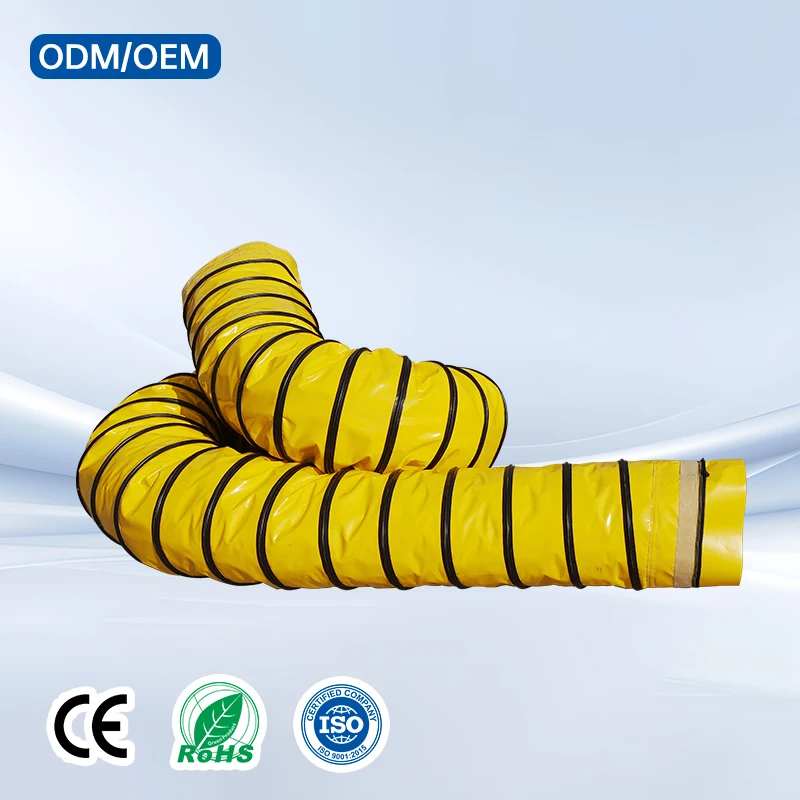
Deep process control over coating adhesion — nearly 30 years of coated-fabric production ensures the PVC layer and aluminum foil insulation in this Aircraft PCA Hose Flexible Air Duct remain bonded under repeated flexing on the apron.
Technical Specifications
| Parameter | Value |
|---|---|
| Product Type | Aircraft PCA Hose Flexible Air Duct |
| Material | PVC coated fabric-reinforced layer with aluminum foil bubble film insulation |
| Temperature Range | -30°C to 150°C (verify against manufacturer catalog) |
| Outer Layer Colour | Yellow-black alternating high-visibility |
| Connection Type | Zipper and Velcro link for disassembly |
| Logo Customization | Supported, MOQ 100 |
| Pattern Customization | Supported, MOQ 100 |
| Mildew Resistance | Yes (test basis not stated) |
| Water Resistance | Yes (test basis not stated) |
| Flame Retardant Grade | Grade not stated — confirm requirement for your market |
| Anti-Static | Not confirmed — verify compliance with airport safety standards |
| Standards on File | ISO, CE (company-level; product-specific reports available upon request) |
Application Suitability
| Application | Exposure & Requirement |
|---|---|
| PCA unit to aircraft cabin air delivery | Continuous thermal cycling, mechanical dragging on apron, jet blast proximity |
| Airport GSE air conditioning connections | Rapid coupling and decoupling between aircraft turns, outdoor storage between uses |
| Flexible ducting for ground aviation operations | Folding and unfolding stress, fuel spillage contact, UV exposure on tarmac |
Why Certification Gaps Matter for Aviation Air Duct Hose on the Apron
A duct without a stated flame retardant grade or anti-static rating cannot clear airport safety audits, regardless of how durable the fabric feels.
Ground support equipment operators face increasing scrutiny from airport authorities over the fire performance and static dissipation of every hose on the ramp. When the Aircraft PCA Hose Flexible Air Duct arrives without a test certificate that names the specific grade, the procurement team is left scrambling for third-party validation while aircraft sit waiting for pre-conditioned air. [NEED_CITE: airport ramp safety requirements for flexible ducting materials] I have watched fleet managers reject entire shipments because the fire classification was listed as "available" rather than confirmed to a named standard, turning a routine replacement into a compliance bottleneck.
Connecting the Hose Where Ground Crews Work Fast
The zipper and Velcro connection system on this Aircraft PCA Hose Flexible Air Duct lets ramp technicians join or separate sections without tools, cutting turnaround time between flights. Airport aprons run on tight schedules, and a duct that requires bolted flanges or clamping rings adds minutes to every aircraft turn. The quick-release links also mean a damaged section can be swapped out on the spot rather than pulling the entire hose run back to the maintenance bay.
Insulation That Handles the Full Thermal Swing
The built-in aluminum foil bubble film insulation layer sits between the PVC-coated outer shell and the airstream, maintaining air temperature from the PCA unit outlet to the aircraft cabin interface. On a winter morning the duct may deliver air heated well above ambient, while summer apron temperatures push the outer jacket toward its upper limit. This dual-exposure thermal range of -30°C to 150°C keeps the insulation functional across seasonal extremes without embrittlement or delamination. [NEED_CITE: thermal performance testing methods for insulated flexible ducting]
Reading the Material Construction
The PVC coated fabric-reinforced layer provides the structural backbone, resisting puncture and abrasion as crews drag the hose across concrete and asphalt. The aluminum foil bubble film beneath it traps air in sealed cells, reducing thermal transfer without adding significant weight — critical when a single hose section must still be manhandled into position. The yellow-black alternating outer colour is not decorative; it meets the high-visibility marking expectations on busy aprons where forklifts, tugs and fuel trucks share the same pavement. Temperature rating alone does not guarantee performance — the coating must also maintain adhesion to the base fabric after repeated thermal expansion and contraction cycles, which is where coating process control separates a duct that lasts from one that peels internally after a season.
What Happens When the Wrong Duct Reaches the Ramp
A hose specified without confirming the flame retardant grade may pass the purchase order but fail the airport fire marshal’s inspection, grounding the PCA unit until a compliant replacement arrives. Colour inconsistency across a fleet order makes it harder for ground crews to identify which hose belongs to which gate or stand, introducing confusion during peak operations. When the insulation layer is not fully bonded to the outer fabric, hot air leaks at flex points and the duct surface becomes a burn hazard for handlers working without gloves. [NEED_CITE: coated fabric delamination failure modes under thermal cycling] These are not warranty claims — they are operational disruptions that cascade into flight delays.
Why Procurement Teams Source This Duct Here
Three full production lines and 36 sets of professional equipment allow batch runs large enough to outfit an entire airport’s PCA fleet in a single order, maintaining colour and construction consistency across every section. The 10-person R&D team handles diameter and length adjustments to match specific PCA unit models, developing samples within days rather than weeks. Dedicated QA/QC inspects every duct at each production stage, with 100% pre-shipment inspection covering seam integrity and connection hardware function. Coating weight and adhesion are controlled in-house, drawing on nearly 30 years of coated-fabric experience to prevent the insulation separation that plagues hastily manufactured alternatives.
Documentation & Verification
- Material specification sheet detailing PVC base fabric, coating weight and aluminum foil insulation layer composition
- Temperature range test report confirming -30°C to 150°C rating for the insulated duct assembly
- Pre-shipment inspection record covering seam welds, zipper and Velcro connection integrity
- ISO and CE certificates on file with customs documentation support for cross-border shipment
- Flame retardant and anti-static test reports provided when grade is confirmed at inquiry stage
Fabrication, Handling & Storage
- Heat-weld seams using temperature settings matched to the PVC coated layer to avoid insulation damage
- Store coiled sections flat or on wide-diameter racks to prevent permanent creasing of the aluminum foil bubble film
- Inspect zipper teeth and Velcro hooks after each aircraft turn for concrete dust or fuel residue buildup
- Avoid dragging the yellow-black outer jacket over sharp pavement edges during apron deployment
- Clean with mild detergent only — solvents may degrade the PVC coating adhesion to the base fabric
- Allow wet ducts to air-dry fully before coiling to prevent mildew formation inside the insulation layer
What to Include in Your Inquiry
Provide the PCA unit model and aircraft types you service so we can match the duct diameter and connection interface. Confirm the fire-retardant grade and anti-static classification required by your airport authority. Specify the number of sections, individual lengths, and whether logo or pattern printing is needed for fleet identification.
Frequently Asked Questions
Q: What fire-retardant or anti-static certifications does the duct carry for airport compliance?
A: The standard product is supplied without a stated flame retardant grade or confirmed anti-static rating. If your airport authority requires a specific classification, share the standard reference at inquiry stage so we can source the appropriate coated fabric and provide a product-specific test report with your shipment.
Q: Can the hose diameter and length be customised to match our PCA unit model?
A: Yes. Our R&D team adjusts diameter and section length to fit the outlet dimensions of your PCA unit and the aircraft cabin interface. Provide the unit model and any coupling drawings, and we will develop a sample for fitment confirmation before full production.
Q: How do you control colour consistency across multiple hoses in a fleet order?
A: All sections in a single order are coated from the same PVC batch, and our in-process QA checks colour reference at each production stage. This prevents visible shade variation when hoses from one fleet order are deployed side by side on the apron.
Q: What is the MOQ and lead time for custom logo or pattern printing?
A: Logo and pattern customization are supported with a minimum order of 100 units. Share your artwork and placement requirements at inquiry stage, and we will confirm the production timeline alongside the sample approval process.