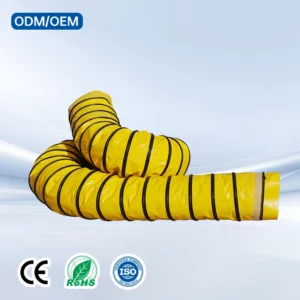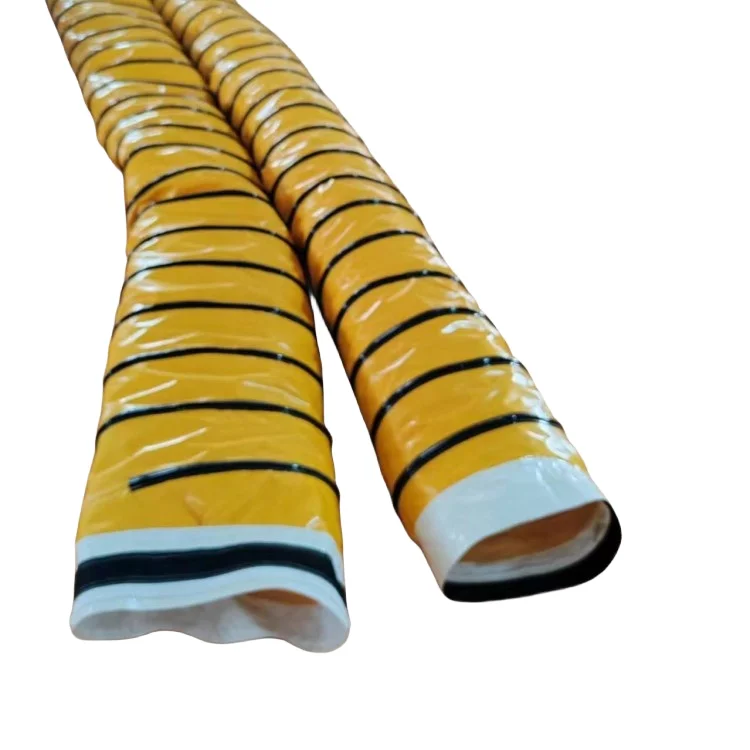
Deep Process Control — Three full production lines and 36 sets of equipment maintain consistent coating weight and adhesion across every aviation duct batch.
Technical Specifications
| Parameter | Value |
|---|---|
| Product Type | Aviation Air Duct |
| Inner Diameter | 12 Inch |
| Coating Material | PVC |
| Construction | PVC coated fabric-reinforced layer with aluminum foil bubble film insulation |
| Temperature Range | -30°C to 150°C |
| Outer Layer | Yellow-black alternating protective coloring |
| Connection Method | Zipper and Velcro |
| Anti-Mildew | Yes (PVC coated cloth mildew resistance claimed) |
| Waterproof | Yes (water resistance claimed) |
| Flame Retardant | (grade not stated in source) |
| Anti-Static | (standard not stated in source — confirm with manufacturer) |
| Customization | Logo and pattern printing available, MOQ 100 |
| Standards | ISO, CE |
Application Suitability
| Application | Exposure & Requirement |
|---|---|
| Airport apron ground support equipment | Constant outdoor weather exposure, fuel spill risk, vehicle traffic abrasion, high-visibility safety marking |
| PCA unit to aircraft cabin air transmission | Rapid temperature cycling, pressurized airflow, repeated deployment and retraction |
| Cold and warm air delivery from ground air supply | Extreme thermal gradients, condensation formation, prolonged UV exposure on tarmac |
| Mobile air supply cart integration | Flex fatigue at connection points, mechanical impact during transport, compact storage requirement |
What Certification Gaps Mean for Apron Safety Compliance
We clarify fire-retardant and anti-static documentation before production begins, so your duct passes site inspection on arrival.
Ventilation duct supplied without the fire-retardant or anti-static certification the site requires remains a recurring issue across aviation ground support procurement. Buyers receive material labeled "flame retardant" but cannot produce the test report the airport safety officer demands during a ramp audit. The Aircraft PCA Air Duct manufacturer must confirm the applicable standard — whether NFPA, local civil aviation authority, or airport-specific regulation — and align the material grade before the order is cut. [NEED_CITE: airport apron fire safety regulations for ground support equipment materials] Without this alignment, entire shipments sit in bonded warehouses awaiting resolution while aircraft turnaround schedules slip.
Reinforced Layer Construction for Apron Abuse
The PVC coated fabric-reinforced layer forms the structural backbone of this aviation air duct, resisting the puncture and abrasion that occur when hoses drag across concrete aprons or contact baggage carts. The reinforced weave distributes localized stress across multiple yarns rather than concentrating it at a single point, which prevents small tears from propagating under pressurized airflow. This construction approach addresses the reality that ground crews deploy and retrieve ducts rapidly between aircraft turns, often without protective handling equipment.
Thermal Insulation Performance Across Climate Extremes
The built-in aluminum foil bubble film insulation layer maintains air temperature integrity from the PCA unit outlet to the aircraft cabin connection point. This insulation barrier minimizes thermal loss during transit across the apron, where ambient tarmac temperatures and solar loading can compromise delivered air quality. The -30°C to 150°C operating range accommodates both winter cold-start scenarios and peak summer heat conditions without material degradation. [NEED_CITE: thermal performance testing methods for insulated flexible ducts] Ground handling operators working across seasonal climate zones require this breadth of thermal tolerance to avoid stocking separate winter and summer duct inventories.
Specification Reading: Where Material Choices Determine Field Performance
The PVC coating method directly influences weld integrity at zipper and Velcro connection points, where the duct flexes most during pressurization cycles. Heat-welded seams on PVC-coated aviation ducts must achieve peel strength comparable to the base fabric tensile capacity; otherwise, the seam fails before the panel does. The aluminum foil bubble film insulation layer adds thermal mass but also introduces a delamination risk if the adhesive bond between insulation and outer PVC layer degrades under repeated thermal cycling. Yellow-black alternating coloring serves a dual function beyond safety visibility: the pigmented outer PVC layer must maintain color stability against UV degradation without chalking or fading, which would reduce apron visibility over time. The 12-inch diameter specification must match standard PCA unit outlet flanges; any mismatch forces adapters into the airflow path, creating turbulence and pressure drop that reduce cooling efficiency.
The Cost of Undocumented Compliance on the Apron
Specifying an Aircraft PCA Air Duct manufacturer without obtaining written confirmation of flame-retardant grade and anti-static surface resistance creates a liability chain that extends from procurement to operations. Airport safety audits increasingly demand physical test reports matching the exact material batch deployed, not generic certificates covering a product family. Ducts that pass initial acceptance but fail subsequent random sampling inspections force operators into emergency replacement cycles at premium cost and extended lead time. [NEED_CITE: aviation ground support equipment material compliance audit procedures] Color inconsistency between production batches compounds the problem when operators expand their duct fleet — mismatched yellow-black panels reduce visibility coherence and create confusion during rapid equipment identification. Weld seam failures at connection points represent the most common field failure mode, typically occurring after repeated pressurization cycles where flex fatigue concentrates stress beyond the adhesive bond strength.
Why Aviation Procurement Teams Source From This Facility
Three full production lines operating 36 sets of professional equipment provide the capacity to fulfill bulk aviation duct orders without extending lead times beyond acceptable ground support procurement windows. A dedicated 10-person R&D team handles diameter customization, insulation layer adjustments, and connection fitting compatibility for specific PCA unit models — development samples reach testing within days rather than weeks. Every production stage carries QA/QC checkpoints, with 100% pre-shipment inspection covering diameter verification, weld seam integrity, and connection fitting function. [NEED_CITE: ISO quality management system requirements for coated fabric manufacturing] The facility’s ISO and CE certification framework provides the documentation baseline that aviation procurement departments require for vendor qualification. Coating weight and adhesion process control, refined over nearly 30 years of coated fabric specialization, ensures that each duct roll maintains consistent wall thickness and insulation bond strength across the full production run.
Documentation & Verification
- Material specification sheet stating base fabric construction, PVC coating weight, and aluminum foil insulation layer composition
- Test report confirming flame-retardant grade and applicable aviation or airport authority standard where required
- Anti-static surface resistance measurement documentation for apron safety regulation compliance
- Pre-shipment inspection record with dimensional check on 12-inch diameter and zipper/Velcro fitting function
- Roll packing list and certificate of origin for international airport procurement customs clearance
- ISO and CE certificates aligned to production batch for vendor audit trail
Fabrication, Handling & Storage
- Heat-weld zipper connection flanges at temperature settings matched to PVC coating thickness to prevent seam delamination under pressure
- Store rolled ducts upright on pallets in shaded areas to prevent yellow-black outer layer UV degradation before deployment
- Use mild detergent without solvent-based cleaners on PVC coated surface to preserve mildew resistance and color integrity
- Inspect Velcro hook-and-loop engagement before each aircraft connection to confirm positive retention under airflow pressure
- Allow cold-stored ducts to reach ambient temperature before unfurling to prevent insulation layer cracking below -30°C threshold
- Align zipper tracks fully before pressurizing to avoid localized stress concentration at partially engaged connection points
Inquiry Direction for Aviation Duct Procurement
Specify the PCA unit model and aircraft interface standard your ground support fleet serves so we can confirm diameter and connection fitting compatibility. State the fire-retardant grade and anti-static standard your airport authority mandates, along with any required test methodology, before we proceed to sample development. Indicate whether custom logo placement and outer packaging configuration apply to your order volume.
Frequently Asked Questions
Q: What fire-retardant and anti-static certifications are available for airport apron use?
A: Flame-retardant grades and anti-static surface resistance levels are available in multiple classifications — confirm the specific aviation authority standard your airport requires before sampling. We provide test reports aligned to the stated grade once confirmed. Different jurisdictions mandate different standards, and supplying documentation for the wrong classification delays site acceptance.
Q: How is the temperature range of -30°C to 150°C verified and tested?
A: Thermal cycling tests subject the complete duct assembly — PVC outer layer, aluminum foil insulation, and connection fittings — to repeated transitions across the stated range. Testing confirms no delamination, cracking, or loss of dimensional stability occurs at either extreme. Request the specific test methodology report when confirming material suitability for your operating climate.
Q: Can the duct diameter and length be customized to fit specific PCA unit models?
A: The standard 12-inch inner diameter matches common PCA unit outlets, but custom diameters are producible to fit specific ground support equipment configurations. Length customization accommodates varying distances between PCA cart positioning and aircraft connection points. Provide your equipment model details and required reach distance for dimensional confirmation and sample development.
Q: What is the MOQ for custom logo and pattern printing on the outer layer?
A: Logo and pattern customization on the yellow-black outer PVC layer carries a minimum order quantity of 100 units. This covers branded identification for fleet operators managing multiple duct sets across ground handling stations. Submit artwork specifications including color references and placement dimensions for print feasibility assessment before production scheduling.
Q: How are zipper and Velcro seams inspected to prevent air leakage under pressure?
A: Every zipper track and Velcro connection point undergoes dimensional and engagement testing during pre-shipment inspection. Inspectors verify full track closure, positive hook-and-loop retention force, and weld seam integrity at connection flanges. This catches manufacturing defects that would otherwise manifest as air leakage during pressurized operation on the apron.