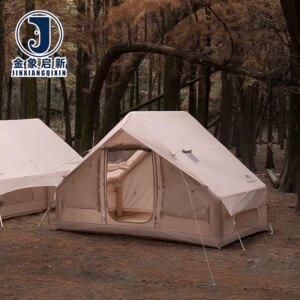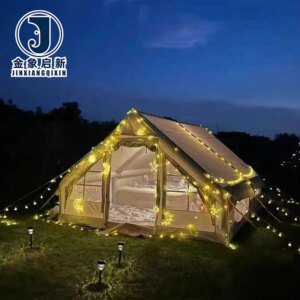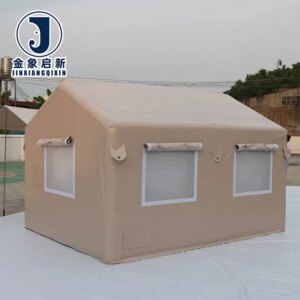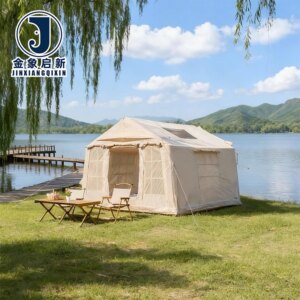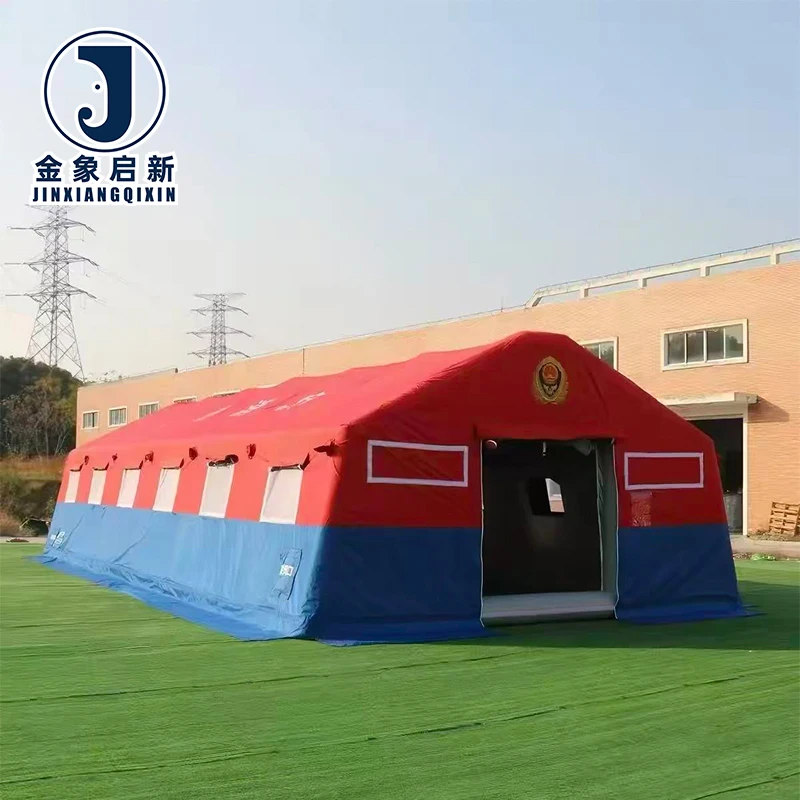
Rapid-deploy shelter engineering — three full production lines and 36 sets of processing equipment support consistent inflatable PVC tent output with verified 3000mm waterproof coating and quick automatic opening mechanisms for fleet operators.
Technical Specifications
| Parameter | Value |
|---|---|
| Product Type | Inflatable Tent Fabric |
| Core Material | PVC tarpaulin |
| Waterproof Rating | 3000mm |
| Construction | Single Layer |
| Design | Four-Season |
| Opening Mechanism | Quick Automatic Opening |
| Customization | OEM & ODM (sample customization, pattern printing) |
| Standards | ISO9001, ISO14001, ISO45001, CE |
| Key Features | Four-season structural integrity, quick automatic deployment, single-layer durability |
Application Suitability
| Application | Exposure & Requirement |
|---|---|
| Temporary driver rest and dispatch offices at truck yards | Constant wind load, vehicle exhaust exposure, frequent ingress and egress wear |
| Equipment maintenance shelters for roadside fleet servicing | Oil and grease contact, tool impact risk, temperature fluctuation across seasons |
| Emergency cargo protection and disaster relief staging | Rapid deployment under pressure, prolonged rain exposure, repeated inflation and deflation cycles |
| Transport yard overflow warehousing | UV exposure, ground moisture contact, abrasion from pallet movement |
Why Quick-Opening Mechanisms Fail Without Proper Fabric Selection
The inflation system is only as reliable as the coated fabric holding the air pressure.
Fleet operators specifying Inflatable Tent for Transport and Logistics often focus on the pump and valve specification while overlooking the fabric’s ability to maintain structural integrity under continuous pressure and weather loading [NEED_CITE: air-hold performance in inflatable structures depends on coating adhesion and seam weld quality]. When the PVC coating delaminates from the base fabric at fold lines — a common failure in single-layer constructions not engineered for repeated flexing — the shelter loses pressure within hours, not weeks. This is particularly critical in four-season deployments where temperature swings accelerate material fatigue at stress concentration points.
Matching Fabric Weight to Deployment Frequency
For transport operators cycling the Inflatable Tent for Transport and Logistics through repeated inflation and deflation, the single-layer PVC construction must balance air retention with fold-line durability. Heavier base fabrics with higher denier counts resist creasing damage at fold points, while the coating weight determines how well the fabric seals against moisture ingress at the 3000mm waterproof rating threshold. Fleet buyers should request coating adhesion test data rather than relying on GSM alone — a heavy fabric with poor coating bond will still fail at the seams under sustained pressure [NEED_CITE: coating adhesion test methods for PVC tarpaulin per ISO 2411].
Wind Load Resistance at Transport Yards
Truck yards and logistics hubs expose inflatable shelters to turbulence from passing vehicles and channelled wind between container stacks. The four-season design maintains structural rigidity across temperature variations, but the actual wind resistance depends on the base fabric’s tensile strength and the reinforced tie-down points — specifications that must be verified against the site’s exposure conditions rather than assumed from the product category.
Understanding the 3000mm Waterproof Rating in Practice
The 3000mm hydrostatic head rating indicates the fabric column height the coating can withstand before water penetrates — sufficient for prolonged rain exposure at transport yards and disaster relief sites. However, this rating applies to the coated surface only; seam welds and zippered openings represent potential failure points if not manufactured to matching standards. Buyers should confirm that seam weld testing accompanies the fabric specification, as welded joints on inflatable structures carry both air pressure and weather exposure simultaneously [NEED_CITE: seam strength testing for inflatable structures].
The Hidden Cost of Unverified Seam Welds on Inflatable Shelters
When Inflatable Tent for Transport and Logistics units arrive at site and lose pressure within the first deployment cycle, the root cause is typically not the fabric itself but the welded seams at high-stress junctions — where the air columns meet the floor panel or where tie-down straps attach. Welding parameters must be calibrated to the specific PVC coating formulation; incorrect temperature or pressure during fabrication creates bonds that appear intact but separate under the combined load of internal air pressure and external wind flexing. Fleet operators who skip pre-shipment weld inspection records face the cost of on-site repairs or complete unit replacement, far exceeding the value of documentation review before dispatch.
Production Capacity Backing Fleet-Scale Orders
Three full production lines running in parallel allow batch consistency across multiple Inflatable Tent for Transport and Logistics units ordered for the same fleet deployment — critical when colour matching and material properties must remain uniform across shelters erected side by side. The 10-person R&D team handles custom sizing to match specific truck bay footprints and pattern printing for fleet branding, with samples developed within days rather than weeks. Dedicated QA/QC at every production stage with 100% pre-shipment inspection ensures each unit meets the 3000mm waterproof rating and quick automatic opening performance before dispatch.
Documentation & Verification
- Material specification sheet stating PVC base fabric, coating weight and 3000mm waterproof rating
- CE certificate and ISO documentation confirming compliance for site acceptance
- Pre-shipment inspection record with 100% QA/QC verification before dispatch
- Custom sizing and pattern printing samples developed for fleet branding approval
- Test report for waterproof rating verification per roll
Fabrication, Handling & Storage
- Store inflated or loosely rolled to prevent permanent creasing at fold lines in single-layer PVC construction
- Clean with mild detergent only — solvent-based cleaners degrade the coating and reduce waterproof performance
- Inspect seam welds at tie-down points before each deployment cycle for signs of coating separation
- Allow full inflation and pressure check in controlled conditions before remote-site deployment
- Patch repairs require PVC-compatible adhesive matched to the coating formulation
Specifying Your Inflatable Shelter Requirements
Provide the intended application environment, expected deployment frequency, and specific dimensions required for your truck yard or logistics hub footprint. Confirm whether fleet branding or colour matching across multiple units is needed, and whether you require custom sizing to match existing infrastructure. Sample approval before production ensures the quick automatic opening mechanism and 3000mm waterproof rating meet your operational requirements.
Frequently Asked Questions
Q: How can fleet operators verify the 3000mm waterproof rating on delivery?
A: Request the pre-shipment inspection record accompanying each unit, which documents hydrostatic head testing results per roll. Independent verification can be conducted using standard hydrostatic pressure test equipment per ISO 811, measuring the water column height the coated fabric withstands before penetration occurs at three random points across the material surface.
Q: What custom sizing options are available for transport yard applications?
A: The Inflatable Tent for Transport and Logistics can be manufactured to match specific truck bay dimensions, trailer footprints or logistics hub layouts. The 10-person R&D team develops custom samples within days, allowing fleet operators to verify fitment before committing to full production runs across multiple shelter units.
Q: How is batch colour consistency maintained across multiple tent orders?
A: Production scheduling groups fleet orders on the same production line using identical PVC coating batches, ensuring colour uniformity across all units deployed side by side at transport yards. Pre-shipment inspection includes visual colour comparison against approved samples before dispatch.
Q: What documentation confirms the welded seam durability at flex points?
A: Each shipment includes pre-shipment inspection records documenting seam weld integrity testing at tie-down junctions and air column connections. The QA/QC process verifies weld parameters against the specific PVC coating formulation to ensure bonds withstand combined internal pressure and external wind loading.
Q: What is the typical lead time for custom-printed fleet shelters?
A: Standard production follows multi-week lead times for custom sizes and pattern printing, with sample development completed within days for approval before full production commences. Exact timelines depend on order quantity and customization complexity, confirmed during the quotation stage.