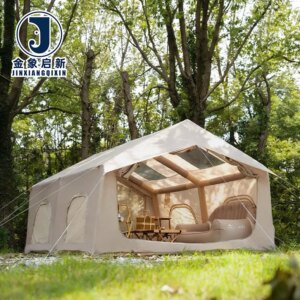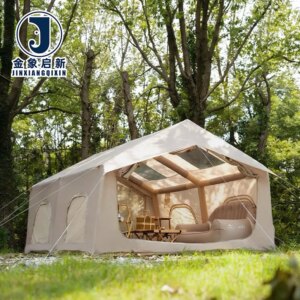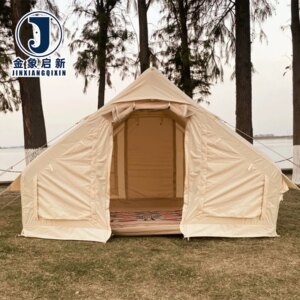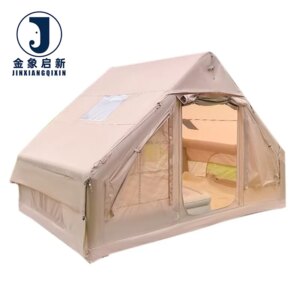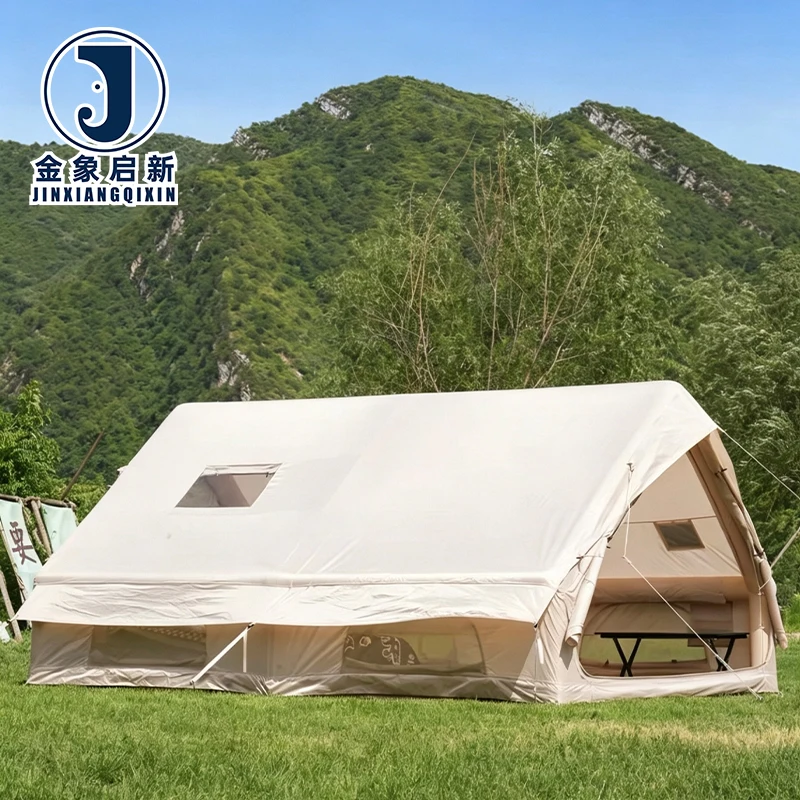
Consistent Seam Integrity Across Production Runs — Our 36 sets of professional welding equipment and full-process QA/QC ensure that every inflatable tent fabric order meets specified strength requirements at critical stress points.
Technical Specifications
| Parameter | Value |
|---|---|
| Product Type | Inflatable Tent |
| Core Material | PVC Tarpaulin |
| Capacity | 8-10 Person |
| Structure | Single-layer PVC tarpaulin construction |
| Key Features | Waterproof, UV-resistant (test basis not stated), Tear-resistant, Fire-retardant (grade not stated), Anti-static (standard not stated) |
| Opening Mechanism | Quick automatic opening |
| Season Rating | Four-season |
| Customization | OEM & ODM (sample customization, pattern printing) |
| Standards | ISO9001, ISO14001, ISO45001, CE |
Application Suitability
| Application | Exposure & Requirement |
|---|---|
| Commercial outdoor gear manufacturing | Consistent batch quality, fire-retardant compliance for retail distribution |
| Professional adventure packages | Repeated deployment cycles, variable weather exposure, rapid setup demands |
| Event shelter systems | High-capacity occupancy, transport logistics, venue safety certification |
| Team accommodation solutions | Extended field use, abrasion from ground contact, UV degradation risk |
Why Fire-Retardant Grades Matter More Than the Claim Itself
Specifying inflatable tent fabric without a verified fire classification creates compliance gaps at delivery. Commercial outdoor equipment manufacturers sourcing inflatable tents for organized events or retail distribution face rejection when fire-retardant documentation does not match destination market requirements. A fabric labeled "fire-retardant" without grade specification leaves buyers vulnerable to regulatory non-compliance, shipment holds, and costly rework [NEED_CITE: fire safety classifications for temporary structures and event shelters].
Transport fleet operators deploying inflatable shelters at depots or roadside operations encounter similar verification challenges. When fire-retardant treatment claims lack traceable test reports, procurement teams cannot confirm whether the material meets local safety codes or commercial venue standards.
Single-Layer Construction for Transport-Grade Deployment
Inflatable tent fabric built for fleet and commercial outdoor applications requires material that balances durability against portability constraints. Single-layer PVC tarpaulin construction reduces overall weight while maintaining structural rigidity when the tent inflates, making it suitable for transport-loaded shelter systems that deploy at remote sites or roadside locations. This construction approach minimizes packing volume and simplifies logistics handling for equipment manufacturers integrating inflatable tents into adventure packages or event shelter inventories.
Waterproof Coating Consistency Across Production Runs
Commercial outdoor gear manufacturers sourcing inflatable tent fabric at volume need assurance that waterproof performance remains consistent from first roll to last. Coating weight variation during production can create thin spots where water penetration occurs under sustained rain exposure, while excessive coating thickness adds unnecessary weight and reduces fabric flexibility during inflation cycles. Our three full production lines with dedicated QA/QC at every stage verify coating uniformity before dispatch, addressing the batch inconsistency that causes field failures and warranty claims.
Quick Automatic Opening Mechanism and Fabric Response
Rapid deployment inflatable tents place specific demands on fabric behavior during inflation and deflation cycles. The material must flex repeatedly at structural seams without developing fatigue cracks or losing coating adhesion at stress concentration points. Quick automatic opening systems require fabric that responds predictably to air pressure changes, maintaining dimensional stability as the structure expands and contracts [NEED_CITE: material fatigue testing for inflatable structures under cyclic loading]. Pattern printing applied during customization must also withstand this flexing without cracking or delaminating from the base substrate.
Coating Method and Base Fabric Interaction for Inflatable Applications
PVC tarpaulin performance in inflatable tent applications depends on how coating bonds to the base fabric weave and whether that bond survives repeated inflation cycles. The coating method—whether knife-over-roll, lamination, or calendering—determines peel strength between coating and substrate, which directly affects seam welding quality and long-term durability at flex points. Base fabric denier and weave density influence tear propagation resistance; higher denier yarns resist initial puncture but may create stiffness that hinders inflation response. Surface finish selection (glossy or matte) affects both cleanability for repeated field use and adhesion quality for pattern printing or branding requirements that commercial manufacturers often specify for fleet identification.
The Hidden Cost of Underspecified Weld Parameters
Welded seams on inflatable tent fabric fail prematurely when heat settings do not match the specific coating thickness and base fabric composition. Fabric that performs well in flat applications may develop seam separation at inflation stress points if welding temperature or pressure was calibrated for different material characteristics. Color variation between production batches forces manufacturers to reject entire orders when installed tents show visible differences side by side, creating costly delays and customer disputes [NEED_CITE: seam strength testing methods for coated fabrics under tension].
Why Procurement Teams Source Inflatable Tent Fabric Here
Nearly 30 years focused on PVC coated fabric production provides process control depth that newer suppliers cannot match for coating weight consistency and adhesion quality. Ten-person R&D team handles material selection, pattern printing development, and custom sizing requests with sample turnaround measured in days rather than weeks. Three full production lines equipped with 36 sets of professional equipment support bulk capacity requirements while maintaining reliable on-time delivery schedules. Dedicated QA/QC personnel conduct 100% pre-shipment inspection, verifying every roll or unit against stated specifications before dispatch. ISO9001, ISO14001, ISO45001, and CE certifications document quality management systems without requiring buyers to verify claims independently.
Documentation & Verification
- Material specification sheet stating base fabric composition, coating weight, and treatment parameters for each inflatable tent fabric order
- Test reports for UV and fire-retardant performance available where applicable, with certification traceability to recognized standards
- Pre-shipment inspection record documenting 100% QA/QC verification before dispatch with measurable parameters
- Roll packing list with batch identification supporting traceability from raw material through finished product
- Certificate of origin and customs documentation for international shipment compliance
Fabrication, Handling & Storage
- Heat welding parameters must match single-layer PVC tarpaulin coating thickness to prevent seam failure at inflation stress points
- Store rolls upright on pallets to prevent permanent creasing that weakens coating adhesion at fold lines
- Avoid dragging fabric across abrasive surfaces during fabrication to preserve waterproof coating integrity
- Use compatible adhesives for repair patches that match PVC coating chemistry for proper bonding
- Allow fabric to acclimate to ambient temperature before inflation in cold conditions to prevent coating brittleness
- Clean with mild detergent solutions; avoid solvents that degrade PVC coating or affect fire-retardant treatment
Specification Requirements for Your Inflatable Tent Fabric Inquiry
Provide your target market fire safety classification requirements, annual volume projections, and whether you need rolls or finished cut-to-size panels. Specify any pattern printing or branding requirements, color consistency expectations across production batches, and sample approval timelines for your product development cycle. Indicate whether OEM customization includes structural modifications beyond standard single-layer construction or if you require fabric only for in-house fabrication.
Frequently Asked Questions
Q: How is fire-retardant grade verified and matched to destination market safety requirements?
A: We provide test reports documenting fire-retardant performance with traceable certification when grade is specified in your inquiry. Confirm the exact classification your destination market requires (B1, M2, NFPA 701, or other regional standards) during specification phase, and we verify our treatment meets that standard before production begins.
Q: What UV treatment test basis supports long-term outdoor and road-exposure durability claims?
A: UV-resistant treatment is available for inflatable tent fabric exposed to extended outdoor conditions. Specify your expected exposure duration and geographic location so we can recommend appropriate treatment levels and provide test documentation supporting the UV stability claims for your application environment.
Q: How are welded seam strength and flex-point integrity ensured for transport-loaded inflatable structures?
A: Our 36 sets of professional welding equipment are calibrated to specific coating thickness and base fabric composition, ensuring consistent heat application at seam stress points. Dedicated QA/QC staff verify weld strength through destructive and non-destructive testing protocols before shipment, with 100% inspection on every production run.
Q: What OEM customization options are available and what are the minimums for custom orders?
A: OEM and ODM services include sample customization, pattern printing for fleet branding, and structural sizing adjustments. Minimum quantities depend on customization complexity and color requirements; provide your specifications during inquiry phase for accurate minimum and lead time quotation.
Q: How does pre-shipment inspection documentation support compliance and receiving verification?
A: Every inflatable tent fabric order receives 100% pre-shipment inspection with documented verification of coating weight, dimensional accuracy, and treatment parameters. Inspection records accompany shipment documentation, providing your receiving team with measurable data to verify the material matches your purchase specifications before acceptance.