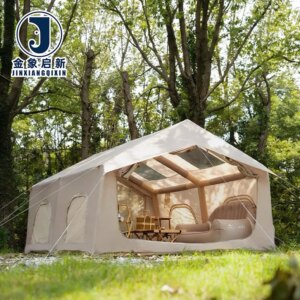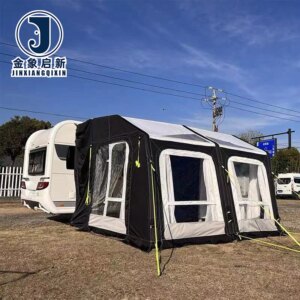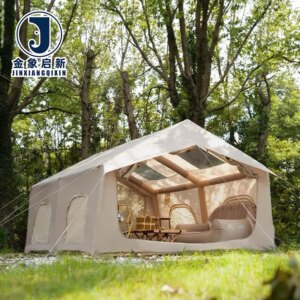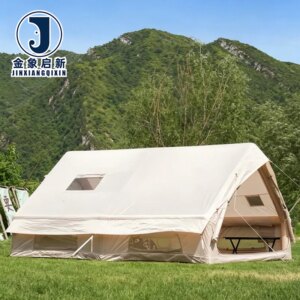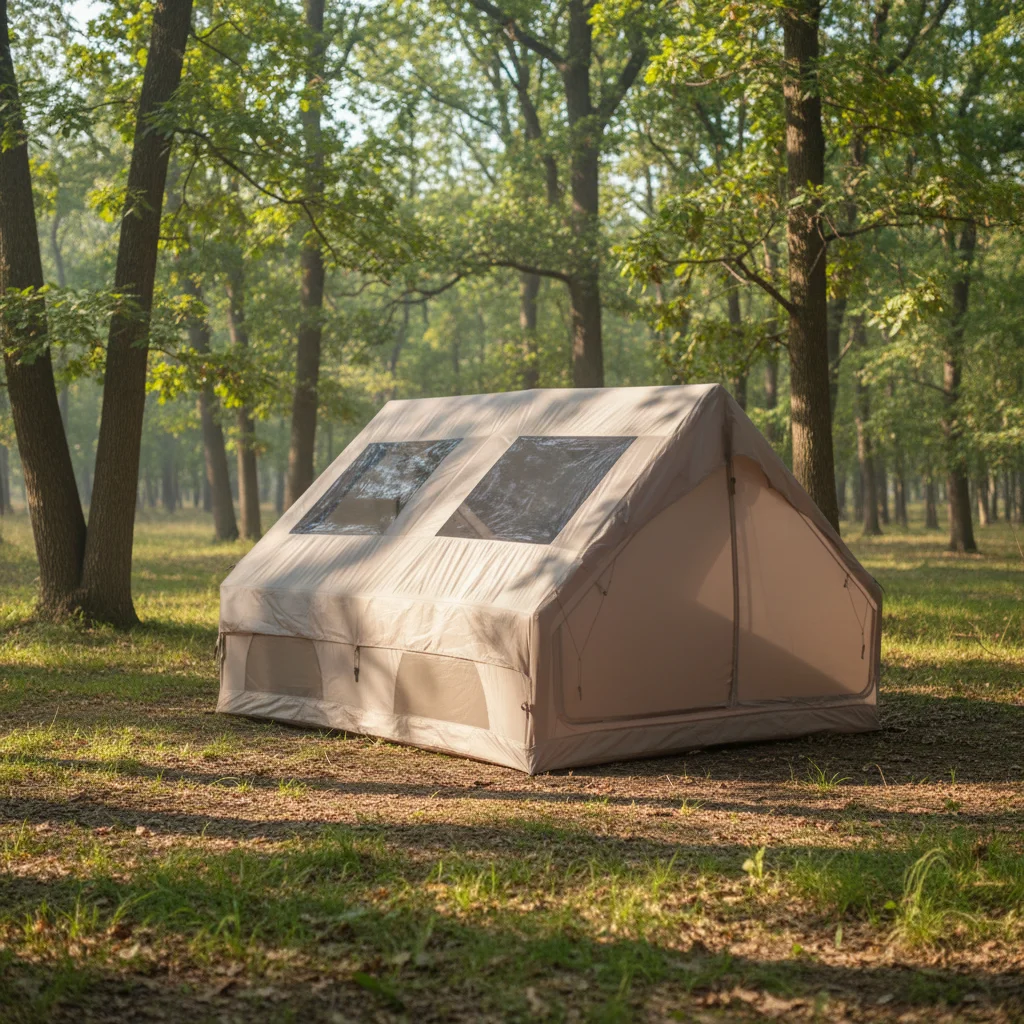
Process-Controlled Coating — Consistent PVC tarpaulin weight and adhesion across every production run, verified by stage-by-stage QA before your inflatable tent fabric leaves the facility.
Technical Specifications
| Parameter | Value |
|---|---|
| Product Type | Inflatable Tent |
| Core Material | PVC tarpaulin |
| Product Forms | 2-8 person capacity, four-season design, single-layer construction |
| Key Features | Waterproof, windproof, tear-resistant |
| UV Resistance | Available with anti-UV treatment — confirm the grade required for your market |
| Flame Retardant Grade | (grade not stated) — available in flame retardant grades, specify required standard |
| Anti-Static | (not stated) — available on request, confirm certification needed |
| Customization | OEM & ODM: sample customization, pattern printing |
| Production Capacity | 3 full production lines, 36 sets of processing equipment |
| R&D Support | 10 technicians for material selection and sample development |
| Quality Control | Full-process inspection with dedicated QA & QC staff |
| Standards | ISO 9001, ISO 14001, ISO 45001, CE |
Application Suitability
| Application | Exposure & Requirement |
|---|---|
| Outdoor event infrastructure | High foot traffic, rapid deployment cycles, public safety compliance, variable weather |
| Construction site temporary shelters | Dust, debris impact, wind load, frequent relocation between sites |
| Expedition base camps | Sustained UV exposure, temperature fluctuation, remote field repair feasibility |
| Emergency response operations | Immediate deployment under adverse conditions, multi-climate adaptability |
Why a Tent Specification Sheet Without Test References Is a Procurement Risk
A PVC camping tent for transport and fleet shelter must carry verifiable test data, not just marketing adjectives.
Fleet operators and construction project managers routinely receive inflatable tent fabric that looks identical to the approved sample but behaves differently under wind load or prolonged sun exposure. The gap between a quotation claiming waterproof and windproof performance and the actual field behaviour often surfaces only after deployment, when seam failure or coating delamination disrupts operations. [NEED_CITE: tensile and tear test methods for coated fabrics per ISO 1421] Without batch-specific test reports tied to recognised standards, buyers have no contractual basis to reject non-conforming material or hold suppliers accountable for early failure.
Sizing Inflatable Tent Fabric to the Actual Operational Footprint
Generic tent dimensions rarely align with the layout of a fleet depot, vehicle staging area, or roadside emergency station. Our OEM service sizes each PVC camping tent to the exact ground plan you specify, eliminating dead space and ensuring the structure anchors properly on uneven or constrained surfaces. This is particularly relevant when the inflatable tent must fit between parked trailers or adjacent to loading bays where clearance is measured in centimetres.
Maintaining Structural Integrity Across Four-Season Cycles
A four-season inflatable tent deployed at a construction site or expedition base camp faces thermal cycling that stresses both the PVC tarpaulin coating and the welded seams. The single-layer construction balances portability with the structural rigidity needed to resist wind uplift and snow accumulation. Material selection during the R&D phase accounts for low-temperature flexibility so the fabric does not become brittle during winter deployment. [NEED_CITE: low-temperature flexibility testing for PVC coated fabrics]
How Base Fabric Construction Influences Real-World Performance
The core of every inflatable tent is the base fabric beneath the PVC coating. Denier and weave density determine how a tear propagates once the surface is punctured — a high-density warp and weft arrests tear spread far more effectively than a loose weave of equivalent weight. Coating adhesion to this base fabric governs whether the PVC layer delaminates under repeated inflation and deflation cycles. Knife-coated PVC tarpaulin typically achieves stronger adhesion than laminated alternatives because the coating penetrates the weave rather than sitting on the surface. Understanding these relationships helps buyers specify material that matches the mechanical demands of rapid-deployment shelters rather than selecting solely on stated weight.
The Hidden Cost of Skipping Batch-to-Batch Verification
Colour variation between tents destined for the same fleet deployment becomes visible the moment structures are erected side by side at a logistics hub or event site. Weight inconsistency across batches means one tent may handle wind load adequately while its neighbour, cut from a lighter roll, fails at the seam under identical conditions. [NEED_CITE: coating weight variance impact on tensile performance in PVC tarpaulin] Welded seams on material that varies in thickness or plasticiser content require constant adjustment of heat and pressure settings, increasing the risk that seams fail before the fabric itself does.
Why Procurement Teams Source This Inflatable Tent Fabric Here
Coating weight and adhesion are controlled through dedicated process parameters at every production stage, not sampled only at final inspection. Three full production lines and 36 sets of professional equipment mean custom widths and OEM sizing for PVC camping tent orders run on dedicated capacity rather than being squeezed between unrelated jobs. The 10-technician R&D team develops samples within days, allowing you to verify dimensions, seam construction, and pattern printing before committing to bulk production. [NEED_CITE: ISO 9001 process control requirements for coated fabric manufacturing] Dedicated QA and QC staff inspect every unit before dispatch, catching weight deviation and visual defects that automated systems miss.
Documentation & Verification
- Material specification sheet stating PVC tarpaulin coating type, base fabric construction, and colour reference for the inflatable tent order
- Batch-specific test report covering waterproof rating, tensile strength, and UV resistance results
- ISO 9001, ISO 14001, ISO 45001, and CE certificates included with each PVC camping tent shipment
- Pre-shipment inspection record documenting weight verification and visual check per unit
- Certificate of origin and customs documentation prepared for cross-border delivery
Fabrication, Handling & Storage
- Weld PVC tarpaulin seams at temperatures matched to coating thickness to prevent delamination at inflation stress points
- Store inflatable tent rolls upright on pallets to avoid flat-spot deformation of the PVC coating
- Use mild detergent without solvents for cleaning to protect the PVC surface treatment layer
- Deploy cold-weather tents gradually, allowing the PVC tarpaulin to reach ambient flexibility before full inflation
- Repair field punctures with compatible PVC adhesive patches that match the coating chemistry
What to Include in Your Inflatable Tent Inquiry
Specify the ground dimensions and clearance constraints of your deployment site so the OEM sizing matches your actual layout. Indicate any fire-safety or anti-static standards your market requires, along with colour references and pattern printing details for fleet branding. State whether you need finished tents with welded seams and inflation ports or roll stock for your own fabrication line, and confirm if pre-production sample approval is required before bulk manufacture.
Frequently Asked Questions
Q: What customization options exist for sizing, printing, and material selection?
A: OEM and ODM services cover capacity sizing from 2 to 8 person configurations, custom pattern printing for fleet branding, and material adjustments including PVC tarpaulin coating weight. Samples are developed within days so you can verify dimensions and finish before committing to production.
Q: What test reports and certifications accompany each shipment?
A: Every PVC camping tent order ships with a batch-specific quality inspection report covering waterproof rating and tensile strength, along with ISO 9001, ISO 14001, ISO 45001, and CE documentation. Additional test reports for UV resistance or flame retardancy are provided where applicable to the specified grade.
Q: How does the sample approval process work before bulk production?
A: A pre-production sample is developed based on your dimensional and material specifications. Once you approve the sample for size, seam construction, colour, and overall finish, bulk production proceeds under identical process parameters to ensure consistency across the full inflatable tent order.
Q: How is colour and weight consistency controlled across multiple tents?
A: Dedicated QA and QC staff conduct full-process inspection with stage checks on coating weight and colour matching. Pre-shipment inspection verifies every unit against the approved sample, and a batch-specific report documents the results so you have traceability for the entire PVC camping tent delivery.