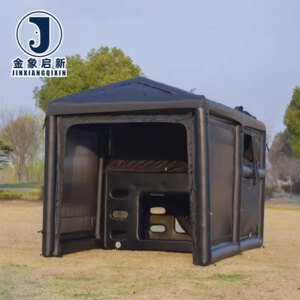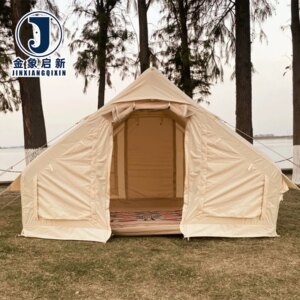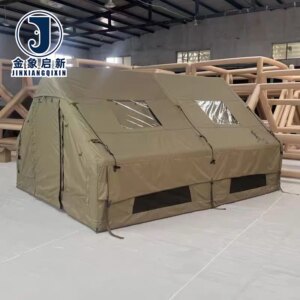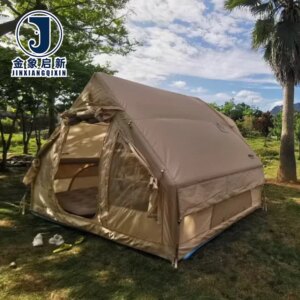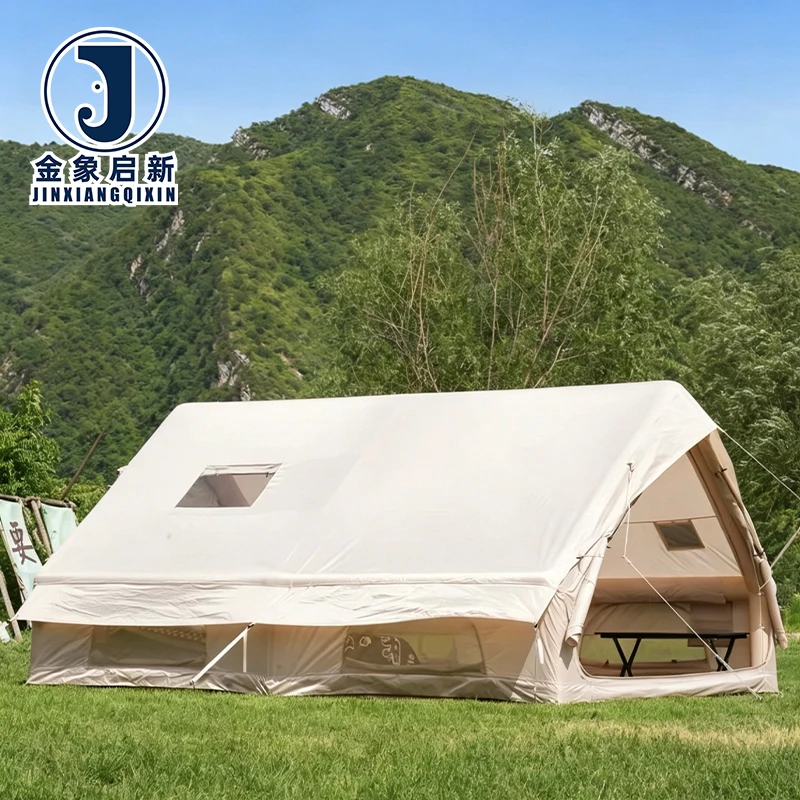
Precision Air-Beam Reliability — PVC knife-coated inflatable tent fabric validated at 20kPa pressure, engineered for fleet operators and transport equipment builders who require weather-ready shelter components that deploy fast and hold integrity under repeated field use.
Technical Specifications
| Parameter | Value |
|---|---|
| Product Type | Inflatable Tent |
| Core Material | PVC Tarpaulin (knife-coated fabric) |
| Coating Material | PVC |
| Product Form | 2-3 Person Single Layer Air Tent |
| Waterproof Rating | Hydrostatic head rating exceeding industry standards (specific value not stated in source) |
| UV Treatment | QUV test results provided (test duration not stated in source) |
| Tear Strength | Tested per ASTM D751 (specific value not stated in source) |
| Airtightness Test | 20kPa pressure |
| UV Aging Simulation | 2000 hours (source value — verify against manufacturer catalog) |
| Printing Option | Custom pattern printing supported |
| Customization | OEM & ODM — size adjustments, pattern printing, color matching, hardware modifications |
| Quality Control | 7-point inspection covering raw material tensile strength, coating adhesion, airtightness, seam integrity, hardware durability, UV aging simulation, dimensional accuracy |
| Lead Time | Sample 7-10 days; mass production 15-20 days for orders under 500 units |
| Certifications | ISO 9001, ISO 14001, ISO 45001, CE |
Application Suitability
| Application | Exposure & Requirement |
|---|---|
| Transport fleet temporary shelters | Road-side deployment, wind load on air beams, UV and rain exposure during multi-day use |
| Construction site rapid-deploy housing | Abrasion from ground contact, repeated inflation/deflation cycles, heavy rainfall protection |
| Expedition and industrial base camps | Extended outdoor exposure, temperature variation, need for reliable airtightness at altitude |
| Commercial equipment rental operations | Frequent setup and breakdown, batch color and performance consistency across inventory |
| Industrial event temporary structures | Quick deployment requirement, weather resistance during event duration, visual branding via printing |
When a Generic Tent Pattern Fails Your Specific Vehicle Model
Fitment gaps between a standard inflatable tent layout and the actual trailer or shelter footprint cause load exposure, rework delays, and wasted deployment time on site.
Fleet operators and transport equipment builders regularly receive inflatable shelter components cut to generic dimensions rather than matched to the specific vehicle or site geometry. The result is air-beam misalignment, fabric bunching at anchor points, and water pooling along seams that were never designed for that particular flex pattern [NEED_CITE: field failure analysis of inflatable shelter structures in transport applications]. When the shelter does not fit the asset it is meant to protect, the entire purpose of rapid deployment is lost.
Air-Beam Integrity Under Repeated Field Deployment
Commercial inflatable tent fabric for transport and outdoor structures must hold pressure through dozens of inflation cycles without seam creep or valve leakage. The knife-coated PVC construction used here is validated at 20kPa — a pressure level that simulates full air-beam inflation under load. For fleet operators running rental pools or construction crews rotating shelters between sites, this means the structure maintains its rigid form even when ambient temperature shifts during overnight use.
UV Resistance Backed by Documented Test Data
Extended outdoor exposure demands more than a marketing claim of UV protection. This inflatable tent fabric is supplied with QUV test documentation confirming resistance to ultraviolet degradation over simulated aging cycles [NEED_CITE: QUV accelerated weathering test method for coated fabrics]. For transport equipment builders specifying material for roadside emergency shelters or construction contractors deploying seasonal camp structures, having verifiable UV data supports warranty claims and compliance with project specifications.
Waterproof Performance Beyond Minimum Thresholds
The hydrostatic head rating of this PVC inflatable tent fabric exceeds industry baseline standards, though the specific millimeter value should be confirmed against your project requirements. Knife-coated PVC creates a continuous waterproof membrane without needle penetrations — unlike sewn-only constructions where stitch holes become infiltration points under sustained rainfall. This matters for construction site housing and expedition base camps where interior dryness directly affects equipment and personnel safety.
Reading the Specification Beyond Surface Claims
Knife-coated PVC differs fundamentally from laminated or calendered alternatives in how the coating bonds to the base fabric. The coating is applied directly under pressure, creating molecular-level adhesion that resists delamination when the air beam flexes during wind loading. This directly affects seam weld quality — a poorly bonded coating will peel away at heat-welded joints before the base fabric itself fails [NEED_CITE: coated fabric delamination mechanisms at welded seam intersections]. Tear strength tested per ASTM D751 provides a standardized basis for comparing materials, but the real-world performance depends on how the coating thickness interacts with the base fabric denier and weave density. A heavier coating does not automatically mean better performance if adhesion is compromised.
The Hidden Cost of Unverified Airtightness Claims
Air-beam shelters that fail pressure tests after a few deployment cycles create cascading costs: emergency repairs in the field, replacement unit shipping, and downtime for the crew that depends on the shelter. When airtightness is stated without a test pressure value, there is no way to verify whether the fabric will hold under the actual inflation conditions your operation requires. Seam integrity at flex points — where the air beam bends against the ground frame or anchor hardware — is where untested constructions typically fail first [NEED_CITE: field failure patterns in inflatable shelter seam construction].
Why Source Inflatable Tent Fabric from Jinan Jinxiang
The 10-person R&D team handles material selection, pattern printing, custom sizing, and sample development specifically for inflatable structure applications. Three full production lines and 36 sets of professional equipment support bulk capacity with consistent roll-to-roll output — critical when fleet operators need replacement panels that match existing inventory. Dedicated QA/QC at every production stage includes 7-point inspection covering raw material tensile strength, coating adhesion, airtightness at 20kPa, seam integrity, hardware durability cycles, UV aging simulation, and dimensional accuracy. Samples are developed within 7-10 days for custom requirements, allowing fitment validation before mass production commitment. Full documentation — including material specification sheets, test reports, and certificates of origin — travels with each shipment for customs and import compliance.
Documentation & Verification
- Material specification sheet stating base fabric, coating type, and color reference per roll
- Hydrostatic pressure test data included with batch-specific quality certificates
- Tear strength test results per ASTM D751 provided per shipment
- QUV aging simulation report confirming UV treatment performance
- Pre-shipment inspection record covering all 7 quality control checkpoints
- Certificate of origin and customs support documentation included
Fabrication, Handling & Storage
- Heat-weld seams on knife-coated PVC require temperature calibration specific to coating thickness to avoid adhesion failure
- Store rolls flat or vertically — never stacked horizontally — to prevent permanent creasing along air-beam fold lines
- Inflate test sections at 20kPa before final assembly to confirm valve and seam integrity under pressure
- Clean with pH-neutral solutions only; abrasive cleaners degrade the PVC coating surface and reduce UV treatment effectiveness
- Allow fabric to acclimate to site temperature before inflation — cold PVC becomes less flexible and more prone to seam stress
Specify Your Inflatable Tent Fabric Requirements
To receive an accurate specification recommendation and sample, provide the intended application environment, required dimensions or vehicle model for fitment matching, target market compliance requirements for UV and waterproof performance, and whether you need cut-to-model components or roll stock. Indicate any custom pattern printing, color matching, or hardware modification requirements. Sample development takes 7-10 days before mass production commitment.
Frequently Asked Questions
Q: What customization options are available for PVC inflatable tent fabric?
A: OEM and ODM services cover size adjustments to match specific vehicle or site dimensions, custom pattern printing for branding, color matching to existing fleet inventory, and hardware specification modifications including valve placement and anchor point reinforcement.
Q: How is airtightness validated before shipment?
A: Each production batch undergoes airtightness testing at 20kPa pressure as part of the 7-point quality control inspection. This validates that air-beam seams and valve attachments hold under simulated full-inflation conditions before dispatch.
Q: Can I receive a custom sample before committing to mass production?
A: Yes. Pre-production samples are developed within 7-10 days based on your specified dimensions, material requirements, and hardware configuration. This allows fitment validation and performance testing before mass production begins.
Q: What international certifications does this inflatable tent fabric hold?
A: The manufacturing facility holds ISO 9001, ISO 14001, ISO 45001, and CE certifications. These cover quality management, environmental management, occupational health and safety, and European conformity for the product range.
Q: How do you ensure batch-to-batch consistency for fleet operators?
A: Every shipment includes batch-specific quality certificates with hydrostatic pressure, tear strength per ASTM D751, and QUV test data. The 7-point inspection process is traceable per batch, and roll-to-roll color consistency is verified during production.