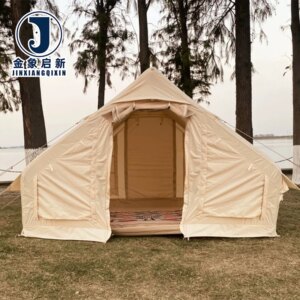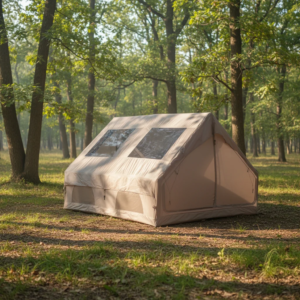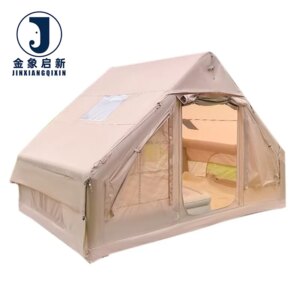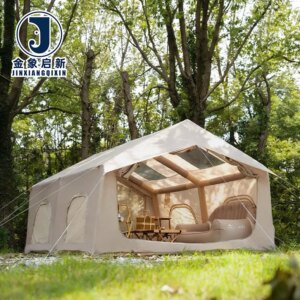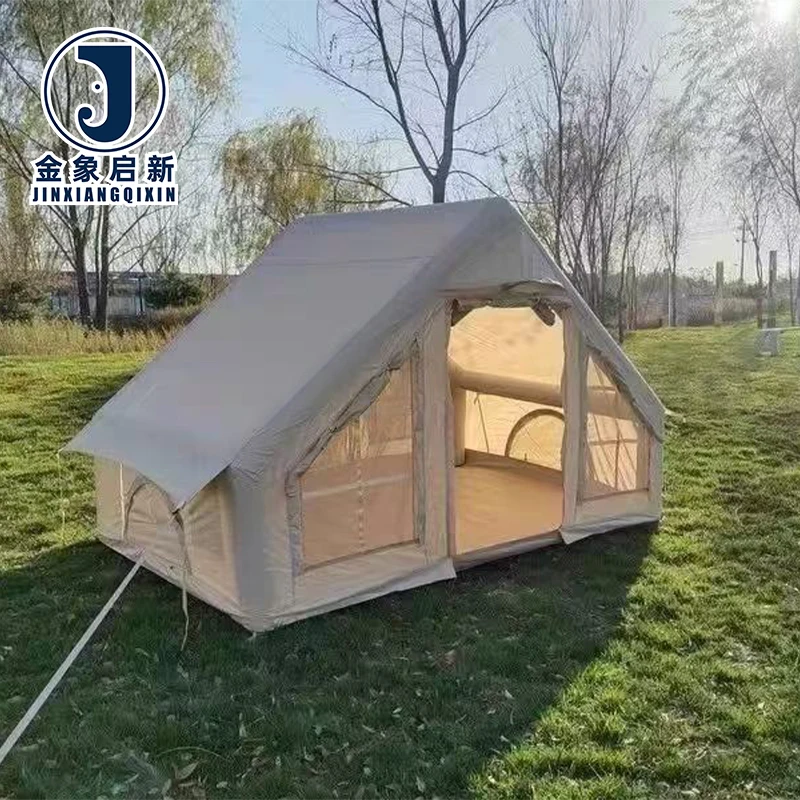
Rapid Deployment Expertise — Three full production lines and 36 sets of processing equipment support bulk inflatable tent orders with reliable on-time delivery for fleet and transport operators.
Technical Specifications
| Parameter | Value |
|---|---|
| Product Type | PVC Inflatable Tent |
| Core Material | PVC Tarpaulin |
| Construction | Single layer |
| Waterproof | Yes (grade not stated in source) |
| UV-resistant | Yes (test basis not stated in source) |
| Tear-resistant | Yes (test basis not stated in source) |
| Deployment Mechanism | Quick automatic opening inflatable structure |
| Certifications | ISO9001, ISO14001, ISO45001, CE |
| Customization | OEM & ODM — size adjustment, pattern printing, material thickness customization |
| Production Facility | 9,180 m² with 10-person R&D team |
Application Suitability
| Application | Exposure & Requirement |
|---|---|
| Temporary command posts at transport hubs | Constant assembly/disassembly cycles, heavy foot traffic, rapid deployment under time pressure |
| Equipment storage shelters at logistics yards | Prolonged UV exposure, rain ingress prevention, wind load on inflatable frame |
| Emergency disaster relief staging | Multi-day continuous use, all-weather deployment, quick single-operator setup |
| Modular workspace on infrastructure sites | Dust and debris exposure, repeated relocation between project phases |
| Fleet maintenance rest points | Extended sunlight exposure, temperature fluctuation, abrasion from ground contact |
Why Off-the-Shelf Shelters Fail Transport Fleets in the Field
A PVC Inflatable Tent built to your exact dimensional and operational requirements eliminates the mismatch between generic shelter sizing and real-world transport logistics.
Fleet operators and transport contractors often source emergency shelters or temporary site offices that look adequate on paper but collapse under actual field conditions. The inflatable beams may not match the wind loads at a coastal logistics yard, or the floor dimensions may not accommodate standard palletised cargo staging. When a disaster site or remote infrastructure project needs shelter within hours, traditional frame tents take too long to erect and lack the durability for repeated deployment cycles. The result is wasted procurement budget, delayed response timelines, and crews working without adequate cover [NEED_CITE: rapid deployment shelter failure modes in emergency logistics].
This PVC Inflatable Camping Tent for transport and fleet operations is engineered from industrial-grade PVC tarpaulin, meaning the same coated fabric technology used for truck side curtains and trailer covers now protects your personnel and cargo at staging areas. Every dimension, beam diameter, and entry point is configurable before production begins.
Shelter That Matches Your Fleet’s Operational Rhythm
Transport fleets do not operate on fixed schedules, and neither should your temporary infrastructure. The PVC Inflatable Camping Tent for transport and fleet deploys via a quick automatic opening mechanism, allowing a single operator to establish a weatherproof command post or inspection shelter in minutes rather than hours. This matters when a logistics yard needs to redirect crew operations after an unexpected weather event or when emergency response staging must scale from one shelter to several within a single shift. The inflatable frame eliminates the pole-and-sleeve assembly that slows down conventional tent erection.
PVC Tarpaulin Durability Translates Directly to Shelter Longevity
The PVC tarpaulin base fabric delivers waterproof, UV-resistant, and tear-resistant performance under prolonged outdoor exposure — the same material properties that fleet operators already rely on for truck covers and trailer side curtains. Single-layer construction keeps transport weight manageable for large-scale deployments while maintaining sufficient structural integrity for all-season field use. Whether the tent serves as an equipment storage shelter at a motorway layby or a disaster relief command post, the coated fabric resists moisture ingress and surface degradation from continuous sunlight [NEED_CITE: PVC tarpaulin weathering behaviour under continuous UV exposure].
Understanding the Performance Parameters That Matter
Waterproof construction on PVC tarpaulin is achieved through continuous coating that seals the base fabric weave, preventing moisture passage even under prolonged rain exposure. The tear resistance of the material depends on both the base fabric denier and the coating adhesion strength — a heavy coating on a loosely woven scrim will peel before it tears, while a thin coating on a dense weave may crack at flex points. UV-resistant treatment, available in grades suited to different exposure durations, must be confirmed against your specific climatic conditions before ordering. The inflatable beam structure relies on airtight seam welding; the quality of the high-frequency or hot-air weld directly determines how many inflation cycles the tent survives before maintenance is required.
The Hidden Cost of Specifying Shelter Material by Price Alone
When procurement decisions focus solely on unit cost, the PVC tarpaulin supplied may carry a lighter coating weight than the agreed specification, leading to moisture penetration during the first heavy rainstorm. Batch-to-batch colour variation becomes visible when multiple shelters are deployed side by side at a staging area, undermining the professional appearance of your emergency response setup. Welded seams on inflatable beams that were rushed through production will fail at the flex points before the fabric itself shows wear, leaving crews without shelter mid-operation [NEED_CITE: coated fabric seam failure under cyclic inflation stress]. UV-resistant treatments claimed without supporting test data result in surface chalking and embrittlement after only one season of continuous deployment.
What This Production Facility Delivers to Fleet Buyers
Nearly 30 years of focused coated fabric production means the process control over coating weight and adhesion is embedded in every roll that feeds into your inflatable tent order. Three full production lines and 36 sets of professional equipment support the volume requirements of fleet-wide shelter rollouts without sacrificing lead time reliability. The 10-person R&D team handles dimensional customisation, pattern printing for corporate or regulatory branding, and material thickness adjustment for your specific climate and deployment frequency. Dedicated QA and QC staff conduct 100% pre-shipment inspection on every tent, checking weld integrity, seam strength, and inflation retention before dispatch.
Documentation & Verification
- Material specification sheet stating base fabric type, coating weight, and colour reference for each tent batch
- Batch quality inspection report with retained test data for waterproof and tear-resistance parameters
- ISO9001, ISO14001, ISO45001, and CE compliance documentation included with every shipment
- Certificate of origin and customs support documentation for cross-border procurement
- Pre-shipment inspection record confirming dimensional accuracy and weld integrity per unit
Fabrication, Handling & Storage
- High-frequency welding parameters must match the single-layer PVC tarpaulin thickness to avoid beam delamination
- Store deflated tents flat or loosely rolled to prevent permanent creasing in the PVC coating surface
- Avoid dragging the PVC tarpaulin base across abrasive ground during deployment to preserve waterproof integrity
- Clean with mild detergent only; solvent-based cleaners may degrade the UV-resistant surface treatment
- Inspect welded beam seams after each deployment cycle for early signs of air leakage or coating separation
- Allow tents to dry fully before long-term storage to prevent mildew formation on the fabric surface
Request a Specification Proposal
Provide your deployment scenario including expected wind loads, duration of continuous use, and typical ground conditions at your staging sites. Confirm whether pattern printing or dimensional branding is required for regulatory or corporate identification. Specify the target market and any local fire safety or material compliance requirements that apply to temporary structures in your operating region. Indicate whether sample units are needed for field evaluation before committing to a full production run.
Frequently Asked Questions
Q: How do you verify waterproof performance on each production batch?
A: Every production batch undergoes waterproof testing at our QC stage before dispatch. We retain test data for traceability and include a batch quality inspection report with your shipment. If your procurement process requires independent laboratory verification against a specific hydrostatic head standard, we can arrange third-party testing — confirm the required standard during the quotation stage so lead time accounts for the testing cycle.
Q: What customization options are available for dimensions, material thickness, and pattern printing?
A: We offer full OEM and ODM customisation including size adjustment to your exact floor plan and height requirements, material thickness selection matched to your deployment frequency and climate, and pattern printing for corporate branding or regulatory markings. Our 10-person R&D team develops samples within days so you can evaluate dimensional accuracy and print quality before mass production commitment.
Q: What certifications does this inflatable tent hold, and how do they map to international procurement standards?
A: Each production batch ships with ISO9001, ISO14001, ISO45001, and CE compliance documentation. These certifications cover quality management, environmental management, occupational health and safety, and European conformity respectively. If your market requires additional regional certifications for temporary structures, provide the specific standard during inquiry so we can verify compliance before quotation.
Q: How do you ensure batch-to-batch colour and material consistency across large orders?
A: Our 100% pre-shipment inspection includes colour matching against the approved reference sample for every tent in the batch. Coating weight and base fabric specification are verified per roll before fabrication begins. For fleet-wide deployments spanning multiple production runs, we retain master samples and production parameters to maintain consistency across sequential orders.
Q: What is the typical production lead time for customized inflatable tent orders?
A: Lead time depends on customisation complexity, order volume, and whether sample approval is required before production. Standard dimensional adjustments typically proceed faster than orders requiring pattern printing or non-standard material thickness. Confirm your required delivery date during inquiry so we can align production scheduling and advise whether expedited options are available for your deployment timeline.