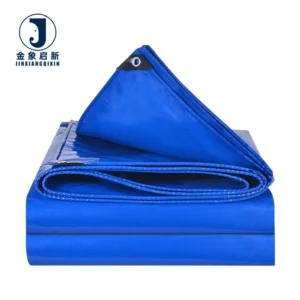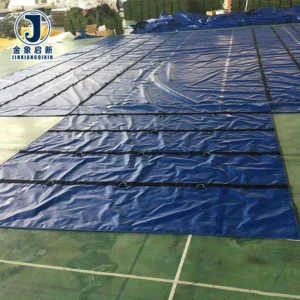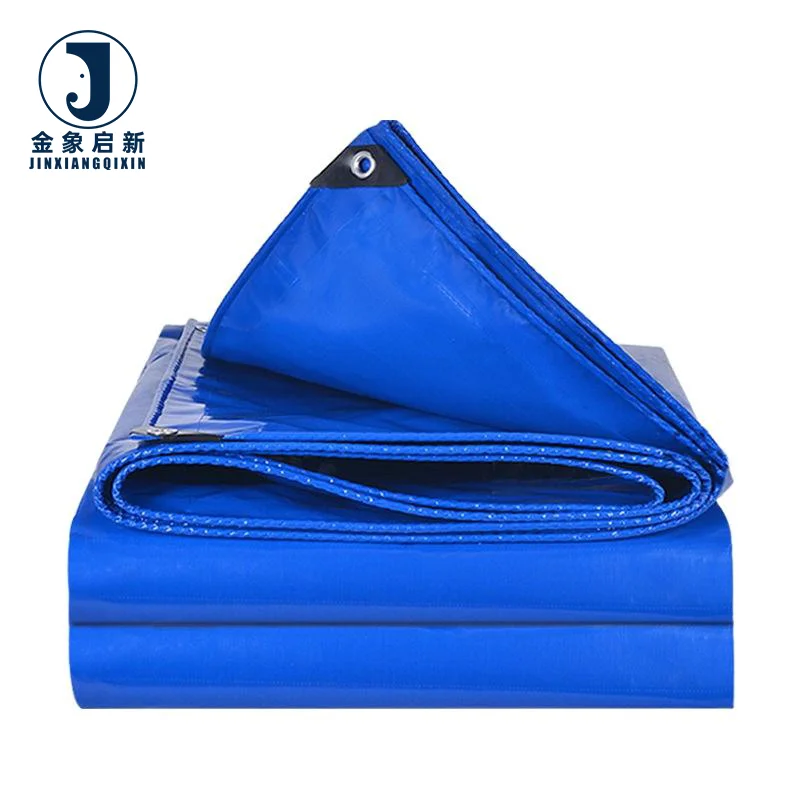
Consistent Roll Quality — Hot-melt and laminated coating lines deliver uniform PVC adhesion across every meter, verified by 100% pre-shipment inspection before any roll leaves the facility.
Technical Specifications
| Parameter | Value |
|---|---|
| Product Type | PVC Coated Tarpaulin |
| Base Material | High-strength polyester mesh fabric |
| Coating Technology | Laminated technology & Hot-melt Coating technology |
| GSM Options | 350gsm / 420gsm / 500gsm / 550gsm / 600gsm / 750gsm |
| Total Thickness | 0.32mm / 0.35mm / 0.4mm / 0.45mm / 0.5mm / 0.65mm |
| Roll Width | 2m / 2.1m |
| Roll Length | 75m (2m width) / 50m (2.1m width) |
| Color | Blue / Red / Yellow / Light blue / Grey (Customized) |
| Finish | Glossy or Matte |
| Waterproof | Double-sided fully waterproof coated construction |
| Cold Crack Resistance | Yes |
| Anti-Mildew | Stated (treatment grade not stated) |
| Anti-Static | Stated (surface resistance grade not stated) |
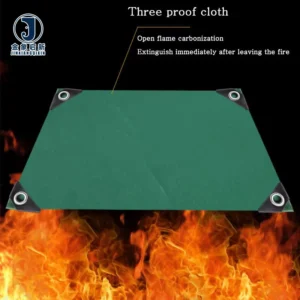
| Flame Retardant | Available in flame retardant grades — confirm the grade required for your application |
| Service Life | 3-7 years under normal circumstances |
Application Suitability
| Application | Exposure & Requirement |
|---|---|
| Truck side curtains | Constant flexing at load points, road abrasion, tie-down strap pressure |
| Trailer load covers | Weather exposure during transit, UV radiation, wind flap fatigue |
| Poultry coop curtains | High humidity, ammonia contact, daily wash-down, dust accumulation |
| Livestock transport | Temperature variation, animal contact stress, static build-up in enclosed spaces |
| Construction enclosure | Scaffolding attachment stress, wind load, debris impact |
When a Truck Cover Fails at the Flex Point, It Is Not a GSM Problem
Seam and weld failure at flex zones traces back to coating adhesion and fabric construction, not weight alone.
Fleet operators frequently report that a cover tears at the exact point where the load shifts most — near tie-down straps and curtain runners. The fabric itself holds, but the welded joint gives way. This happens when the coating does not bond deeply enough into the polyester mesh, leaving a weak plane at the heat-sealed seam. PVC Coated Tarpaulin for truck and transport applications must withstand thousands of flex cycles per journey, and weld integrity is where most generic products fail within the first months of service [NEED_CITE: tensile and tear test methods for coated fabrics per ISO 1421].
Coating Adhesion That Survives Curtain Track Movement
Laminated and hot-melt coating methods force PVC into the gaps of the polyester mesh rather than sitting on the surface. This creates a mechanical lock between coating and base fabric, which directly affects how well heat-welded seams hold up under repeated bending. For truck side curtains that travel through runners every day, the PVC Coated Tarpaulin must maintain bond strength at the weld line long after the initial fabrication.
Anti-Static Treatment for Enclosed Transport Environments
Poultry transport and livestock trailers generate static build-up in enclosed, dusty spaces. Standard PVC fabrics can accumulate charge across the curtain surface, attracting particulate and creating discharge risk near electrical fittings. The anti-static treatment addresses this, though the specific surface resistance grade should be confirmed against your transport compliance requirements before ordering [NEED_CITE: anti-static test standards for PVC-coated fabrics in agricultural transport].
Reading the Specifications Beyond Weight Class
The relationship between GSM, base fabric denier, and coating thickness determines how the material behaves under real-world load. A 550gsm fabric with a dense 1000-denier base and thin coating may resist tearing better than a 600gsm fabric with a loose weave and thick PVC layer. Hot-melt coating typically delivers deeper mesh penetration than simple calendering, which improves peel strength at welded seams — critical where curtain eyelets and tie-down points concentrate stress. Glossy surfaces shed dirt and water more readily on exposed trailer sides, while matte finishes reduce glare for applications where light reflection matters. The available thickness range from 0.32mm to 0.65mm allows selection based on whether the priority is flexibility for curtain operation or rigidity for flat-panel covers.
The Cost of Specifying on Weight Without Verifying Construction
A cover that meets the quoted GSM on arrival can still fail prematurely if the base fabric is lighter than expected and the coating makes up the difference. This results in poor tear propagation resistance — once a puncture starts, it spreads quickly. Batch colour variation across rolls in the same shipment forces operators to reject panels that look mismatched when installed side by side on a single trailer. Welded seams that separate from the fabric within months of service require full cover replacement, not just patch repair [NEED_CITE: coating adhesion and weld strength testing per DIN 53354].
Why Fleet Operators Source This Range
Three full production lines running laminated and hot-melt coating ensure that bulk orders for an entire fleet maintain roll-to-roll consistency. The 10-person R&D team develops cut-to-model samples, matching curtain dimensions to specific trailer drawings rather than relying on generic size charts. Every roll undergoes dedicated QA inspection at each production stage, with 100% pre-shipment checking before dispatch. Custom colour matching across multiple rolls in one order is confirmed before dispatch, eliminating visible panel mismatch. The team has nearly 30 years of focused experience in coated fabric, translating into reliable process control over coating weight and mesh adhesion.
Documentation & Verification
- Material specification sheet listing base fabric denier, coating weight, and confirmed GSM per roll
- Colour reference card matched to production batch for visual comparison on arrival
- Pre-shipment inspection record covering weight, thickness, and surface finish per roll
- ISO and CE certificates supplied with every dispatch
- Anti-static and flame retardant test reports provided where treatment grade is confirmed at order
Fabrication, Handling & Storage
- Hot-weld temperature must match the selected coating technology — hot-melt grades typically require higher bar settings than laminated PVC
- Eyelet reinforcement patches should use the same GSM grade as the curtain body to maintain balanced stress at tie-down points
- Store rolls horizontally on pallets to prevent edge compression marks on the glossy or matte surface
- Allow cold-stored rolls to reach ambient temperature before unrolling to avoid cracking at low-flex zones
- Clean with mild detergent only — abrasive cleaners can compromise the anti-mildew and anti-static surface treatment
What to Include in Your Inquiry
Specify the truck or trailer model, curtain track type, and whether you need finished panels with eyelets or roll stock for in-house fabrication. Confirm the anti-static or flame retardant grade your market or facility requires, along with target colour reference and annual volume. If you need a pre-production sample to verify hand feel, weld behaviour, or colour match, request this before bulk production begins.
Frequently Asked Questions
Q: How do I confirm the GSM on delivery matches what was quoted?
A: Each roll is inspected against the stated GSM before dispatch, and a pre-shipment inspection record is included with your documentation. You can verify weight independently on arrival using a standard fabric scale. The material specification sheet lists both base fabric and coating contribution to total weight.
Q: Can you cut truck covers to my specific trailer model rather than a generic size?
A: Yes. Provide the trailer make, model, and curtain track dimensions. The R&D team develops a sample cut to those exact measurements, including eyelet placement matched to your tie-down system. Production proceeds only after you approve the sample for fit and fabrication quality.
Q: What certifications support the anti-static and flame-retardant claims?
A: Where anti-static or flame retardant treatment is specified at order, the corresponding test report is supplied with dispatch documentation. Confirm the grade required by your site safety standards or regional transport regulations, and the appropriate treatment level will be applied and certified.
Q: How do you ensure color consistency across multiple rolls in one order?
A: All rolls in a single order are produced from the same coating batch, and 100% pre-shipment inspection includes a colour comparison check between rolls. A colour reference card matched to the production batch is included in the dispatch documentation for your receiving team.
Q: What is the typical lead time for custom width, color or printed branding?
A: Lead times depend on the level of customization — standard stock colours and widths move faster than custom Pantone matches or printed branding. Request a quotation with your specific requirements, and the production schedule will be confirmed before order commitment.