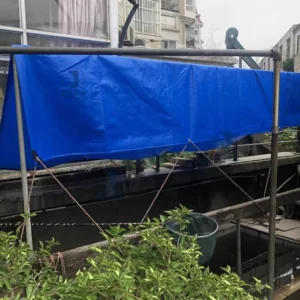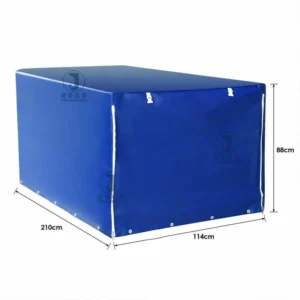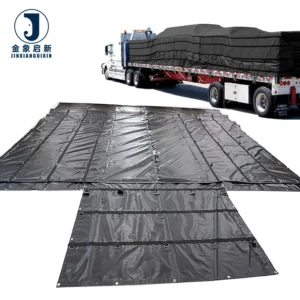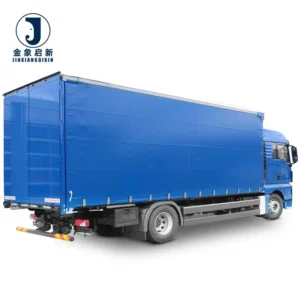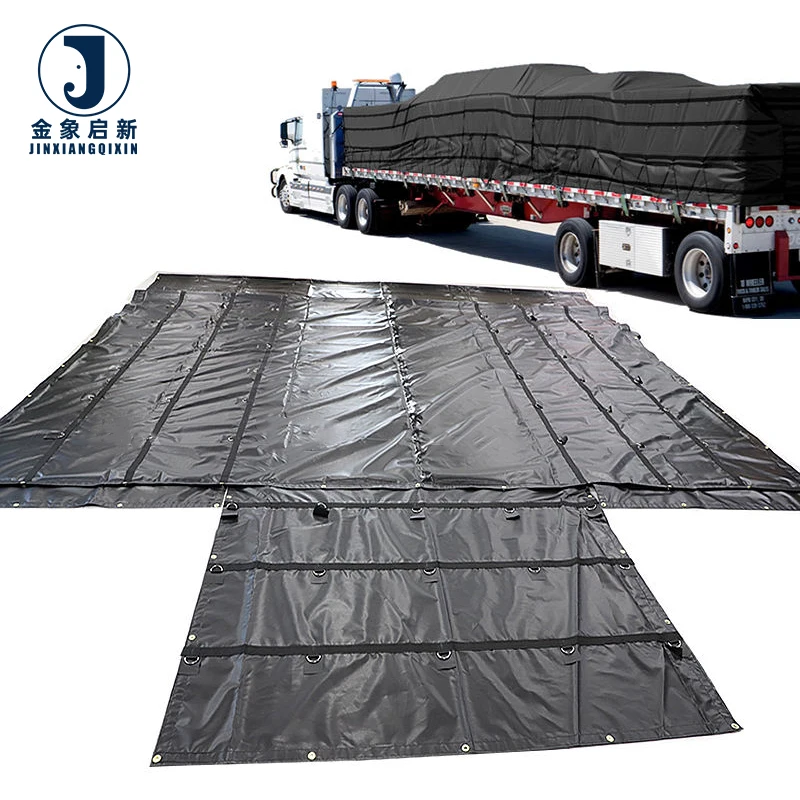
Cut-to-Model Fitment — every PVC truck tarpaulin we ship is sized to your flatbed or lumber trailer dimensions, not cut from a generic roll.
Technical Specifications
| Parameter | Value |
|---|---|
| Product Type | PVC Coated Tarpaulin |
| Base Fabric | RipSTOP weave |
| Coating Material | Vinyl (PVC) |
| Weight Options | 12oz / 14oz / 15oz / 18oz per square yard |
| Drop Length | 8′ |
| Piece Configuration | 1PC / 2PC / 3PC |
| Abrasion Resistance | Stated (test standard not provided — confirm requirement for your application) |
| Anti-Mildew Treatment | Stated (test basis not stated — request certificate if specified) |
| Anti-Pull Construction | Stated |
| Waterproof | Fully coated waterproof construction |
| Flame Retardant | Available in flame retardant grades — confirm the grade required for your market |
| UV Treatment | Available with UV stabilisation — verify test basis before specifying |
| Customisation | Density and sizing adjustable per trailer model |
Application Suitability
| Application | Exposure & Requirement |
|---|---|
| Flatbed semi-truck freight covering | Highway-speed wind flex, tie-down strap abrasion, rain and road-salt spray |
| Lumber transport protection | Heavy sharp-edged cargo, repetitive loading cycles, prolonged UV exposure on long-haul routes |
| Steel and building material haulage | Concentrated point loads at dunnage contact, side-sway during cornering, weather ingress risk |
| Owner-operator rig replacement | Field-fit install on existing trailer hardware, need for immediate weatherproof coverage |
Why a Generic-Fit Cover Costs More Than the Tarps Itself
A PVC truck tarpaulin cut to a generic rectangle rarely sits flush on a flatbed deck, leaving cargo exposed at the corners and forcing drivers to double-strap for security.
Fleet operators who have bought off-the-shelf covers know the pattern: the first tarp that flaps loose on the interstate becomes a road hazard, and the cargo underneath absorbs moisture before the truck reaches its next stop. Drivers spend extra minutes at every tie-down fighting a cover that does not match the trailer footprint. [NEED_CITE: DOT cargo securement violations linked to inadequate tarp coverage]. When the PVC truck tarpaulin is cut to the exact deck length and drop of your trailer, the fabric lies flat, straps seat correctly, and the load stays dry from dispatch to delivery.
Flatbed and Lumber Fitment Without the Guesswork
We map your trailer make, deck length, and side-rail height before any panel is cut. The 8′ drop is engineered to reach past the bolster stakes on a standard lumber trailer, and the 1PC, 2PC, or 3PC configuration is chosen around how your crew handles the cover during loading. A PVC truck tarpaulin that arrives pre-configured for your trailer eliminates the on-site trimming that weakens hem integrity.
Reinforcement at the Points That Actually Wear
RipSTOP weave places heavier yarns at regular intervals in both warp and weft, creating a grid that halts tear propagation before a small nick from a lumber edge becomes a full-panel failure. Combined with the abrasion-resistant treatment specified on this product line, the fabric withstands the repetitive rubbing at D-ring contact zones and strap crossover points that typically destroy a standard weave within a single haul season [NEED_CITE: tear propagation behaviour in ripstop-coated fabrics under cyclic load].
Reading the Weight Grades for What They Actually Deliver
The 12oz, 14oz, 15oz, and 18oz grades listed here refer to total coated weight per square yard. That number includes both the RipSTOP base fabric and the PVC coating applied to it. A heavier grade does not automatically mean a stronger base fabric — two tarps can carry the same coating weight yet differ substantially in tensile strength if the underlying yarn denier and pick count diverge. When selecting a PVC truck tarpaulin grade, ask for the base fabric specification alongside the coated weight so you can evaluate tear resistance and flex endurance as separate factors. The coating method also matters: knife-over-edge application typically produces higher peel strength at welded seams than lamination, which directly affects how the panel behaves when cargo shifts against a tie-down during braking.
What Happens When the Wrong Grade Goes on the Road
We have seen lighter-grade PVC covers develop seam separation at the first winter, not because the fabric failed but because the welded overlap was specified for a heavier panel. Batch colour drift across a multi-truck fleet order becomes visible the first time two trailers park side by side at a depot. [NEED_CITE: coating weight variance and its effect on long-term seam adhesion in PVC tarpaulins]. Drivers who receive an under-specified cover for a heavy lumber load report accelerated wear at the drop hem where the fabric contacts the trailer rail.
Why Fleets Source This PVC Truck Tarpaulin Here
Three full production lines run in parallel, meaning a mixed-order of 1PC, 2PC, and 3PC configurations can move through cutting and welding without queuing behind unrelated product runs. The 10-person R&D team develops sample panels against your trailer drawings so you can verify fitment and seam placement before full production starts. Every roll undergoes 100% inspection before dispatch — weight, coating adhesion, and colour reference are checked against the specification sheet, not sampled from one roll in ten. With nearly 30 years of focus on coated fabric, process control over coating weight consistency is maintained across the entire order. Pre-shipment documentation travels with your PVC truck tarpaulin so receiving verification is immediate.
Documentation & Verification
- Material specification sheet stating actual GSM per grade, base fabric denier, and RipSTOP grid spacing
- UV and flame retardant test reports supplied only when the corresponding grade is confirmed and ordered
- Pre-shipment inspection record documenting weight check, colour match, and seam integrity per panel
- Cut-to-model dimension confirmation signed off against your trailer drawing before production begins
- Packing list with roll and panel count cross-referenced to your purchase order line items
Fabrication, Handling & Storage
- Welded seams on RipSTOP base require adjusted heat settings versus plain weave — confirm parameters with our R&D team before field repair
- 8′ drop panels should be folded along the factory crease lines to prevent permanent coating stress marks during storage
- 18oz grade requires heavier-duty grommet press tooling; standard hand-crimped eyelets will pull through under strap tension
- Store rolled PVC truck tarpaulin on its core, upright, to avoid flat-spot creasing that weakens the coating bond
- Clean with mild detergent only — solvent-based degreasers can degrade the anti-mildew treatment on the coating surface
What We Need to Start Your Quotation
Send us your trailer make, model, deck length, and the drop height you need beyond the standard 8′. If your fleet operates across jurisdictions with specific flame retardant or UV test requirements, list the standards so we can confirm grade availability. For colour-matched orders, provide a Pantone or RAL reference and the total panel count so we can plan a single production batch. Let us know whether you need finished panels with eyelets and hem reinforcement or roll stock for your own fabrication shop.
Frequently Asked Questions
Q: How is tarp weight verified on arrival to match the quotation?
A: Every panel is weighed during pre-shipment inspection and recorded against the stated oz/yd² grade. The inspection report accompanies the shipment so your receiving team can cross-check immediately. If a discrepancy is found, the documentation provides the baseline for a replacement claim.
Q: What tie-down and eyelet reinforcement options are available?
A: Eyelet spacing and reinforcement webbing are configured based on your strap layout and D-ring positions. We can add extra reinforcement patches at known high-stress contact points identified from your trailer drawings, preventing the early wear that standard grommet spacing cannot address.
Q: How do 1PC, 2PC, and 3PC configurations affect coverage?
A: A single-piece cover suits shorter flatbeds where one person can handle the full panel. Two-piece or three-piece splits are chosen for longer lumber trailers, letting your crew manage each section independently during loading and reducing the risk of dragging the fabric over sharp cargo edges.
Q: What abrasion measures protect the tarp at strap contact points?
A: The RipSTOP base fabric resists tear propagation, while the abrasion-resistant treatment on the coating surface reduces wear from repetitive strap movement. Additional reinforcement patches can be specified at known high-friction zones identified during the fitment design stage.
Q: How is colour consistency maintained across fleet orders?
A: All panels in a single order are produced from coating batches matched to the same Pantone or RAL reference in one run. The pre-shipment inspection includes a side-by-side colour check so any visible variance is caught before dispatch, not discovered in your depot yard.