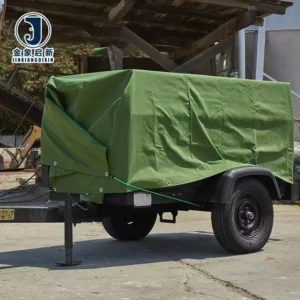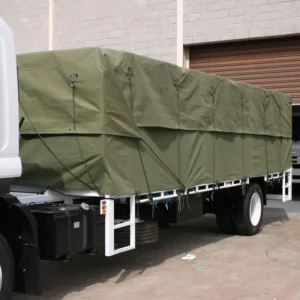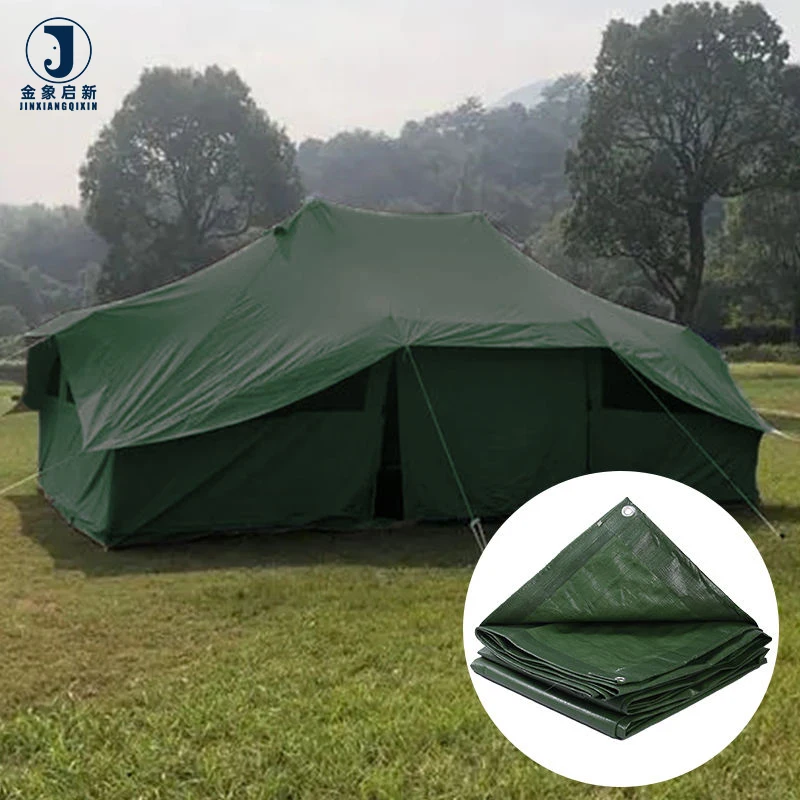
Precision-Fit Transport Covers — Dimensioned to exact vehicle models with tie-down-ready eyelet spacing, verified by 100% pre-shipment inspection before dispatch.
Technical Specifications
| Parameter | Value |
|---|---|
| Product Type | PE Tarpaulin |
| Coating Material | HDPE woven fabric with LDPE coat on both sides |
| Mesh Count | 6×6 to 16×16 mesh |
| Weight | From 50 g/m² up to 300 g/m² (confirm the grade for this item) |
| Color | Blue, Orange, White, Black, Grey, Yellow, Green, Red, or custom |
| Printing Option | Logos and company information; reinforced strip addition available |
| Sheet Size | 2×3, 3×4, 3×5, 4×5, 5×6, 6×8, 10×10, 10×12, 12×14, or custom dimensions |
| Roll Size | 100 m per roll or as required |
| Edge & Hem | All edges hemmed with PP ropes |
| Corner Reinforcement | All corners reinforced with black plastic triangles |
| Eyelet Options | Rustproof aluminum eyelets spaced every 1 m or 1.5 m or per requirement |
| Flame Retardant Grade | Fire resistant available — confirm the grade required for your market |
| UV Treatment | UV protection available — confirm test basis required for your market |
Application Suitability
| Application | Exposure & Requirement |
|---|---|
| Long-haul truck and trailer fleets | Continuous road vibration, wind uplift at speed, rain and road spray exposure |
| Flatbed cargo covering (steel, timber, machinery) | Abrasion from load shifting, tie-down strap pressure at eyelet points, UV from direct sunlight |
| Transport equipment builder assemblies | Integration into side curtain and top cover systems requiring consistent batch colour and dimensional accuracy |
| Construction site equipment protection | Static outdoor storage with weather cycling, puncture risk from sharp-edged materials |
Why Generic-Size PE Tarpaulin for Truck Cover Leaves Cargo Exposed
A cover that shifts under road vibration fails regardless of material quality.
Fleet operators often receive PE tarpaulin truck covers cut to nominal dimensions that ignore the specific trailer model’s bed length, bolster spacing, and side rail geometry. The result is a cover that bunches at the front, leaves the rear corners exposed, or puts excessive strain on eyelets that are misaligned with the trailer’s tie-down rails. Over a long-haul route, wind gets under the loose fabric, creating a lifting force that accelerates wear at the hem and can rip eyelets free entirely [NEED_CITE: wind load effects on loose-fitting transport covers]. The damage is not to the fabric itself — it is to the cargo underneath, which takes on rain and road spray through gaps the generic sizing created.
Dimensioned to the Vehicle, Not the Catalogue
Every trailer model has a unique bed profile. A PE tarpaulin truck cover specified for a standard 13.6 m curtain-sider will not perform correctly on a step-deck or extendable trailer. Covers are dimensioned to the exact vehicle model, accounting for overhang allowances, rope-rail positioning, and the drape required at corners to prevent water pooling. This eliminates the gap between what the quotation states and what arrives on the loading dock.
Eyelet Spacing Aligned to Tie-Down Infrastructure
Tie-down systems on commercial trailers follow specific spacing conventions. Rustproof aluminum eyelets are placed at 1 m or 1.5 m intervals, or configured to match the trailer’s existing anchor points. When eyelet spacing does not correspond to the anchor layout, operators either skip anchors — reducing hold-down security — or add intermediate straps that create uneven stress across the fabric surface. Proper alignment keeps the PE tarpaulin truck cover flat and tensioned across the load [NEED_CITE: tie-down compatibility standards for commercial transport covers].
Hem and Corner Construction at Flex Points
The edges and corners of a truck cover endure the highest localized stress. All edges are hemmed with PP ropes to distribute load along the hem line rather than concentrating it at individual stitch or weld points. Every corner receives a black plastic triangle reinforcement, addressing the specific failure mode where the corner pulls away from the main panel under diagonal tension. These reinforcements are critical at the points where the load flexes most during transit — typically the rear corners and the area immediately behind the cab where aerodynamic turbulence is strongest.
Mesh Count and Coating Weight: What the Numbers Mean on the Road
The mesh count range from 6×6 to 16×16 determines the base fabric’s weave density, which directly influences tear propagation resistance. A higher mesh count provides more yarn intersections per unit area, creating more friction points that resist a tear from spreading once initiated. However, mesh count alone does not define overall strength — the LDPE coating on both sides fills the weave interstices and bonds the yarns, contributing to waterproof integrity and adding to the total weight. A 6×6 mesh at a higher coating weight may outperform a 16×16 mesh with minimal coating in puncture resistance, which matters when covering loads with sharp edges like steel coil or sawn timber. The HDPE woven base provides the structural skeleton, while the LDPE coating delivers the environmental barrier. Selecting the right combination depends on the cargo type and the mechanical stresses expected during transit.
The Cost of Colour Inconsistency Across a Fleet
When a fleet operator orders multiple covers for identical trailers, visible colour variation between rolls signals inconsistent coating batches. Once installed side by side in the yard or on the road, the mismatch is immediately apparent and reflects poorly on the operator’s brand. Beyond aesthetics, colour variance can indicate differences in pigment loading that affect UV stability — a cover with lower pigment concentration may degrade faster under sun exposure [NEED_CITE: pigment concentration effects on polyethylene UV degradation]. Batch colour consistency checks during production ensure every cover in a fleet order matches the agreed reference, avoiding partial returns and replacement delays.
Why Procure PE Tarpaulin Truck Covers Here
Three full production lines and 36 sets of professional equipment support bulk fleet orders with reliable on-time delivery, so a 50-cover order for a national transport company ships as a single coordinated batch rather than staggered partial deliveries.
A 10-person R&D team handles model-specific sizing, pattern printing, and sample development, producing dimensioned samples within days so operators can verify fit before committing to the full production run.
Dedicated QA/QC at every production stage with 100% pre-shipment inspection ensures that GSM, eyelet spacing, and finished dimensions are verified against the agreed truck model specification before the covers leave the facility.
Deep process control over coating weight and adhesion, built over nearly 30 years of focused coated fabric production, means the LDPE coating on both sides of the HDPE base is consistent roll to roll — no thin spots that compromise waterproofing at critical flex points.
Documentation & Verification
- Pre-shipment inspection record confirming GSM, eyelet spacing, and finished dimensions per truck model
- Material specification sheet stating HDPE mesh count, LDPE coating material, and verified weight
- Batch colour consistency report for multi-cover fleet orders referencing agreed colour standard
- Roll packing list with piece count, dimensions, and gross weight for customs clearance
- Certificate of origin and customs support documentation for cross-border fleet supply
Fabrication, Handling & Storage
- Hem folding must account for PP rope diameter to prevent edge puckering on finished covers
- Heat welding temperature should match LDPE coating melt point to avoid base fabric damage
- Eyelet insertion force must be calibrated to the HDPE weave density to prevent ring pull-through
- Folded covers should be stored flat to avoid permanent crease marks in the LDPE coating layer
- Clean with mild detergent only; solvents may degrade the LDPE surface coating
Preparing Your PE Tarpaulin Truck Cover Inquiry
To specify covers accurately, provide the exact truck and trailer model designations, the cargo types routinely carried, and the tie-down system currently in use. If the fleet operates across markets with different fire safety requirements, state the applicable flame retardant grade so the correct treatment can be confirmed. Include colour references, any logo or branding requirements, and whether covers should ship folded and individually packed or rolled.
Frequently Asked Questions
Q: How is the cover sized to fit a specific truck or trailer model?
A: Provide the exact make, model, and year of each vehicle along with bed dimensions and any non-standard features such as headboards or side rails. The cover is then patterned to those measurements with allowances for drape and tie-down clearance, and a sample is produced for physical fit verification before bulk production begins.
Q: What eyelet spacing and hem reinforcement options are available?
A: Rustproof aluminum eyelets are installed at 1 m or 1.5 m intervals as standard, or configured to match your trailer’s specific anchor point layout. All edges are hemmed with PP ropes, and every corner receives a black plastic triangle reinforcement. Custom spacing and additional reinforcement strips can be added at high-stress zones.
Q: How do you control colour consistency across a fleet order?
A: Every roll in a fleet order is produced from the same coating batch and checked against the agreed colour reference. A batch colour consistency report accompanies the shipment. If covers are ordered at different times, the original colour standard is retained on file to ensure continuity across reorders.
Q: What is the lead time and minimum order for custom-sized covers?
A: Lead times depend on order volume and the degree of customization required, including custom dimensions, colour, and printing. Samples for fit verification are typically developed within days. Contact the sales team with your specific vehicle list and quantity to receive a confirmed production schedule and minimum order guidance.
Q: How are welded seams and corner reinforcements tested before dispatch?
A: Each cover undergoes 100% pre-shipment inspection where welded seams are visually examined and physically stressed at flex points. Corner reinforcements are checked for bond integrity and correct positioning. Eyelet pull-out resistance is verified at sample intervals. A pre-shipment inspection record documenting these checks is included with every shipment.