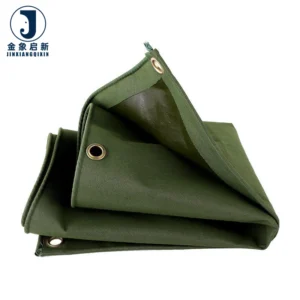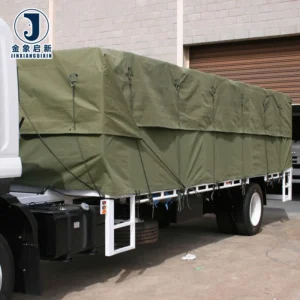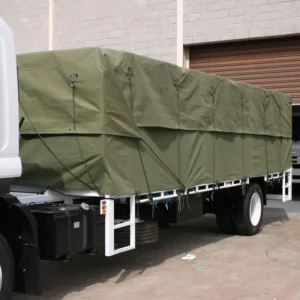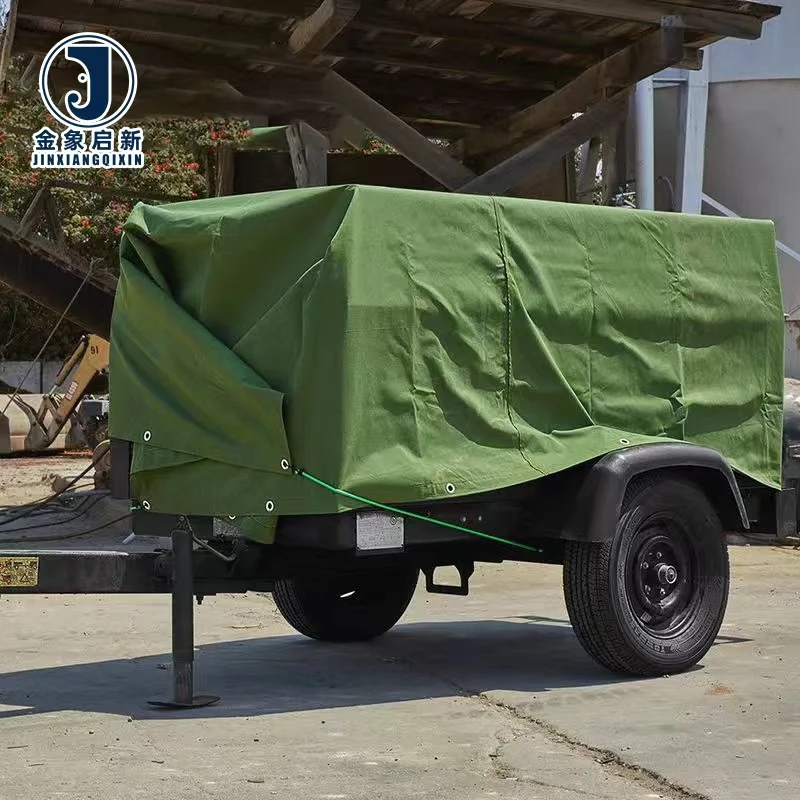
Custom Specification Control — Three full production lines with dedicated coating and lamination equipment allow GSM, width, and eyelet layout to be matched precisely to each transport and outdoor covering requirement.
Technical Specifications
| Parameter | Value |
|---|---|
| Product Type | PVC Laminated Canvas Tarpaulin |
| Material | Silicone Canvas with PVC Lamination |
| Construction | Woven Ripstop Style |
| Properties | Waterproof, Tear Resistant, Heat Resistant, High Breathability |
| Mounting | Grommets Installed on All Four Sides |
| Flame Retardant Grade | Available in flame retardant grades — confirm the grade required for your market |
| UV Treatment | Available with UV stabilisation — verify applicable test standard before ordering |
Application Suitability
| Application | Exposure & Requirement |
|---|---|
| Truck and trailer load cover | Continuous highway wind load, road debris abrasion, tie-down tension at grommet points |
| Engine hood and vehicle cover | Heat exposure from engine bay, repeated fitting and removal, oil and fluid contact |
| Construction site equipment shelter | Prolonged sun and rain, wind uplift, contact with rough ground and steel structures |
| Roof and temporary outdoor cover | Standing water, UV exposure, thermal expansion and contraction cycles |
| Floor mat and protective layer | Foot traffic abrasion, rolling equipment load, moisture from substrate |
Why Coating Adhesion Matters More Than GSM for a PVC Laminated Canvas Tarpaulin
Laminated canvas fails at the bond line before the base fabric tears.
Most tarpaulin buyers focus on weight as a proxy for strength, yet the lamination bond between the PVC film and the woven canvas base is where flex-cycle failures originate. On a truck cover subjected to daily tie-down and release, the repeated bending at hem and grommet zones peels the coating away from the yarn long before the ripstop weave reaches its tear limit. [NEED_CITE: adhesion strength test methods for laminated coated fabrics per ISO 2411] A specification that states GSM without confirming peel strength leaves the most critical failure point unchecked. For fleet operators and transport equipment builders, requesting a peel strength value alongside the weight figure gives a far more reliable predictor of in-service life.
Ripstop Weave as the First Line Against Tear Propagation
The woven ripstop construction in this heavy duty canvas tarpaulin introduces thicker reinforcement yarns at regular intervals across both warp and weft. When a puncture or cut occurs during handling or road travel, the ripstop grid arrests the tear before it spreads across the panel. This is particularly relevant for transport covers that are dragged over sharp-edged loads or construction materials. The grid pattern also maintains dimensional stability, reducing the stretch that causes grommets to pull through under sustained wind load.
How PVC Lamination Differs from Knife Coating at the Flex Point
Lamination bonds a pre-formed PVC film to the canvas substrate under heat and pressure, producing a coating layer with consistent thickness across the entire surface. Unlike knife coating, where paste penetrates the yarn interstices, lamination keeps the coating on the face and allows the woven base to retain a higher degree of breathability. [NEED_CITE: comparative peel strength and flex endurance of laminated versus knife-coated PVC fabrics] For covers that must be folded and unfolded repeatedly — such as engine hood tarps or removable truck sheets — this balance between waterproof barrier and fabric flexibility reduces the stiffness that leads to crease cracking.
Reading the Specs: What Each Parameter Controls in Use
Weight per square metre and base fabric density work together to determine tensile and tear performance; a heavy PVC film over a low-density weave will resist water but tear easily under tie-down tension. The ripstop construction compensates by adding reinforcement yarns, so the relationship between stated GSM and actual tear resistance must be confirmed with test data rather than assumed. Heat resistant formulation maintains the lamination bond at elevated temperatures, which matters for engine hood covers and tarps exposed to direct summer sun on dark-painted trailers. Grommet installation on all four sides distributes load evenly; the spacing interval should match the tie-down hook pattern of the target vehicle to avoid unsupported spans that flutter and fatigue.
The Cost of Overlooking Lamination Bond Quality
When the PVC film delaminates from the canvas base, the exposed yarn absorbs moisture and the panel loses both waterproof integrity and tear resistance. On a truck cover, this typically appears as bubbling along the hem and grommet rows after several months of highway use. [NEED_CITE: field failure patterns in PVC laminated tarpaulins under cyclic wind load] Buyers who approved a sample based on weight and colour alone often discover the adhesion shortfall only when the production batch is already installed on vehicles. Specifying a minimum peel strength value and requiring a pre-shipment test record for each roll prevents this category of late-stage rejection.
What This Supply Chain Delivers to Transport and Outdoor Cover Buyers
Dedicated lamination lines control film thickness and bond pressure for every roll, producing batch-to-batch consistency across multi-container orders. In-house sample development means custom widths, grommet layouts, and colour references can be confirmed on a physical swatch before bulk production begins. Each roll undergoes full inspection for coating adhesion, ripstop grid integrity, and grommet pull-through resistance before dispatch. [NEED_CITE: pre-shipment inspection standards for coated technical textiles] The QA team documents every finding in a roll-by-roll record that travels with the shipment, giving receiving warehouses a verification baseline independent of the supplier invoice.
Documentation & Verification
- Material specification sheet stating GSM, silicone canvas base, and PVC lamination weight per roll
- Heat resistant performance confirmation with applicable test standard referenced
- Pre-shipment inspection record covering lamination bond, ripstop grid, and grommet installation
- Roll packing list with individual roll ID for trace-back to production batch
- Certificate of origin and customs documentation for destination-country clearance
Fabrication, Handling & Storage
- Heat-seal temperature must match the PVC lamination melting point to avoid delamination at weld seams
- Grommet spacing should align with tie-down hardware pattern to prevent unsupported canvas spans
- Store rolls horizontally on pallets to prevent permanent creasing of the laminated surface
- Allow cold-stored rolls to reach ambient temperature before unrolling to avoid coating crack
- Use mild detergent only; solvents may degrade the silicone canvas to PVC lamination bond
What to Include with Your Inquiry
Provide the vehicle or structure dimensions, expected wind load class, and typical exposure conditions so the correct grommet spacing and edge reinforcement can be specified. Confirm whether flame retardant certification is required by local regulation at the installation site. State the roll width and annual volume needed to determine production scheduling and batch consistency parameters.
Frequently Asked Questions
Q: How do I verify GSM and coating weight on arrival against the quotation?
A: Request the pre-shipment inspection record that lists measured GSM for each roll. On receipt, cut a measured sample from the roll end and weigh it on a calibrated scale. Compare the result against the specification sheet supplied with the shipment. Any variance beyond the stated tolerance should be reported before the roll is cut or fabricated.
Q: What grommet spacing and hem reinforcement options are available for specific trailer models?
A: Grommet spacing can be adjusted to match the tie-down rail or hook pattern of your trailer. Standard spacing is uniform on all four sides, but closer intervals can be specified at high-stress corners. Hem reinforcement with additional canvas strip or webbing is available where tie-down loads concentrate. Provide the trailer drawing or photo for a matched layout proposal.
Q: Is batch colour and coating consistency guaranteed across multiple rolls in one order?
A: Every roll in a single production run uses the same PVC film batch and lamination parameters, which controls colour and gloss uniformity. The pre-shipment inspection record includes a visual consistency check across all rolls. For orders spanning multiple production runs, reference samples from the first run are retained and used to align subsequent batches.
Q: Laminated versus knife-coated construction — which performs better at flex and tie-down points?
A: Laminated construction offers a consistent coating film that resists moisture penetration and maintains breathability through the ripstop weave, making it suited to covers that are folded repeatedly. Knife coating penetrates the yarn interstices for higher adhesion at extreme flex cycles. The choice depends on whether breathability or maximum bond strength is the priority for your application.
Q: How is heat resistant performance confirmed and what test standards apply?
A: Heat resistant grade must be confirmed with the manufacturer before bulk ordering, as performance levels vary by formulation. Request a test report that states the applicable standard and the temperature threshold verified. This report should be cross-referenced against the thermal conditions of your specific application, such as engine bay proximity or direct sun on dark surfaces.