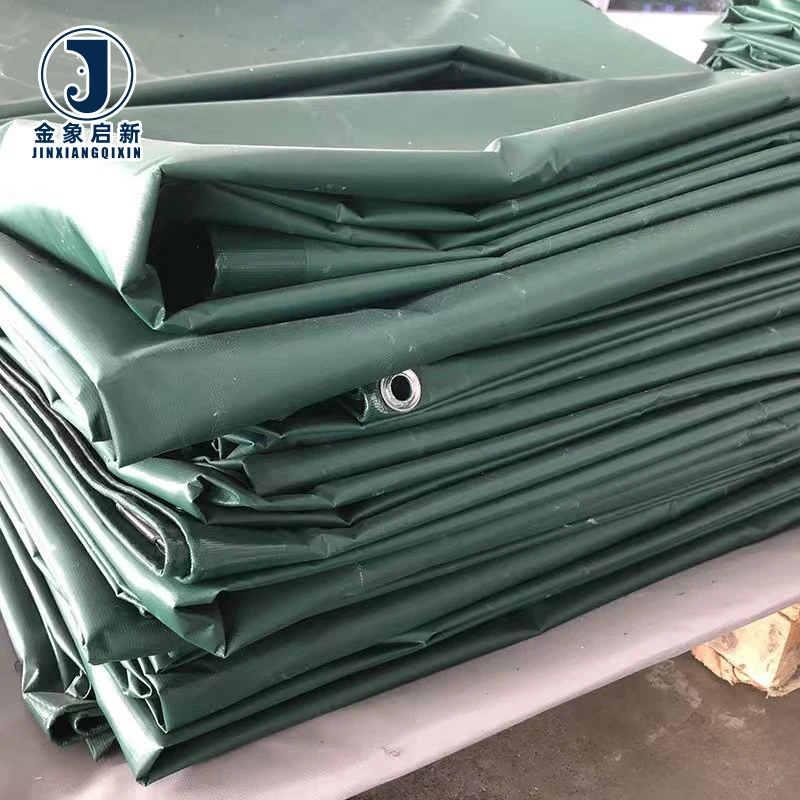
Deep Coating Adhesion Control — hot-melt lamination technology bonds PVC layers to the polyester base under heat and pressure, producing weld seams that hold at flex points where truck loads shift during transit.
Technical Specifications
| Parameter | Value |
|---|---|
| Product Type | PVC Coated Tarpaulin |
| Base Fabric | 100% high toughness polyester yarn |
| Coating Material | PVC coating |
| Coating Method | Lamination technology and hot melt coating technology |
| Weight (Medium-sized) | 400–500 g/m² |
| Weight (Heavy-duty) | 700–1000 g/m² |
| Weight (Super heavy) | 1100–1500 g/m² |
| Thickness (Medium-sized) | 0.35–0.45 mm |
| Thickness (Heavy-duty) | 0.70–1.0 mm |
| Thickness (Super heavy) | 1.2–1.5 mm |
| Knitting Density (Medium-sized) | 500D |
| Knitting Density (Heavy-duty) | 1000D |
| Knitting Density (Super heavy) | 500D–2000D |
| Tensile Strength (Medium-sized) | Longitude 1500–2000 / Latitude 1200–1800 N/5cm |
| Tensile Strength (Heavy-duty) | Meridian 2000–2500 / Latitude 1800–2200 N/5cm |
| Tensile Strength (Super heavy) | Warp 2500–3000 / Weft 2200–2800 N/5cm |
| Waterproof | Yes |
| Cold Resistant | Stated (test basis not stated in source) |
| Anti-Static | Available (grade not stated in source) |
| Anti-Mildew | Mold proof |
| UV Treatment | Available in anti-UV grades — confirm the grade required for your market |
| Flame Retardant | Available in flame retardant grades — confirm the grade required for your market |
| Weld Tear Strength | Excellent (test basis not stated in source) |
| Color Fastness | Best (test basis not stated in source) |
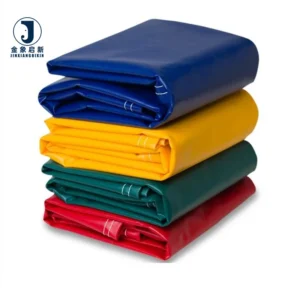
| Color Options | Blue, Blue/Orange, Green, Grey, Black, Clear, Grey/Green, Orange, or custom colors |
| Weather Resistance | 3–5 years outdoor living guarantee |
| Standards | ISO, CE |
Application Suitability
| Application | Exposure & Requirement |
|---|---|
| Full-size pickup truck covers | Road debris impact, wind flap fatigue, UV exposure, repeated folding at tailgate edges |
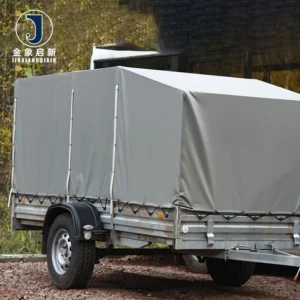
| Large trailer side curtains | Constant flexing at load shift points, tie-down abrasion, highway-speed wind load |
| Farm equipment wraps | Chemical fertilizer contact, mud splash, prolonged sun exposure in open fields |
| Construction site equipment covers | Abrasive dust, crane hook contact, overnight moisture and condensation |
| Industrial pipe canopy | Welded seam tension at support frames, thermal expansion cycling, rain pooling |
| Tensioned structural fabric | Biaxial load under wind uplift, seam integrity at anchor points, long-term UV exposure |
Why PVC Coated Tarpaulin for Truck Covers Fails at the Weld Before the Fabric Tears
Coating adhesion quality determines whether a seam survives road vibration or splits open at the first flex point.
Fleet operators report that truck covers frequently fail along heat-welded seams while the surrounding PVC coated tarpaulin for truck covers remains intact. The failure concentrates at tie-down zones and eyelet reinforcement areas where load movement creates repeated stress. When the coating bond to the base fabric is weak, the heat-activated weld zone separates before the polyester yarn reaches its tensile limit [NEED_CITE: weld seam peel strength test methods for coated fabrics]. Hot melt coating and lamination technology addresses this by fusing PVC into the yarn structure under controlled temperature and pressure, producing adhesive strength that lets the welded zone flex without delamination.
How Hot Melt Coating Changes Seam Behaviour on the Road
The lamination and hot melt coating process forces PVC into the interstices of the polyester yarn rather than sitting on the surface as a film. This means that when a heat weld is applied during fabrication, the coating layers on both sides of the seam are already integrated with the base fabric. The result is a weld zone that behaves as a single structural unit rather than two coating films pressed together. For fleet operators specifying PVC coated tarpaulin for truck covers, this difference shows up at the tie-down straps and D-ring attachment points where dynamic load is highest.
Matching Weight Grade to the Actual Load Profile
Selecting the correct weight grade depends on how the cover will be used, not just the size of the vehicle. Medium-weight grades in the 400–500 g/m² range suit light commercial vehicles and short-haul delivery trucks where the cover is removed and refitted frequently. Heavy-duty grades from 700–1000 g/m² serve long-haul trailers exposed to sustained highway wind loads and road debris. Super heavy grades above 1100 g/m² are specified for construction and mining equipment transport where sharp-edged loads and crane hook contact demand maximum puncture resistance [NEED_CITE: DIN 53354 tensile and tear test methods for coated fabrics]. Each weight grade pairs with a corresponding knitting density — 500D for medium, 1000D for heavy-duty, and up to 2000D for super heavy — which determines how the base fabric distributes load across the weave.
What Denier and Coating Thickness Mean in Practice
The knitting density of the polyester base fabric controls how tensile force distributes when a load point concentrates stress. A 1000D base fabric spreads impact energy across more yarn intersections than a 500D weave, reducing the chance of a tear propagating from a puncture or a seam corner. Coating thickness works in tandem with denier: a 0.70–1.0 mm coating on a heavy-duty grade provides enough PVC mass for heat-weld penetration while maintaining flexibility at fold lines. The lamination method ensures that coating weight correlates directly with adhesive bond rather than simply adding surface thickness. For PVC coated tarpaulin for truck covers, the combination of denier, coating thickness, and coating method together determines whether the material handles road conditions without cracking at cold temperatures or softening in summer heat.
The Cost of Overlooking Coating Method When Specifying Weight
A common procurement error is selecting a weight grade without confirming how the coating is applied. Two fabrics rated at the same GSM can perform very differently if one uses dip coating while the other uses hot melt lamination. Dip-coated fabric may meet the weight specification but leave a weaker bond between PVC and polyester, resulting in delamination at welded seams under road vibration [NEED_CITE: coating adhesion and peel strength standards for transport tarpaulins]. Fleet operators who replace covers prematurely often trace the failure back to coating separation rather than fabric wear. Specifying both the GSM range and the coating method — lamination technology and hot melt coating technology — closes this gap and ensures the PVC coated tarpaulin for truck covers performs as expected across the full service period.
Why Procurement Teams Should Source Here
Three full production lines with dedicated equipment sets allow simultaneous processing of different weight grades without cross-contamination of coating formulations. Each production run includes in-process QA checks that verify coating adhesion at the weld zone before the material leaves the line. The 10-person R&D team develops custom sizing matched to specific truck and trailer models rather than cutting generic rectangles, which reduces on-site fabrication waste. Pre-shipment inspection covers every roll against the quoted specification, including GSM verification and seam integrity at designated flex zones. Samples are developed within days for custom colour or treatment requirements, letting buyers confirm material behaviour before committing to bulk volume.
Documentation & Verification
- Material specification sheet stating base fabric denier, coating method, and weight grade per order line
- Weld seam inspection record at flex-point zones completed before dispatch
- Custom sizing confirmation matched to specific truck or trailer model dimensions
- Weight verification per roll against the stated GSM before shipment
- ISO and CE certificates covering production scope and quality management
- Colour consistency check across multiple rolls within the same batch order
Fabrication, Handling & Storage
- Heat weld parameters must match the coating thickness: medium-weight grades at 0.35–0.45 mm require lower temperature than heavy-duty at 0.70–1.0 mm
- Eyelet reinforcement zones should include an additional PVC patch layer to distribute tie-down load across the 1000D base fabric
- Store rolls horizontally on padded racks to prevent permanent creasing in the PVC coating at contact points
- Allow cold-stored rolls to reach ambient temperature before unrolling to avoid cracking the PVC surface
- Use mild detergent for cleaning; solvent-based cleaners can degrade the hot melt coating bond on the polyester yarn
- Cut patterns should account for the fabric width to minimise off-cuts and reduce the number of welded joints in the finished cover
What to Include in Your Inquiry
Provide the truck or trailer model and the exact cover dimensions required, including any cutouts for mirrors, lights, or access panels. Specify the operating environment — highway transit, construction site, agricultural field — so the correct weight grade and treatment combination can be recommended. Confirm whether anti-static or flame retardant treatment is required by your local regulations, and state the applicable standard. Indicate whether you need finished covers with eyelets and hem reinforcement or roll stock for your own fabrication line.
Frequently Asked Questions
Q: How is the actual weight verified against the quoted specification?
A: Every roll undergoes a GSM check during pre-shipment inspection. A weight verification record is generated per roll and included with the dispatch documentation. If your market requires third-party lab verification, this can be arranged before shipment. The quoted GSM range is confirmed against the specific weight grade — medium, heavy-duty, or super heavy — selected for your order.
Q: Can the cover be sized to a specific trailer model rather than a generic rectangle?
A: Yes. The R&D team works from vehicle model drawings or on-site measurements to produce a cutting pattern that accounts for mirror cutouts, access flaps, and tie-down point placement. This eliminates the on-site trimming and additional welding that generic cuts require. Sample covers are produced for fitment approval before bulk production begins.
Q: What eyelet spacing and hem reinforcement options are available?
A: Eyelet spacing is configured to match the tie-down strap pattern of your specific truck or trailer. Hem reinforcement includes folded edges with additional PVC coating layers at stress concentration points. The hot melt coating technology ensures that heat-welded hems maintain adhesive bond strength through repeated tension cycles during loading and transit.
Q: How are welded seams tested at high-flex zones before shipment?
A: Weld seam inspection is part of the in-process QA protocol. Flex-point zones — tie-down areas, eyelet lines, and corner gussets — are checked for coating adhesion and weld integrity before the cover leaves the production line. Inspection records are included in the pre-shipment documentation package provided with each order.
Q: What documentation supports flame retardant or anti-static claims?
A: When flame retardant or anti-static treatment is specified, the applicable grade and test standard are declared on the material specification sheet. Test reports supporting the claimed treatment grade are provided with the shipment documentation. Buyers should confirm the grade required by their local fire safety or mining regulations at the inquiry stage.