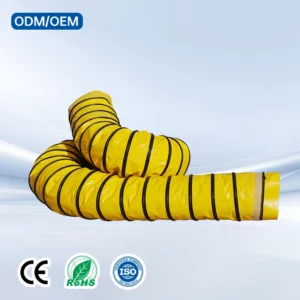
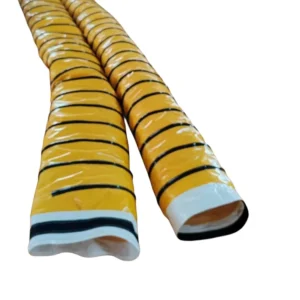
Proven Process Control — Every roll of PCA air duct fabric passes in-process coating weight and adhesion checks across three dedicated production lines, ensuring consistent thermal and mechanical performance for aviation ground support deployments.
Technical Specifications
| Parameter | Value |
|---|---|
| Product Type | Aviation Air Duct |
| Diameter | 12 Inch |
| Coating Material | PVC |
| Base Fabric | Fabric-reinforced layer |
| Insulation Layer | Built-in aluminum foil bubble film |
| Temperature Range | -30°C to 150°C |
| Connection Method | Zipper and Velcro |
| Outer Layer Color | Yellow-black alternating (high visibility) |
| Anti-Mildew | Yes (PVC coated cloth) |
| Flame Retardant | Grade available upon request — confirm the grade required for your airport compliance regime |
| Anti-Static | Standard available upon request — confirm the certification required for your ground support site |
| Standards | ISO, CE (company certification; product-specific certification available on request) |
Application Suitability
| Application | Exposure & Requirement |
|---|---|
| Airport apron PCA unit to aircraft cabin connection | Continuous cold or warm air transmission, outdoor temperature extremes, forklift and ground crew traffic, rapid connect-disconnect cycles |
| Aviation MRO hangar ventilation | Enclosed-space airflow delivery, compliance with hangar fire safety regimes, extended deployment periods |
| Military and general aviation ground support | Rugged terrain handling, wide temperature operating range, high-visibility requirements on shared tarmac zones |
What Happens When Ground Support Ducting Lacks the Right Certification Paperwork
Compliance documentation must be confirmed before the duct arrives on the apron, not after it fails a site audit.
Ground handling teams often discover too late that the ventilation duct delivered to the airfield does not carry the fire-retardant or anti-static grade the airport operator mandates. The duct may perform adequately in airflow terms, yet without the matching test report it cannot legally remain in service [NEED_CITE: airport ground support equipment fire safety compliance requirements]. Procurement teams then face the choice of pulling the duct from active turnaround operations or running it without documented approval — neither of which is acceptable when an aircraft is waiting at the gate.
Insulated Airflow That Holds Temperature Across the Apron
The built-in aluminum foil bubble film insulation layer is bonded within the duct wall to maintain thermal integrity from the PCA unit outlet all the way to the aircraft cabin interface. This Aviation Air Duct for ground support operates across a temperature range of -30°C to 150°C, covering both pre-conditioned cold air delivery in summer heat and warm air supply during winter ground holds. The insulation construction reduces thermal bleed so the air reaching the cabin stays within the temperature band the aircraft environmental control system expects.
Rapid-Connect Joints Built for Turnaround Speed
Zipper and Velcro connection points allow ground crews to assemble, disconnect and stow the duct between shifts without tools or specialist training. On a busy commercial apron where turnaround windows are measured in minutes, this connection system reduces the time spent mating the duct to the PCA unit flange and the aircraft under-door interface. The high-visibility yellow-black alternating outer colour keeps the duct conspicuous to apron vehicle operators, lowering the risk of drive-over damage during push-back and taxi operations.
Reading the Specs Beyond Diameter and Temperature
The 12-inch diameter sets the cross-sectional airflow area, but actual delivery performance depends equally on internal surface smoothness and insulation continuity — any gap in the aluminum foil bubble film layer creates a thermal short-circuit that degrades cabin air temperature. The PVC-coated fabric-reinforced outer layer provides structural rigidity so the duct maintains its circular profile under positive pressure rather than flattening at bends [NEED_CITE: flexible duct collapse resistance under positive air pressure]. Mildew resistance in the PVC coating matters on aprons where the duct sits on damp tarmac between uses, preventing microbial degradation of the outer shell. The -30°C to 150°C range defines the operational envelope; sustained use near either boundary requires confirming that the insulation layer and seam adhesive remain stable at those extremes over repeated thermal cycles.
The Cost of Specifying Duct Without Matching Site Requirements
When a duct arrives without the flame-retardant grade the airport fire marshal requires, the entire batch sits in quarantine while alternative documentation is chased — and aircraft turnarounds revert to APU-powered cabin conditioning, burning fuel on the ground. Similarly, if the outer PVC coating lacks adequate mildew resistance for the local climate, the fabric surface degrades visually within months, prompting premature replacement even though the structural fabric layer remains intact [NEED_CITE: PVC coated fabric degradation in high-humidity outdoor environments]. Zipper and Velcro joints that are not matched to the daily connect-disconnect frequency will show mechanical fatigue long before the duct body itself fails, turning a minor hardware issue into a full duct swap.
Why Procurement Teams Source This Duct Here
Three full production lines and 36 sets of professional equipment support consistent output volume, so repeat orders maintain the same insulation layer bonding quality and outer colour consistency. A dedicated 10-person R&D team handles diameter adjustments, connection method modifications and custom branding for fleet identification. Every production stage carries QA/QC checkpoints, with 100% inspection before shipment covering seam integrity, zipper function and dimensional verification. Samples for custom configurations are developed within days, letting you validate fitment on your specific PCA unit before committing to full production. The coating process is controlled in-house, giving direct oversight of PVC application weight and fabric adhesion rather than relying on third-party laminators.
Documentation & Verification
- Material specification sheet listing base fabric type, PVC coating weight, insulation layer composition and temperature range
- Flame-retardant and anti-static test reports matching the specific grade your airport compliance regime demands
- Pre-shipment inspection record covering seam welds, zipper and Velcro function, diameter and length measurement
- Certificate of origin and customs documentation prepared for cross-border delivery to airport sites
- Roll packing list with individual duct identification for traceability
Fabrication, Handling & Storage
- Heat-weld seams at manufacturer-recommended temperature to avoid delaminating the aluminum foil insulation layer
- Store coiled ducts upright on pallets to prevent compression creasing of the fabric-reinforced PVC outer shell
- Avoid dragging the yellow-black outer surface across abrasive tarmac during deployment to preserve coating integrity
- Clean PVC exterior with mild detergent only; solvent-based cleaners may degrade the mildew-resistant coating surface
- Inspect zipper teeth and Velcro hook faces for debris accumulation after each apron shift before stowing
What to Include in Your Enquiry
Specify the PCA unit model and aircraft types you service so we can confirm diameter compatibility and connection interface dimensions. State the fire-retardant and anti-static certification grades your airport operator or airline client mandates, along with the applicable regulatory standard. Indicate whether you require custom length sections, branded outer printing for fleet identification, or specific packaging for air freight delivery to your ground support depot.
Frequently Asked Questions
Q: What flame-retardant and anti-static certifications does the duct carry for airport compliance?
A: The duct is available in flame-retardant and anti-static grades suited to aviation ground support environments. The specific grade and test standard must be confirmed against your airport operator’s compliance regime before production. We supply matching test reports and certification documentation with each shipment so your ground support fleet passes site audits without delay.
Q: How is diameter and length customised to match different PCA unit and aircraft interface sizes?
A: Our R&D team adjusts duct diameter and section length based on your PCA unit outlet flange and the aircraft under-door air conditioning interface dimensions you provide. Custom samples are produced within days for fitment validation before full-batch manufacturing begins, ensuring the Aviation Air Duct for ground support mates correctly without adapters or field modifications.
Q: What is the expected service behaviour of the aluminum foil insulation under continuous cold-air delivery?
A: The built-in aluminum foil bubble film insulation layer is designed to sustain thermal performance across the -30°C to 150°C operating range. Under continuous cold-air delivery on hot aprons, the insulation reduces thermal gain so cabin-bound air stays within acceptable temperature bands. We recommend confirming insulation stability with a sample test under your local peak summer apron conditions.
Q: How are zipper and Velcro joints maintained under daily apron use and forklift traffic?
A: The zipper and Velcro connection system is designed for repeated connect-disconnect cycles typical of commercial turnaround operations. Ground crews should clear debris from zipper teeth and Velcro hook faces after each shift. If mechanical wear appears on connection hardware, individual joint sections can be replaced without discarding the entire duct body.
Q: What packaging and loading method prevents compression damage during international shipment?
A: Each duct section is packed to preserve its circular cross-section and protect the aluminum foil insulation layer from compression creasing during transit. We prepare packing lists, certificates of origin and customs documentation for cross-border delivery. Share your preferred freight method and destination airport so we can configure packaging accordingly.