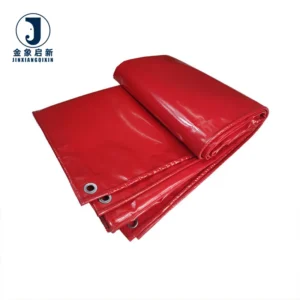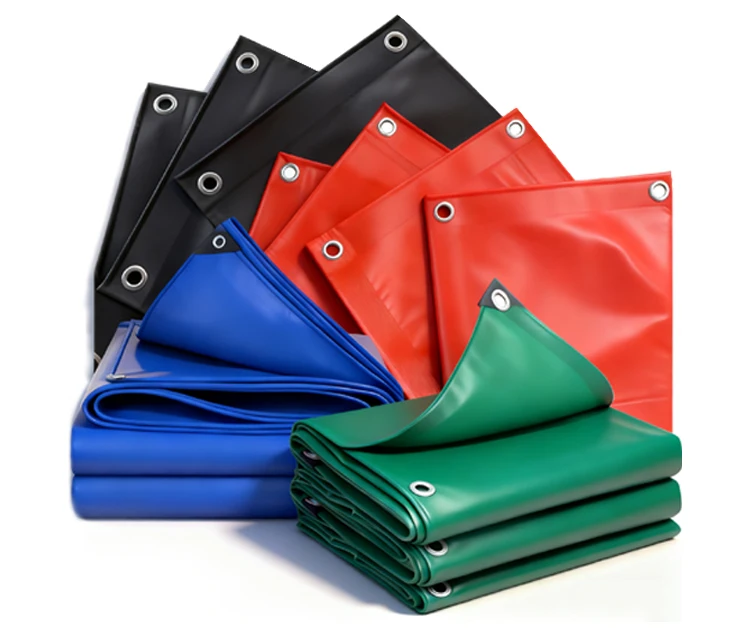
Hot Melt Coating Expertise — Three full production lines with 36 sets of professional equipment maintain consistent adhesive bond strength across every roll of PVC coated tarpaulin for truck and transport applications.
Technical Specifications
| Parameter | Value |
|---|---|
| Product Type | PVC Coated Tarpaulin Roll |
| Base Fabric | 100% high toughness polyester yarn |
| Base Fabric Denier | 500D / 1000D / 500D-2000D |
| Weight (GSM) | 400-500 / 700-1000 / 1100-1500 |
| Total Thickness | 0.35-0.45 mm / 0.70-1.0 mm / 1.2-1.5 mm |
| Coating Material | PVC |
| Coating Method | Lamination technology and hot melt coating technology |
| Tensile Strength (N/5cm) | Warp 1500-2000 / Weft 1200-1800 (medium); Warp 2000-2500 / Weft 1800-2200 (heavy-duty); Warp 2500-3000 / Weft 2200-2800 (super heavy) |
| Flame Retardant | Available — confirm the grade required for your market |
| Anti-Static | Treatment available — confirm the standard required for your application |
| UV Treatment | Available — test basis to be confirmed per grade |
| Anti-Mildew | Mold proof |
| Cold Resistant | Cracking resistant |
| Welding Tear Strength | Excellent — verify test basis for your specification |
| Color Fastness | Best — confirm grade per colour reference |
| Outdoor Weather Resistance | 3-5 years |
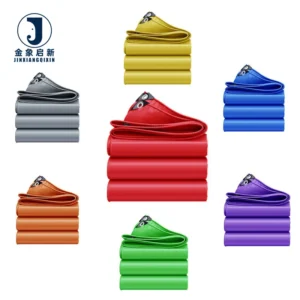
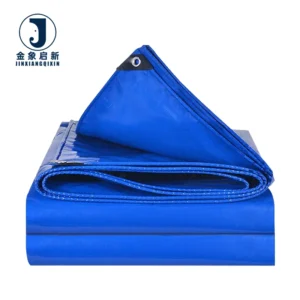
| Color | Blue (additional colours available on request) |
| Standards | ISO, CE |
Application Suitability
| Application | Exposure & Requirement |
|---|---|
| Truck side curtain fabric | Constant flexing at load points, road debris abrasion, sustained UV and rain exposure |
| Custom-fit truck and trailer covers | Tension across irregular load shapes, tie-down stress at edges, highway wind loading |
| Heavy-duty engineering protective cloth | Construction site dust and impact, equipment vibration, prolonged outdoor storage |
| Industrial pipe canopy | Static load bearing, UV and thermal cycling, chemical splash resistance |
| Tensioned structural fabric | Sustained tensile load, wind uplift forces, long-term weather exposure |
Why Welded Seams Fail Before the Fabric Does on Truck Covers
Weld failure at flex points traces back to coating adhesion, not fabric strength alone.
Fleet operators replacing truck covers repeatedly encounter the same problem: the PVC coated tarpaulin for truck and transport use remains intact, yet the welded seam splits where the load shifts and flexes most. This is not a fabrication error in most cases — it originates at the coating stage. When the PVC layer bonds weakly to the polyester base yarn, heat welding cannot create a homogenous joint. The seam then peels apart under cyclic stress long before the fabric itself reaches its tensile limit. I have seen heavy-grade coated rolls fail at the weld line while the body of the cover showed no damage whatsoever. [NEED_CITE: tensile and tear test methods for coated fabrics per ISO 1421]
How Hot Melt Coating Technology Addresses Flex-Point Failure
The PVC coated tarpaulin for truck and transport applications relies on lamination and hot melt coating technology to fuse the PVC layer directly into the polyester base yarn. Unlike simple adhesive lamination, hot melt coating drives the PVC compound into the weave structure under heat and pressure. This creates a mechanical interlock that survives repeated flexing at the weld zone. When the fabricator applies heat to join two panels, the coating at the seam remelts and fuses with the adjacent panel’s coating rather than simply sitting on the surface.
What This Means for Trailer Curtain and Cover Durability
Trailer side curtains endure thousands of articulation cycles per journey. Each corner and load-bearing edge undergoes micro-flexing that tests the adhesive bond between coating and base fabric. Hot melt coated material maintains its peel strength through these cycles because the bond is integral to the yarn structure, not a surface layer. This is especially relevant for heavy-duty grades at 700-1000 GSM and above, where the thicker coating must still penetrate the 1000D polyester base to achieve uniform adhesion across the full fabric width. [NEED_CITE: peel strength test standards for coated technical textiles]
Reading the Specification Sheet Beyond GSM
GSM tells you how much material exists per square metre, but it does not tell you how that material is distributed. A 900 GSM fabric with a 1000D base and tight weave will outperform a 900 GSM fabric built on a loose 500D base with heavy coating fill. The base fabric denier determines the structural skeleton — 500D suits medium-duty truck covers where weight savings matter, while 1000D handles heavy-duty transport with high tie-down loads. The 500D-2000D range covers super heavy applications such as engineering protective cloth and tensioned structures. Hot melt coating technology must match the denier: heavier yarns require higher temperature and pressure to achieve full penetration, which is why coating process control directly determines the final tensile and tear performance. Thickness values from 0.35-0.45 mm through to 1.2-1.5 mm correspond to these weight and denier tiers, giving fabricators a clear reference for welding temperature settings and press dwell times.
The Hidden Cost of Specifying on Price Per Kilogram Alone
When procurement focuses solely on cost per kilogram of PVC coated tarpaulin for truck and transport use, the delivered material often arrives lighter than the quoted GSM. A specification sheet may state 900 GSM, yet the rolls weigh in below that figure upon arrival. This shortfall means less coating and weaker adhesion at the weld line. Fleet operators then face premature cover replacement, and the downtime for re-fitting a trailer curtain far exceeds the initial savings on material cost. Colour variation between rolls in the same batch compounds the problem — visible once installed side by side across a fleet, forcing either acceptance of a patchwork appearance or a full reorder. [NEED_CITE: coating weight verification methods for PVC tarpaulin rolls]
Why Sourcing This Fabric Through Jinxiang Tarpaulin
Nearly 30 years of focused coated fabric production translates to process control over coating weight and adhesion that newer mills cannot replicate quickly. Three full production lines with 36 sets of professional equipment provide the capacity to deliver bulk roll orders for fleet-wide cover programmes on schedule. A dedicated 10-person R&D team handles material selection and sample development, producing custom samples within days when a specific GSM or treatment combination is needed. QA/QC inspection runs at every production stage with 100% pre-shipment inspection, catching GSM deviation and colour inconsistency before rolls leave the facility. This matters directly for fleet operators who need every roll in a container load to match the same weight, colour, and welding behaviour.
Documentation & Verification
- Material specification sheet stating exact GSM, base fabric denier, and coating weight per roll
- Test reports for flame retardant and anti-static grades matched to the specific product ordered
- Pre-shipment inspection record confirming GSM and colour consistency across all rolls in the order
- Roll packing list with individual roll weights and dimensions for receiving verification
- Certificate of origin and customs documentation for international transport shipments
Fabrication, Handling & Storage
- Set welding temperature and dwell time to match the specific thickness tier — 0.35-0.45 mm requires lower heat than 1.2-1.5 mm super heavy grades
- Allow hot melt coated seams to cool fully under pressure before releasing the press to prevent peel-back at flex points
- Store rolls horizontally on racking to avoid flat spots that create visible crease lines in truck curtain panels
- Unroll cold-resistant grades at ambient temperature before fabrication to prevent cracking at fold lines
- Clean finished covers with mild detergent only — solvent-based cleaners can degrade the PVC coating surface over time
- Cut panels with sealed-edge blades to prevent base yarn fraying before hemming or welding
Preparing Your Enquiry for a Transport Cover Programme
To specify the correct PVC coated tarpaulin for truck and transport covers, share the trailer models and dimensions in your fleet, the typical cargo types and load configurations, and the operating climate range including minimum winter temperatures. Let us know whether flame retardant or anti-static treatment is required by your regional transport regulations, and confirm if you need roll stock for your own fabrication or finished cut-to-size covers with hemming and eyelets. Colour and branding requirements should be confirmed early, as custom colours carry different minimums than stock blue.
Frequently Asked Questions
Q: How is GSM verified on arrival and what documentation accompanies the shipment?
A: Every order ships with a material specification sheet stating the exact GSM, base fabric denier, and coating weight. A pre-shipment inspection record confirms measured values per roll. We recommend weighing sample cuts from received rolls against the stated specification to verify consistency across the delivery batch before fabrication begins.
Q: How do welded seams perform at truck load flex points compared to stitched seams?
A: Hot melt coating technology allows welded seams to fuse the PVC layers together at a molecular level, creating a joint that flexes with the fabric rather than resisting it. Stitched seams introduce needle holes that interrupt the coating and create water ingress paths, making welding the preferred method for side curtain and cover applications exposed to road weather.
Q: Can truck covers be cut to specific trailer model dimensions rather than generic sizes?
A: Custom sizing is a core part of our production capability. Provide the exact trailer model, body dimensions, and any protrusions such as tail lifts or refrigeration units. The R&D team develops a cutting pattern and sample for approval before full production runs, ensuring each cover fits the specific vehicle rather than relying on oversized generic tarps.
Q: What flame retardant or anti-static certifications are available for transport compliance?
A: Flame retardant and anti-static treatments are available across the product range, with test reports supplied for the specific grade ordered. Confirm the regulatory standard your market requires — different regions mandate different classifications — and the appropriate grade will be matched and documented before production.
Q: How is colour consistency maintained across multiple rolls for fleet-wide cover replacement?
A: All rolls within a single production run are coated from the same batch of PVC compound with controlled pigment dosing. The 100% pre-shipment inspection includes visual colour matching across rolls to flag any variation before dispatch. For fleet programmes spanning multiple shipments, colour reference samples are retained for cross-batch comparison.