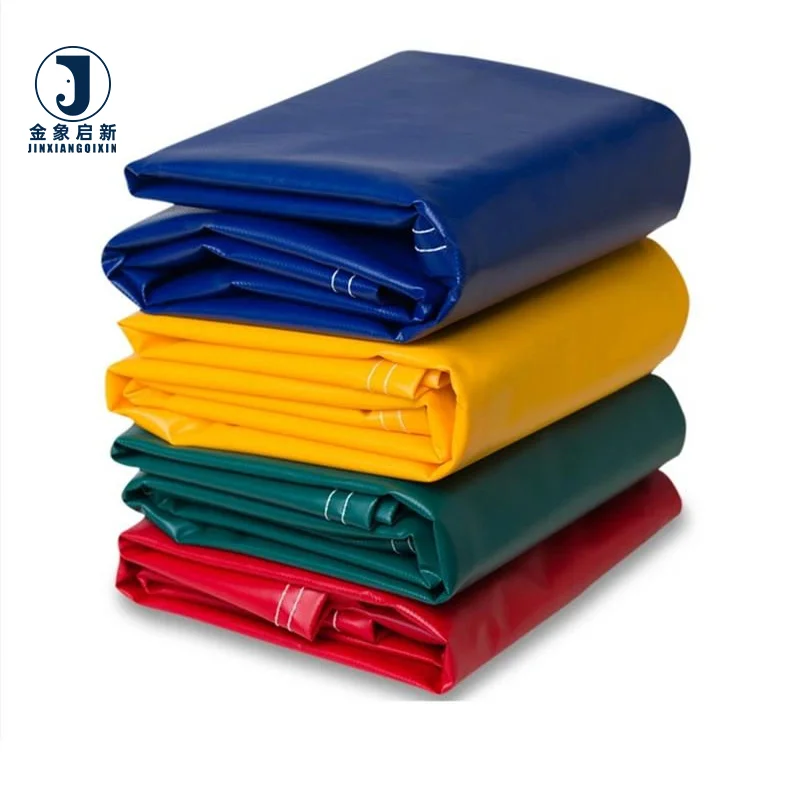
Deep Process Control Over Coating Weight — Nearly 30 years focused on coated fabric, this PVC coated tarpaulin for truck and transport applications is produced under tight GSM and adhesion control, ensuring batch-to-batch consistency that fleet operators can verify on arrival.
Technical Specifications
| Parameter | Value |
|---|---|
| Product Type | PVC Coated Tarpaulin Fabric |
| Material | PVC coated fabric |
| Total Thickness (medium-duty) | 0.35–0.45 mm |
| Total Thickness (heavy-duty) | 0.70–1.0 mm |
| Total Thickness (super heavy-duty) | 1.2–1.5 mm |
| Weight (medium-duty) | 400–500 g/m² |
| Weight (heavy-duty) | 700–1000 g/m² |
| Weight (super heavy-duty) | 1100–1500 g/m² |
| Base Fabric Denier (medium-duty) | 500D |
| Base Fabric Denier (heavy-duty) | 1000D |
| Base Fabric Denier (super heavy-duty) | 500D–2000D |
| Tensile Strength (medium-duty) | Longitude 1500–2000 / Latitude 1200–1800 N/5cm |
| Tensile Strength (heavy-duty) | Meridian 2000–2500 / Latitude 1800–2200 N/5cm |
| Tensile Strength (super heavy-duty) | Warp 2500–3000 / Weft 2200–2800 N/5cm |
| UV Treatment | Available (test basis not stated) |
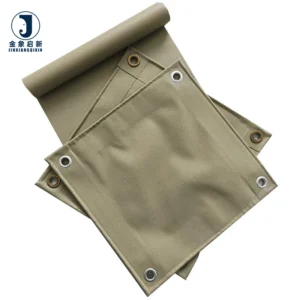
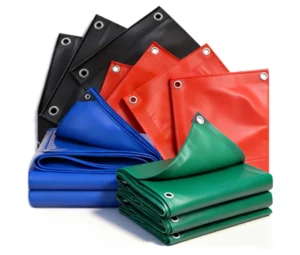
| Color Options | Blue, Blue/Orange, Green, Grey, Black, Clear, Grey/Green, Orange, or custom |
| Key Features | Waterproof, washable, tear resistant, weather proof, sunproof, mildew proof, anti-aging |
| Printing Option | Custom brand printing available |
| Standards | ISO, CE (certifications mentioned in company profile, specific certificate numbers not stated in source) |
Application Suitability
| Application | Exposure & Requirement |
|---|---|
| Truck side curtain fabric | Constant flexing at fold lines, road debris abrasion, sustained UV exposure, wind load stress at tie-down rails |
| Flatbed trailer load covers | Full weather immersion during transit, tie-down strap point loading, surface friction against cargo edges |
| Full-size pickup truck covers | Daily fit and removal, UV and rain exposure, wind flap fatigue at mirror and cab cutouts |
| Farm machinery and equipment covers | Chemical and fertilizer dust contact, prolonged sun exposure, handling abrasion from repeated placement |
| Construction site protection | Impact from falling debris, mud and alkaline water contact, prolonged outdoor staging |
| Industrial pipe canopy and tensioned structure | Structural wind load on welded seams, long-term UV and thermal cycling, tension stress at anchor points |
Why Generic-Sized Truck Covers Fail Under Real Road Conditions
A cover that does not match the trailer model creates stress concentration points that tear first.
Fleet operators regularly receive truck tarpaulins cut to round-number dimensions that do not account for the exact body width, headboard height, or tailgate geometry of the vehicle in service. The result is excess fabric that flaps at highway speed or a short hem that leaves cargo exposed. PVC Coated Tarpaulin for Truck and Transport loads must follow the vehicle contour, not a catalogue grid. [NEED_CITE: dimensional tolerances for side curtain and load cover fitment on standard trailer bodies]
Model-Matched Sizing Eliminates Road-Side Rework
Each trailer model in a mixed fleet has distinct body dimensions, roller track positions, and tie-down rail spacing. When the PVC coated tarpaulin for truck and transport covers is cut to these exact measurements, the fabric sits flush against the load envelope, eliminating the loose panels that whip in crosswind and abrade against the trailer frame. This precision matters most at curtain-sider rails where the fabric must slide or tension without binding.
Reinforcement Placement Follows the Stress Map
Tie-down points, roller pockets, and curtain hem edges experience cyclical loading that exceeds the static tensile rating of the base fabric. Reinforcement is positioned at these high-stress flex zones rather than applied uniformly along every edge. This targeted approach directs material and labour to the locations where failure actually occurs, extending service life without adding unnecessary weight to the cover. [NEED_CITE: stress distribution mapping on PVC coated tarpaulin at tie-down and curtain hem zones]
Understanding the Relationship Between Denier, GSM, and Real-World Strength
Tensile strength in PVC coated fabric is governed by two variables working in combination: base fabric denier and coating weight. A 1000D base fabric at 700 g/m² total weight will behave very differently under strap tension than a 500D base at the same GSM, because the heavier yarn carries load while the lighter yarn relies more on coating adhesion. Total GSM alone does not predict tear propagation resistance — the weave density and yarn thickness determine how far a puncture spreads before stopping. Buyers should review both the base denier and the stated tensile values across warp and weft to match the grade to the actual loading cycle. Thickness readings from 0.35 mm through 1.5 mm correspond to these grade tiers, but a thicker coating does not compensate for an undersized base yarn in high-tension applications. UV treatment is available in this range — confirm the treatment grade required for your regional climate exposure.
What Happens When the Wrong Grade Meets the Road
Selecting a medium-duty 400–500 g/m² grade for a flatbed trailer that hauls heavy machinery means the tie-down strap points will punch through the fabric under dynamic load, long before the material itself degrades from weather. Conversely, specifying a super heavy-duty 1100–1500 g/m² grade for a farm equipment cover that is handled daily adds unnecessary weight, making the cover difficult for a single operator to place and remove. [NEED_CITE: field failure patterns in PVC coated tarpaulin across duty-grade misapplications] Colour inconsistency between rolls in the same fleet order creates visible panel mismatches once the covers are installed side by side, prompting return requests that delay vehicle dispatch.
Why This Production Capability Matters for Your Fleet
Three full production lines and 36 sets of professional equipment mean that bulk orders of PVC coated tarpaulin for truck and transport applications are completed without splitting across outsourced finishing. The 10-person R&D team handles custom sizing and pattern development in-house, so a new trailer model added to your fleet receives a fit-checked sample before full production runs. Dedicated QA/QC inspection at every production stage with 100% pre-shipment review catches colour drift and seam defects before dispatch. Deep process control over coating weight and adhesion ensures that the GSM stated on your quotation matches the material that arrives on your dock. Custom width, colour, and brand printing are accommodated within standard production scheduling, reducing the premium typically associated with non-stock specifications.
Documentation & Verification
- Material specification sheet stating GSM, base fabric denier, and coating type per roll
- Colour reference sample matched to approved fleet standard before production
- UV treatment test report provided where treatment grade is specified
- Pre-shipment inspection record confirming dimensional accuracy and seam integrity
- Roll packing list with batch traceability for each consignment
- ISO and CE certificates available for compliance filing
Fabrication, Handling & Storage
- Heat-weld seams at manufacturer-recommended temperature for the specific duty grade to prevent delamination under flex load
- Reinforce eyelet zones with additional PVC patches matching the base thickness before punching
- Store rolls vertically on end-caps to avoid compression creases on the 0.70–1.0 mm heavy-duty grades
- Allow cold-stored rolls to reach ambient temperature before unrolling to prevent surface cracking
- Clean with mild detergent only — solvent-based cleaners degrade the PVC coating bond over time
- Field-repair punctures with matching-grade PVC patches welded at the same temperature as factory seams
What We Need to Quote Accurately
Provide the truck and trailer model designations in your fleet, the specific cover type required (side curtain, flatbed load cover, or equipment shroud), and the annual volume per model. If your market mandates a particular UV or fire classification, state the standard reference so we can match the correct treatment grade. Specify whether you need finished covers with eyelets and reinforcement, or roll stock for your own fabrication line.
Frequently Asked Questions
Q: How do I specify the right PVC tarpaulin size for my truck or trailer model?
A: Provide the exact vehicle make, model year, and body type. We cut covers to the specific trailer dimensions — length, width, height, and door or curtain geometry — rather than using generic round-number sizes. A sample panel is produced for fit-check before full order confirmation.
Q: What GSM grade is needed for side curtain versus flatbed load cover use?
A: Side curtains that flex continuously at roller tracks typically run on the heavy-duty 700–1000 g/m² range with 1000D base fabric. Flatbed load covers with high tie-down point loading may require the super heavy-duty tier. We recommend reviewing the tensile strength values for the specific duty grade against your strap tension and loading cycle.
Q: How do you ensure colour consistency across multiple rolls in one order?
A: Every roll in a fleet order is produced from the same coating batch. Our QA/QC team inspects colour against the approved reference sample at the coating stage and again during pre-shipment review. A colour match record is included in the dispatch documentation.
Q: Can you supply PVC tarpaulin with UV treatment backed by test documentation?
A: UV treatment is available across the PVC coated tarpaulin range. When specifying, state the test standard or exposure rating required for your market so we can supply the corresponding treatment grade and test report with your shipment.
Q: What reinforcement options are available at eyelet and seam flex points?
A: Reinforcement is applied as additional PVC patches welded at tie-down zones, roller pockets, and hem edges where cyclical stress is highest. The patch material matches the base fabric grade to maintain consistent flex behaviour and prevent hard-edge tearing.