Precision Process Control — nearly 30 years of focused coating expertise applied to every run of this PVC coated canvas tarpaulin, ensuring consistent adhesion and lamination quality across every roll.
Technical Specifications
| Parameter | Value |
|---|---|
| Product Type | PVC Coated Canvas Tarpaulin |
| Base Fabric | Polyester cotton industrial textile, 8-12 strands of fine cotton yarn |
| Coating | PVC laminated |
| Weight | 600gsm |
| Thickness | 0.5mm / 0.6mm / 0.7mm (variant grades) |
| Roll Size | 2m width × 100m length |
| Finish Product Size | Custom items as per customer’s needs, or sold by inventory |
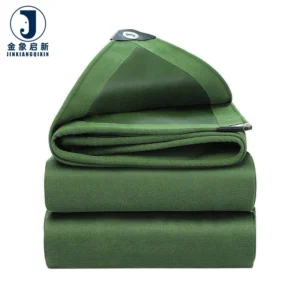
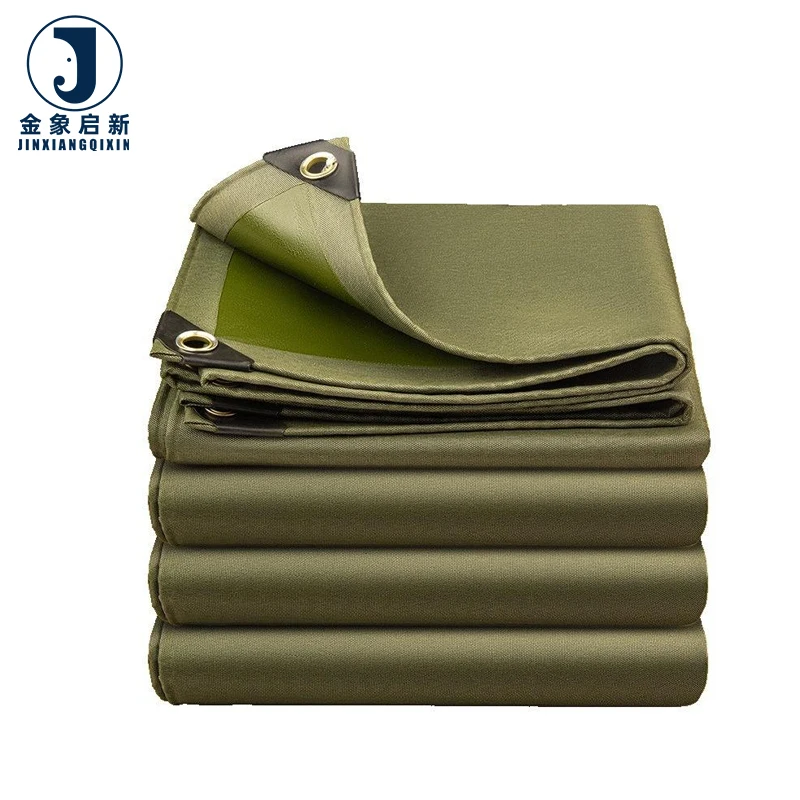
| Color | Army Green Camouflage / Custom |
| Key Features | Wear-resistant, corrosion-resistant, tensile-resistant, high- and low-temperature resistant, long service life |
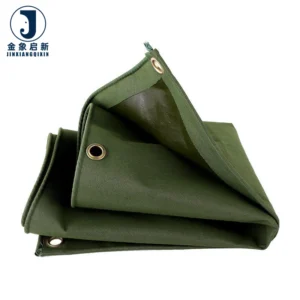
| Eyelet & Hem Options | Rust-proof aluminum eyelets every 1 meter at corners and hem; folding and seams welded and sewn with poly ropes |
| Certification | ISO, CE (product-specific certificate — confirm with shipment documentation) |
Application Suitability
| Application | Exposure & Requirement |
|---|---|
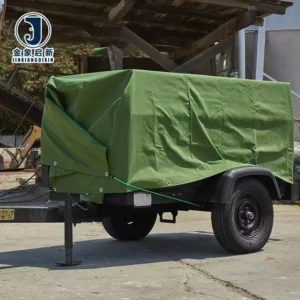
| Truck and trailer canopy covers | Constant flexing from load movement, highway wind uplift, road debris abrasion at tie-down and contact points |
| Flatbed side curtains | Repeated folding and unfolding, friction against cargo edges, long-term UV and weather exposure |
| Construction and transport site covers | Abrasion from rough aggregate and steel materials, standing water, site dust and chemical contact |
| Open-air cargo and asphalt covers | Sustained heat exposure from hot mix asphalt, heavy handling and drag across uneven ground |
| Tent and outdoor awning structures | Wind-driven rain, prolonged sun exposure, structural tension at pole and frame contact points |
| Engine hood and equipment covers | Heat from machinery, oil and grease contact, repeated removal and replacement causing fold-line wear |
What Happens When a Truck Cover Fails at the Weld Line
Generic tarps split at the seam long before the fabric itself wears through.
When a load shifts during braking or cornering, the greatest stress concentrates exactly where the panel joins the hem. Fleet operators frequently discover that a cover rated at the correct weight still tears open along the weld after a few hundred trips. The failure is rarely in the coated canvas itself — it is in the joint construction and the reinforcement spacing [NEED_CITE: tensile and tear test methods for coated fabrics per ISO 1421]. This PVC coated canvas tarpaulin for truck cover applications addresses that gap with welded and sewn poly-rope seams and rust-proof aluminum eyelets set at one-meter intervals, distributing the tie-down load across a wider area of the base fabric rather than concentrating it at a single punch point.
Covering Moving Loads: Why Truck Fitment Demands More Than a Standard Tarp
A PVC coated canvas tarpaulin for truck cover use must perform under conditions that static covers never encounter. Every time a trailer brakes, the cargo pushes forward against the canopy. Every crosswind on an open motorway lifts the fabric and snaps it back. The base fabric in this material uses a polyester cotton industrial textile with 8-12 strands of fine cotton yarn, providing a woven structure that resists the diagonal distortion forces that cause conventional canvases to pull out of shape at the corners.
Reinforcement Where the Load Flexes Most
The hem and eyelet construction is where most transport covers fail first. This PVC coated canvas tarpaulin uses folded hems that are both welded and sewn with poly rope inserted into the fold. The rope adds a continuous load-bearing cord along the entire edge, so when a ratchet strap pulls on an eyelet, the force transfers into the rope and spreads along the hem rather than tearing through the fabric at a single grommet. Rust-proof aluminum eyelets are set every one meter at corners and along the hem line, matching standard tie-down spacing on most flatbed and curtain-side trailers [NEED_CITE: standard tie-down spacing requirements for heavy goods vehicle load securing].
Reading the Specification Sheet: What GSM, Thickness and Base Yarn Actually Mean Together
The stated 600gsm weight reflects the total mass of base fabric and PVC lamination per square meter, but weight alone does not define strength. The polyester cotton base with 8-12 strands of fine cotton yarn determines how the fabric handles tensile and tear loads — a heavier yarn count produces a denser weave that resists tear propagation. The PVC lamination coating locks those yarns in place and adds abrasion protection, but the lamination method matters: a laminated construction bonds the coating to the base fabric under heat and pressure, producing strong peel resistance at the interface. The available thickness options of 0.5mm, 0.6mm and 0.7mm across variant grades reflect different coating weights applied over the same base structure, allowing fabricators to select the grade that matches the abrasion severity and flexibility requirements of their specific trailer configuration. A thicker lamination adds surface durability but also increases roll weight and reduces the number of linear meters per container.
The Hidden Cost of Specifying the Wrong Canvas Grade
Ordering a generic-weight tarp for a long-haul fleet may seem economical until the first cover splits at a seam within months of deployment. When the lamination peels from the base fabric at a fold line — typically caused by selecting a grade with insufficient coating adhesion for repeated flexing — the exposed yarn absorbs moisture and rots. Batch-to-batch inconsistency in coating weight means one roll in a multi-roll order may perform differently from the next, creating unpredictable failure patterns across a fleet [NEED_CITE: coating adhesion test methods for laminated fabrics]. For fleet operators standardising across multiple vehicles, specifying a PVC coated canvas tarpaulin with consistent lamination quality and requesting batch weight records prevents the situation where some covers last for years while others need replacement after a single season.
Why Source This Canvas Tarpaulin Through Jinxiang
Three full production lines and 36 sets of professional equipment support bulk output of this PVC coated canvas tarpaulin with reliable on-time delivery for fleet-scale orders. The 10-person R&D team handles custom sizing based on specific trailer model drawings rather than supplying generic cut sizes that leave gaps at the corners. Dedicated QA and QC inspection runs at every production stage, with 100 percent pre-shipment inspection to verify weight and construction against the agreed specification. Samples are developed within days when a fleet operator needs to test fitment, eyelet placement or seam construction before committing to a full container order. Deep process control over the lamination coating weight and adhesion means the PVC bond to the polyester cotton base fabric is managed at the coating line, not left to chance.
Documentation & Verification
- Weight verification per roll against the stated 600gsm before dispatch with inspection record
- PVC lamination adhesion and coating consistency data included with pre-shipment report
- ISO and CE certificates confirmed as product-specific for this canvas tarpaulin line
- Custom cut-size confirmation drawing matched to trailer model dimensions before cutting
- Roll packing list with batch reference for traceability across multi-roll orders
Fabrication, Handling & Storage
- Weld temperatures must match the PVC lamination grade to avoid delamination at seam joints
- Sewn poly-rope hems require compatible thread rated for the 600gsm fabric tension load
- Store 2m × 100m rolls upright on pallets to prevent flat-spot creasing in the lamination
- Allow rolls to acclimatise before unrolling in cold conditions to avoid coating crack damage
- Use mild detergent only — solvent cleaners can degrade the PVC lamination surface layer
- Lay flat or hang when cutting custom sizes to avoid distortion in the woven base fabric
What to Include With Your Enquiry
Provide your trailer model dimensions or the finished cover sizes required, along with the operating climate and typical cargo types your fleet carries. Specify whether you need roll stock at 2m × 100m for in-house fabrication or finished custom-cut covers with eyelets and hems installed. If your market requires fire classification or specific compliance documentation, state the standard your end user must meet so we can confirm which grades are available and supply the corresponding test reports with your quotation.
Frequently Asked Questions
Q: How do I measure my trailer for a custom-fit canopy?
A: Measure the internal load deck length and width, then add the drop height from the deck edge to the lowest point the cover must reach on each side. Include any protrusions such as tail lifts or side markers. Send us the drawing with these dimensions and your trailer model number, and we will confirm the cut pattern before production begins.
Q: What grommet spacing works best for standard ratchet strap tie-downs?
A: This PVC coated canvas tarpaulin comes with rust-proof aluminum eyelets set every one meter along corners and hems as standard. This spacing aligns with most ratchet strap configurations on flatbed and curtain-side trailers. If your tie-down system uses a different interval, custom eyelet spacing can be specified during the order confirmation stage.
Q: Can I get the same color and batch consistency across multiple rolls for fleet standardization?
A: Yes. When you order multiple rolls of the army green camouflage or a custom color, all rolls are produced in the same batch run. A pre-shipment inspection record confirms color consistency across rolls so there are no visible shade differences when covers are installed side by side on adjacent vehicles in your fleet.
Q: How does this canvas handle abrasion at corners and contact points with the load?
A: The PVC lamination over the polyester cotton base fabric provides a sacrificial surface layer that absorbs abrasion at high-wear points. The welded and sewn poly-rope hem reinforcement adds structural durability at edges and corners where the fabric contacts cargo edges, trailer hardware and tie-down straps during loading and transit.
Q: What is the lead time for custom sizes versus standard inventory dimensions?
A: Standard inventory sizes are typically available for faster dispatch. Custom-cut covers tailored to specific trailer models require pattern confirmation, cutting, hem welding and eyelet installation, which adds production time. Submit your trailer drawings early in the enquiry process so we can confirm the schedule alongside your quotation.