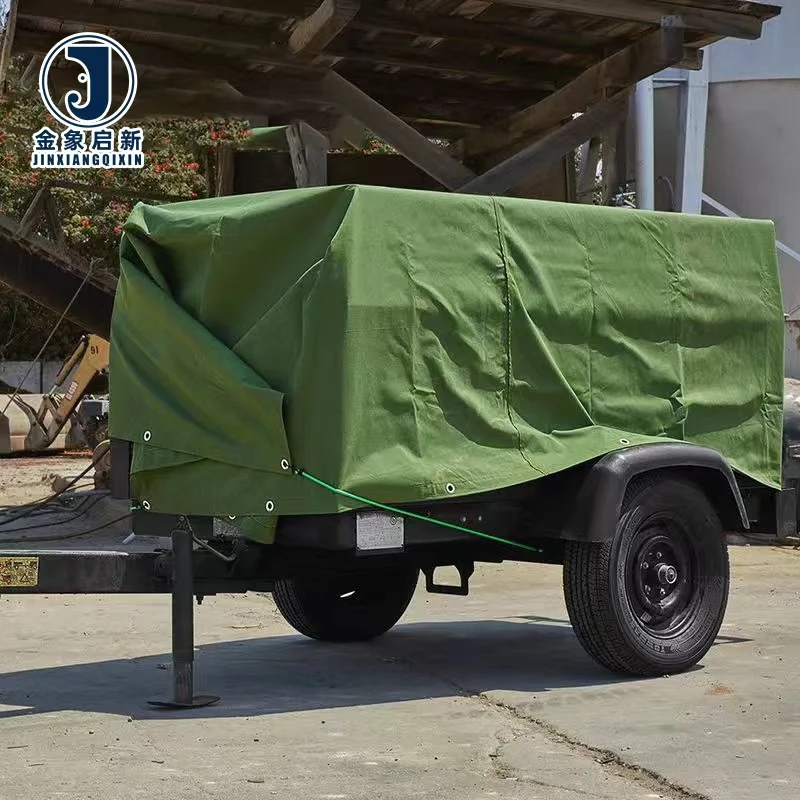
Deep Process Control — Nearly 30 years of coating weight and adhesion management applied to every roll of PVC laminated canvas we ship, ensuring the GSM on your quotation matches the fabric on your dock.
Technical Specifications
| Parameter | Value |
|---|---|
| Product Type | Canvas Tarpaulin |
| Base Fabric | Woven canvas |
| Coating Method | Laminated |
| Coating Material | PVC |
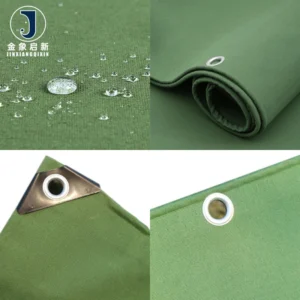
| Waterproof | Yes |
| Heat Resistant | Yes (test basis not stated in source) |
| Tear Resistance | Tear resistant (test basis not stated in source) |
| Breathability | High breathability (test basis not stated in source) |
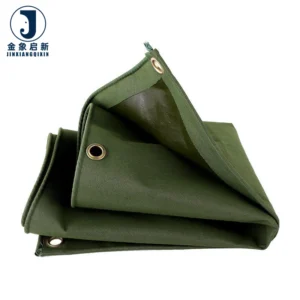
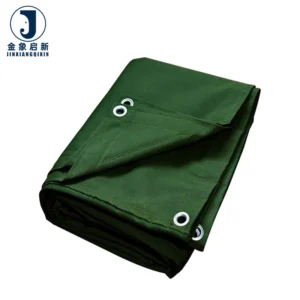
| Edge Finish | Reinforced hems with eyelets on all four sides |
| Assembly State | Finished tarpaulin, ready for tie-down |
Application Suitability
| Application | Exposure & Requirement |
|---|---|
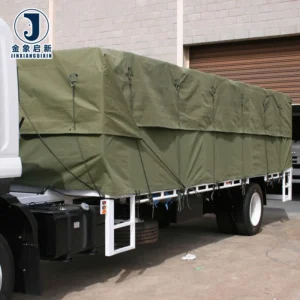
| Truck and trailer load covers | Road vibration, wind uplift, constant flexing at articulation points, rain and debris |
| Engine hood and vehicle covers | Proximity heat, oil mist, repeated removal and refitting, UV exposure |
| Temporary roof and site shelters | Static water pooling, wind shear at fixings, puncture from falling debris |
| Outdoor floor and ground mats | Abrasion from foot and equipment traffic, moisture ingress, chemical spill contact |
| Sun and rain shelters for outdoor activities | Sustained UV exposure, sudden downpours, frequent packing and unpacking |
Why Generic Sizing Costs Transport Fleets More Than the Tarp Itself
A cover that does not match the trailer profile creates slack zones where wind gets underneath and welds peel apart within weeks.
Fleet operators routinely buy off-the-shelf dimensions that leave excess fabric flapping at the rear corners or fall short at the tailgate. That slack fabric vibrates at highway speed, concentrating stress at the eyelets and welded seams until they tear. [NEED_CITE: tarpaulin failure analysis at flex points on articulated trailers] The replacement cycle then costs more in downtime and load damage than a correctly measured cover would have cost in the first place. This heavy duty PVC laminated canvas tarpaulin is cut to your specific trailer model dimensions so every edge sits flush and every tie-down point carries an even load.
Covering a Moving Load Without Seam Failure
Transport operators need a PVC laminated canvas tarpaulin for truck and trailer use that survives the constant articulation of a loaded trailer. When a vehicle corners or brakes hard, the load shifts and the cover flexes with it. Laminated PVC bonding to the woven canvas base delivers dimensional stability so the fabric tracks the load movement without delaminating at the coating interface. Reinforced hems distribute tie-down tension across the full edge rather than concentrating it at individual grommets.
Securing the Cover Against Wind and Road Vibration
Eyelets installed on all four sides give operators multiple anchor points to eliminate the slack zones that cause flapping and fatigue tearing. The spacing and reinforcement of each grommet matters because wind load on a moving trailer is not uniform — the rear corners and leading edge take disproportionate force. [NEED_CITE: wind load distribution on heavy vehicle tarpaulin systems] By specifying eyelet spacing and hem doubling to match the trailer profile, the cover stays seated under crosswinds and braking loads without pulling free from its fixings.
Reading the Specifications That Actually Matter
The woven canvas base fabric provides the structural backbone: its yarn denier and weave density determine how a tear propagates once the surface is punctured. PVC lamination rather than knife-over coating means the coating film is bonded to the substrate under heat and pressure, producing a uniform coating weight and consistent surface across the full sheet. Waterproof performance comes from the continuous PVC film, while the stated high breathability depends on the specific base fabric construction — always confirm the test basis for your ventilation requirement. Heat resistant formulation extends serviceability in engine hood proximity where ambient temperatures exceed normal outdoor ranges, though the test standard supporting this claim should be verified before specifying for high-temperature zones.
What Happens When the Wrong Specification Reaches Your Site
A tarpaulin that arrives lighter in GSM than the quotation stated will stretch further under the same tie-down tension, accelerating fatigue at every welded seam. Colour variation between rolls in a single consignment becomes immediately visible when two panels are installed side by side on the same trailer. [NEED_CITE: batch colour consistency standards for coated fabrics] A cover supplied without the heat or flame test report required by the receiving site will be rejected at inspection regardless of actual performance, turning a full container into dead stock. Welded seams that are set at incorrect temperature or pressure for the coating formulation will peel before the fabric itself reaches end of life, leaving the operator replacing covers on a schedule driven by seam failure rather than fabric wear.
Why Procurement Teams Source This Fabric Here
Deep process control over PVC coating weight and lamination adhesion means the specification on the data sheet matches the material that ships — verified through in-process QA at every production stage. Three full production lines and 36 sets of professional equipment support bulk roll output with reliable on-time dispatch for fleet-scale orders. A 10-person R&D team develops samples within days when custom sizing, colour matching or pattern printing is required for a specific trailer model or corporate livery. Dedicated QA/QC runs 100 percent inspection before shipment, catching seam integrity and eyelet pull-through issues before they reach your dock. [NEED_CITE: pre-shipment inspection protocols for coated fabric consignments] Custom widths, colours and cut-to-size covers are produced on standard lead terms rather than the extended minimums that smaller mills require.
Documentation & Verification
- Material specification sheet stating GSM, base fabric type and PVC coating weight for each roll
- Pre-shipment inspection record confirming eyelet spacing and hem integrity before dispatch
- Test reports for heat resistant and waterproof claims where applicable to your market
- Roll packing list with individual roll weights for receiving verification
- Certificate of origin and customs documentation for cross-border transport shipments
Fabrication, Handling & Storage
- Heat-weld seams at temperatures matched to the PVC laminated coating to avoid delamination at flex points
- Double-fold hems before eyelet insertion to spread tie-down loads across the woven canvas base
- Store rolls horizontally on pallets to prevent permanent creasing in the laminated PVC surface
- Allow cold-stored tarpaulins to reach ambient temperature before unfolding to avoid coating crack
- Clean with mild detergent only — solvent-based cleaners can soften the PVC laminated layer
- Cut panels with sealed edges to prevent moisture wicking into the woven canvas substrate
What We Need to Quote Your Cover Accurately
Provide the exact trailer make, model and body dimensions so the cover is patterned to fit without slack zones. Tell us the operating environment — highway transport, static yard storage or engine hood proximity — so we match the correct heat resistant and reinforcement level. Confirm whether you need finished tarpaulins with eyelets and hems or roll stock for your own fabrication line. Share your annual volume and colour requirements so we can plan batch-consistent production runs.
Frequently Asked Questions
Q: How is GSM verified on arrival against the quotation?
A: Every roll ships with a material specification sheet stating the exact GSM, base fabric and coating weight. Our pre-shipment inspection records document measured values before dispatch. On receipt, you can cut a known-area sample and weigh it to cross-check. If any discrepancy appears, the inspection record gives both parties a baseline for resolution.
Q: Can the tarpaulin be cut and finished to fit specific truck and trailer models?
A: Yes. Provide the trailer make, model and body dimensions and we pattern the cover to match. This eliminates the slack zones that cause flapping and premature weld failure on generic-size tarps. Eyelet placement and hem reinforcement are positioned to suit the tie-down rail configuration on your specific vehicle.
Q: What eyelet spacing and hem reinforcement options are available for tie-down loads?
A: Eyelets are installed on all four sides as standard, with spacing adjustable to your tie-down rail pitch. Hems can be double-folded and reinforced with additional webbing at high-load corners. This distributes wind and braking forces across the woven canvas base rather than concentrating stress at individual grommet points.
Q: How do welded seams perform at high-flex points on a moving trailer?
A: Laminated PVC construction produces a uniform coating film that responds consistently to heat welding. When weld temperature and dwell time are set to the specific coating formulation, the seam strength tracks with the parent fabric. Failures typically occur when generic weld settings are applied without matching the coating type and weight.
Q: What test evidence supports heat resistant and waterproof claims?
A: Heat resistant performance and waterproof integrity are both stated features of this PVC laminated canvas tarpaulin. We recommend requesting the specific test reports applicable to your market and end-use temperature range. Confirming the test basis before specifying ensures the material meets the compliance requirements at your receiving site.