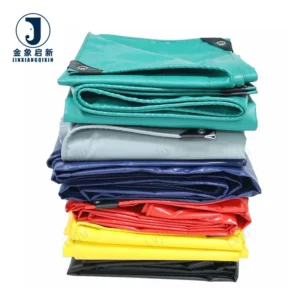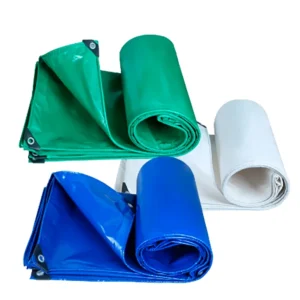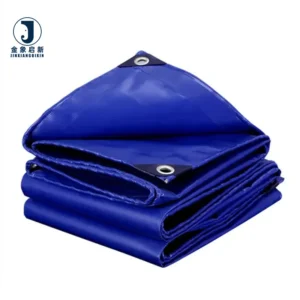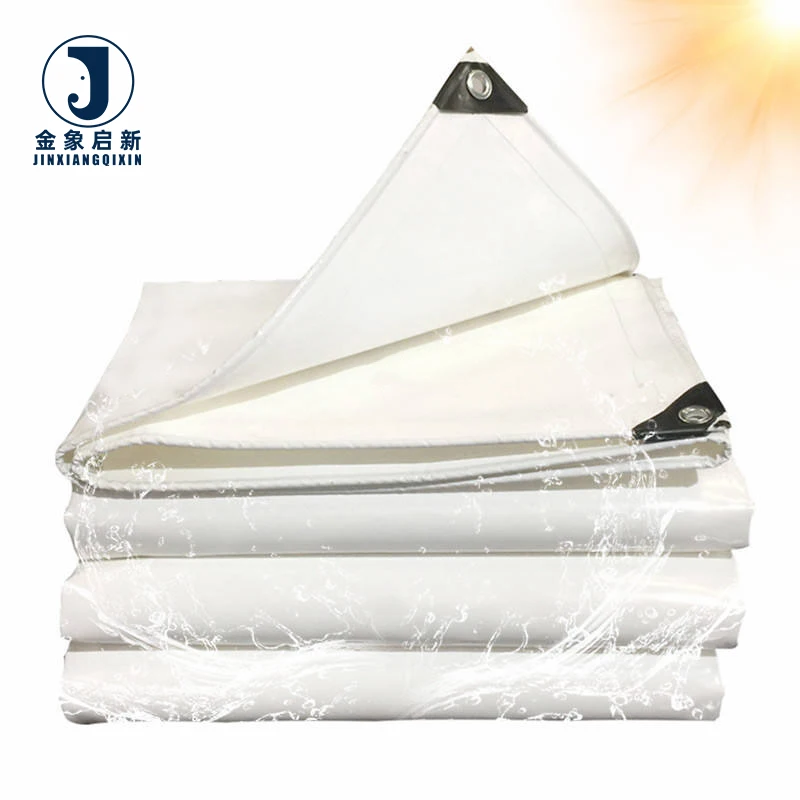
Model-specific truck cover cutting — every PVC coated tarpaulin for truck and transport is cut to the exact trailer dimensions you provide, with reinforced hems positioned at the tie-down points your fleet actually uses.
Technical Specifications
| Parameter | Value |
|---|---|
| Product Type | PVC Coated Tarpaulin |
| Base Fabric | High-strength polyester mesh |
| Coating Method | Laminated technology & Hot-melt coating technology |
| Weight Range | 350 gsm / 420 gsm / 500 gsm / 550 gsm / 600 gsm / 750 gsm |
| Thickness Range | 0.32 mm / 0.35 mm / 0.4 mm / 0.45 mm / 0.5 mm / 0.65 mm |
| Standard Roll Size | 2 m × 75 m / 2.1 m × 50 m |
| Custom Sizes | Available per customer drawing |
| Temperature Range | −70 °C to +100 °C |
| Colour Options | Blue / Red / Yellow / Light blue / Grey (customised) |
| Special Treatments | Flame retardant / Anti-static / Anti-cold / Anti-mildew / UV protection (grade and test basis to be confirmed) |
| Service Life | 3–7 years under normal conditions |
| Certifications | ISO / CE |
Application Suitability
| Application | Exposure & Requirement |
|---|---|
| Long-haul truck and trailer load covers | Constant road vibration, tie-down flex, rain, dust, UV exposure |
| Side curtain fabric for transport equipment | Repeated rolling and folding, edge abrasion against rails |
| Cargo ship deck cargo protection | Salt spray, marine humidity, sustained wet contact |
| Dock yard and airport construction enclosure | Wind load, temporary rigging, equipment weather shielding |
| Transport packaging for oversized freight | Strap pressure points, corner abrasion, multi-leg journey exposure |
Why Generic-Size Covers Fail at the Tie-Down Points
A PVC coated tarpaulin for truck and transport must be cut to the exact trailer model — not a blanket rectangle.
When a cover is sized generically, the excess material bunches at the edges and the eyelet spacing never aligns with the trailer’s anchor rail. The result is uneven load distribution: some eyelets carry all the tension while others sit slack, and the welded seams at the high-stress corners begin to peel within weeks. Fleet operators then face the cost of re-covering an entire trailer because one cover did not match the vehicle profile [NEED_CITE: field failure analysis of transport tarpaulin seam integrity].
Cut-to-Model Fitment Replaces Guesswork
Every PVC coated tarpaulin for truck and transport produced here starts from the trailer model drawing you supply — wheel-arch clearance, headboard height, tailgate drop, and anchor-rail position. The hot-melt coating technology used on the high-strength polyester mesh base creates a bond strong enough to hold welded seams at the flex points where the cover meets the load, rather than tearing open under repeated road vibration.
Reinforcement Placed Where the Load Actually Flexes
Reinforced hems and tie-down eyelets are positioned according to the stress map of your specific trailer, not a default pattern. On a long-haul flatbed, for example, the corner eyelets experience the highest peel force when the load shifts during braking; the hem in that zone is widened and the weld overlap increased so the seam strength matches the base fabric tensile capacity [NEED_CITE: weld seam peel testing methods for coated polyester fabrics].
Reading the Specification Beyond GSM
GSM alone does not predict how a PVC coated tarpaulin for truck and transport will perform on the road. The base fabric denier and weave density determine tensile and tear resistance; the coating method — laminated versus hot-melt — governs adhesion strength and therefore how well the welded seam holds when the cover flexes. A heavier GSM with a weak coating bond will still fail at the seam before the fabric itself wears. Temperature range matters equally: the −70 °C to +100 °C operating window means the cover remains flexible in sub-zero night hauls without cold-cracking, and does not soften or lose dimensional stability in high-ambient-heat routes.
The Hidden Cost of Unverified Seam Strength
When a welded seam fails before the fabric, the entire cover must be replaced — not patched. The failure almost always occurs at the point of maximum load flex: the corner eyelet, the headboard fold, or the tailgate hem. If the seam adhesion was never tested to a recognised standard, the buyer only discovers the weakness after the cover has been in service for a single season, by which time the cargo has already been exposed to rain and dust damage [NEED_CITE: transport tarpaulin warranty claim data on seam versus fabric failure].
Why Fleet Operators Specify Here
The three-line production capacity and 36 sets of dedicated equipment allow bulk roll stock and custom-cut covers to run in parallel, so a fleet order of mixed trailer models does not create a sequencing bottleneck. A 10-person R&D team develops a sample from your trailer drawing within days, confirming fitment before production begins. Every roll and every finished cover undergoes 100 % pre-shipment inspection, with GSM verified against the quoted grade and seam adhesion spot-checked at reinforced zones. Documentation travels with the shipment — not held back until the buyer asks.
Documentation & Verification
- Material specification sheet stating base fabric denier, coating weight and colour reference per roll
- Weight verification per roll against the stated GSM before dispatch
- Pre-shipment inspection record covering seam adhesion at reinforced tie-down zones
- Test report for UV and flame-retardant treatments where applicable, tied to the grade required
- ISO and CE certificates available for audit
- Roll packing list with individual roll dimensions and weight
Fabrication, Handling & Storage
- Hot-melt coating responds well to standard wedge and hot-air welding; confirm temperature settings against the specific GSM grade before full-seam runs
- Reinforced hems at eyelet zones should be inspected for weld overlap consistency before installation on the trailer
- Store rolls upright on a flat, dry surface; avoid stacking more than two high to prevent permanent creasing at the fold line
- In sub-zero conditions, allow the PVC coated tarpaulin for truck and transport to acclimatise before unfolding to reduce cold-crack risk at fold lines
- Clean with mild detergent only; solvent-based agents can degrade the PVC coating surface and affect colour fastness
Getting a Fitment-Specific Quote Started
To move from inquiry to sample, share the trailer model or dimensional drawing, the GSM grade and any special treatment required for your market’s compliance rules, plus the colour and quantity. If your fleet runs mixed trailer types, a model-by-model list helps the R&D team prepare individual samples for fitment approval before bulk production begins.
Frequently Asked Questions
Q: How do I verify the GSM on arrival matches what was quoted?
A: Each roll ships with a pre-shipment inspection record stating the measured GSM. You can independently verify by cutting a 100 mm × 100 mm sample, weighing it and calculating grams per square metre. If the result falls outside the tolerance stated on the specification sheet, the roll is replaced under the quality guarantee.
Q: My previous truck cover failed at the welded seam where the load flexes most — how is your seam strength tested?
A: Welded seams at reinforced tie-down zones are spot-checked for peel adhesion during the 100 % pre-shipment inspection. The hot-melt coating technology used on the polyester mesh base is selected specifically for its bond strength at flex points. If your trailer has a known high-stress zone, share the location so the sample can replicate the reinforcement detail before production.
Q: Can you cut covers to fit specific truck and trailer models rather than generic sizes?
A: Yes. Provide the trailer model name or a dimensional drawing including wheel-arch clearance, headboard height and anchor-rail positions. The R&D team produces a fitment sample within days for your approval. Production cutting then follows the approved drawing, so every cover matches its designated vehicle.
Q: What anti-UV test basis supports the sunproof claim for long-haul outdoor exposure?
A: UV protection is available as a special treatment; the specific test standard and expected exposure hours depend on the grade selected. During inquiry, confirm the market and exposure duration you need, and the team will recommend a grade backed by the corresponding test report.
Q: How do you control colour consistency when I order multiple covers for the same fleet?
A: All covers within one order are produced from the same coating batch, and each roll is checked against the approved colour reference before dispatch. The material specification sheet includes the colour reference code so you can cross-check on arrival. If a future reorder is needed, the same reference code is used to maintain fleet-wide consistency.