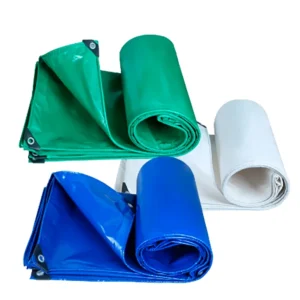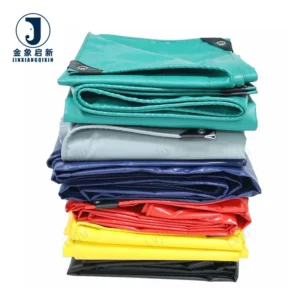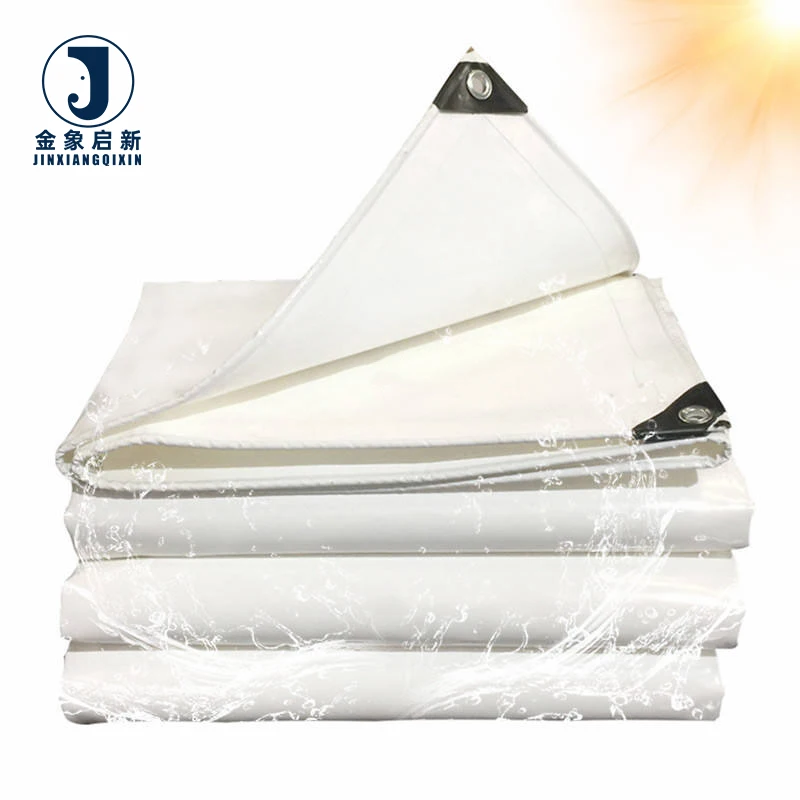
Coating Process Control — Hot-melt knife coating technology applied across three production lines ensures PVC-to-polyester adhesion remains intact where truck covers flex most during transit.
Technical Specifications
| Parameter | Value |
|---|---|
| Product Type | PVC Knife-Coated Fabric |
| Material | PVC + High-strength polyester mesh fabric |
| Coating Method | Laminated technology & Hot-melt Coating technology |
| Weight Options | 350gsm / 420gsm / 500gsm / 550gsm / 600gsm / 750gsm |
| Total Thickness | 0.32mm / 0.35mm / 0.4mm / 0.45mm / 0.5mm / 0.65mm |
| Roll Width | 2m / 2.1m |
| Roll Length | 75m (2m width) / 50m (2.1m width) |
| Color Options | Blue / Red / Yellow / Light blue / Grey (Customized) |
| Temperature Range | -70°C to +100°C |
| Key Features | Cold Crack Resistance, Anti-Mildew, Waterproof, Sunproof, Good electrical insulation |
| Special Treatments Available | Flame retardant, Anti-static, Anti-cold, Anti-mildew, 3P — confirm the grade required for your market |
| Finish | Wax-like feel, odorless, non-toxic |
| Standards | ISO, CE |
Application Suitability
| Application | Exposure & Requirement |
|---|---|
| Flatbed and curtain-side truck trailers | Constant flexing at load points, road debris abrasion, wind-driven rain, prolonged UV exposure |
| Long-distance road freight covers | Tie-down tension stress, temperature swings across climate zones, repeated folding and unfolding |
| Transport equipment OEM side curtains | Dimensional stability under track tension, weld seam durability at articulation points |
| Intermodal and sea-freight cargo protection | Salt-air moisture, container condensation, stacking pressure during transit |
| Dock yard and depot temporary covers | Ground contact abrasion, standing water pooling, forklift handling damage |
Why Generic-Size Covers Fail on Your Specific Trailer Model
Cutting to your fleet’s exact trailer dimensions eliminates the gaps, flaps and premature wear that generic-sized PVC Truck Tarpaulin Covers cause.
Fleet operators ordering off-the-shelf truck covers regularly face a mismatch: the tarp is nominally the right size but leaves slack at corners, drags on the load bed, or stretches too tight across load peaks. Each of these fitment errors concentrates stress at specific points, and the cover begins to fail at seams and hems long before the fabric itself reaches the end of its working life. [NEED_CITE: common failure modes in transport tarpaulin fitment and load coverage]
How Trailer-Specific Fitment Changes Wear Patterns
When a PVC knife-coated truck tarpaulin is cut and welded to match the exact dimensions of your trailer model — including the bow spacing, header rail profile and tie-down positions — the load distributes evenly across the fabric surface. Flex points align with the trailer’s natural articulation rather than fighting against it, which reduces the cyclic stress that drives crack propagation at welded seams.
Weld Integrity Where the Load Flexes
The welded seams on a truck cover carry the highest mechanical demand on the road. Hot-melt knife coating produces strong PVC-to-polyester adhesion, meaning the weld zone retains a high proportion of the base fabric’s tear resistance. For fleet operators running curtain-side trailers, this matters because every load cycle and every bow transition tests the seam before it tests the field of the fabric. [NEED_CITE: tensile and tear test methods for coated fabrics per ISO 1421]
What GSM and Base Fabric Density Mean Together for Truck Covers
Gram weight alone does not determine how a PVC Truck Tarpaulin Cover performs under transport loads. The base fabric denier and weave density set the tensile and tear baseline, while the coating weight adds puncture resistance, waterproofing and the surface that accepts welds. A heavier coating on a loosely woven base may show high GSM but deliver poor peel strength at welded seams, whereas a tightly woven polyester mesh with controlled hot-melt coating gives balanced performance across tensile load, tear propagation and weld integrity. The available weight options from 350gsm to 750gsm correspond to different combinations of base fabric and coating, so specifying by application demand — curtain-side flex, flatbed tie-down tension, or intermodal stacking — produces better results than selecting on GSM alone. [NEED_CITE: relationship between base fabric weave density and coated fabric tensile performance]
The Hidden Cost of Wrong Specification Selection
Choosing a truck cover fabric without verifying GSM against actual delivered weight leads to covers that degrade faster than expected under road conditions. A batch where colour varies between rolls becomes visible the moment two panels hang side by side on the same trailer, forcing a full replacement rather than a panel repair. Covers specified without the fire-retardant or anti-static grade required at the destination site get rejected at inspection, delaying the load and incurring demurrage. Welded seams that fail before the fabric does — often because the coating method does not support strong thermal bonding — leave operators replacing entire covers when a seam repair would have sufficed on correctly specified material. [NEED_CITE: coated fabric specification errors and their downstream cost impact in transport logistics]
Why Procurement Teams Source This Fabric Here
Deep process control over hot-melt knife coating means adhesion strength and coating weight stay consistent from roll to roll, which matters when you are outfitting an entire fleet and need every cover to behave identically under the same route conditions.
Three full production lines and 36 sets of professional equipment support the volume and lead-time requirements of fleet-scale orders, so you are not waiting for capacity to free up between production runs.
A 10-person R&D team develops samples within days when your fleet specification calls for custom width, colour or printed branding, letting you validate fitment on a physical sample before committing to a full production run.
Dedicated QA/QC at every production stage with 100% pre-shipment inspection catches GSM deviation, colour drift and weld weakness before the rolls leave the facility.
Nearly 30 years of focus on coated fabric gives the production team accumulated process knowledge that shows up in fewer field failures and more predictable cover lifespan across your fleet.
Documentation & Verification
- Material specification sheet stating GSM, base fabric and coating weight per roll
- Pre-shipment inspection record confirming weight, colour and weld integrity before dispatch
- Test report for flame retardant or anti-static grades where specified for your market
- Colour reference documentation matching the approved sample across the production run
- Roll packing list with roll count, dimensions and weight for customs and logistics
Fabrication, Handling & Storage
- Hot-melt coated surfaces accept high-frequency and hot-air welding — confirm weld temperature settings against the coating method before production
- Reinforced hems and eyelet positions must align with the fabric’s warp direction to distribute tie-down loads across the mesh
- Store rolls horizontally on padded supports to prevent permanent creasing across the 2m or 2.1m width
- Unfold and allow the PVC knife-coated fabric to acclimatize before fabrication when ambient temperature is near the lower service limit
- Use mild detergent for cleaning — solvent-based products may degrade the wax-like surface finish over time
- Plan cutting layout to maximize yield from the 75m or 50m roll length and minimize welded joints on visible panels
What to Include in Your Inquiry
To get an accurate specification recommendation, share the trailer models in your fleet, the type of load you carry and the climate zones your trucks operate through. Specify whether you need roll stock for your own fabrication or finished covers cut to vehicle dimensions with hemming and eyelets. If your destination market requires fire-retardant or anti-static compliance, state the applicable standard so the correct treatment grade can be confirmed before sampling.
Frequently Asked Questions
Q: How do we verify GSM weight on arrival against the quotation?
A: Every roll ships with a pre-shipment inspection record documenting actual GSM measured during production. You can cross-check this against the material specification sheet included in the documentation package, which states the target GSM, base fabric denier and coating weight for your order.
Q: Can you cut covers to our specific trailer model dimensions?
A: Yes. We cut and weld PVC knife-coated truck tarpaulin covers to the exact dimensions of your trailer model, including bow spacing and header rail profile. Provide the trailer make, model and year, and we develop a sample for fitment validation before full production.
Q: What test evidence ships with flame-retardant or anti-static material?
A: When flame-retardant or anti-static treatment is specified for your order, the applicable test report is included in the shipping documentation. Confirm the grade and standard required for your market at the inquiry stage so the correct treatment is applied and documented.
Q: How do you maintain colour consistency across multiple rolls for one fleet order?
A: Colour matching is controlled through a reference sample approved before production begins. The QA process monitors colour at each coating stage, and the pre-shipment inspection compares every roll in the batch against the approved reference to flag any drift before dispatch.