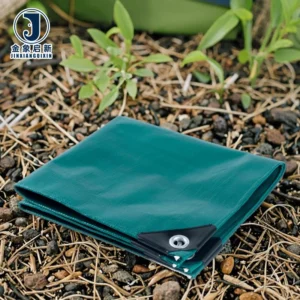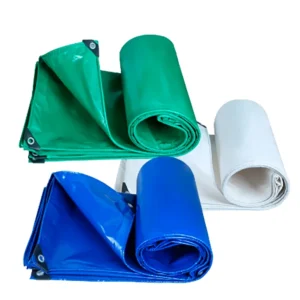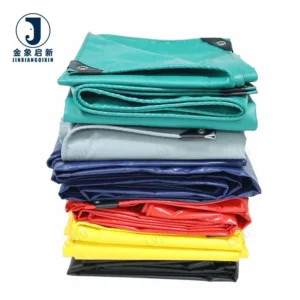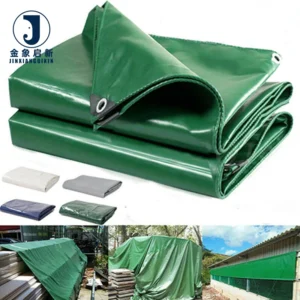
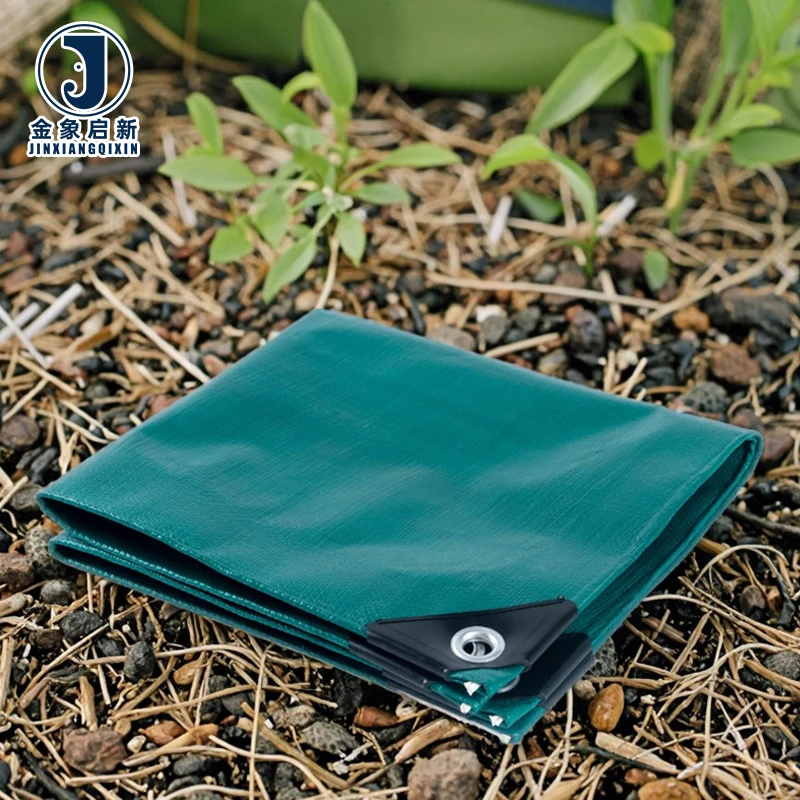
Precision Cut-to-Model — Every truck cover pattern is developed against the specific trailer chassis dimensions, with eyelet and tie-down placement matched to the load securement points on the vehicle.
Technical Specifications
| Parameter | Value |
|---|---|
| Product Type | Heavy Duty PVC Truck Tarpaulin Cover |
| Material Composition | PVC coating on high-strength polyester mesh fabric |
| Coating Technology | Laminated technology & Hot-melt coating technology |
| Weight Options | 350gsm / 420gsm / 500gsm / 550gsm / 600gsm / 750gsm |
| Total Thickness | 0.32mm / 0.35mm / 0.4mm / 0.45mm / 0.5mm / 0.65mm |
| Roll Width | 2m / 2.1m |
| Roll Length | 75m (2m width) / 50m (2.1m width) |
| Colour Range | Blue / Red / Yellow / Light blue / Grey (Customized) |
| Key Features | Cold crack resistance, Anti-mildew, Waterproof, High tearing strength for welding, Good colour fastness |
| Special Treatments | Flame retardant (grade not stated — confirm requirement), Anti-static (test basis not stated), Anti-cold, 3P |
| Standards | ISO, CE |
Application Suitability
| Application | Exposure & Requirement |
|---|---|
| Side curtain for tautliner trailers | Continuous flexing at load points, road debris impact, wind flap fatigue, UV from daily highway exposure |
| Flatbed and tipper truck covers | Heavy tie-down strap loads at eyelets, abrasion from load shifting, rain and spray ingress at highway speed |
| Oversize and heavy machinery transport | Puncture risk from sharp load edges, high tensile stress at reinforced hems, crane loading contact wear |
| Refrigerated route tarpaulins | Sustained sub-zero temperatures demanding cold crack resistance, condensation and ice buildup at seams |
Why Generic-Size Covers Fail Where Your Load Flexes Most
A cover cut to a standard rectangle will never match a purpose-built trailer profile.
When a PVC tarpaulin is cut to a generic footprint, the excess fabric either bunches at the corners or drags along the deck edge. On a long-haul route, that loose material flaps at speed, creating cyclic stress that tears the welded seam long before the fabric itself reaches its limit [NEED_CITE: tensile and tear test methods for coated fabrics per ISO 1421]. Fleet operators replacing covers repeatedly often trace the failure back to a sizing mismatch rather than a material defect. A Heavy Duty PVC Truck Tarpaulin Cover cut to the exact trailer model eliminates this failure mode by aligning every seam, eyelet and hem with the structural geometry of the vehicle.
Fitment That Follows the Chassis, Not a Template
Every trailer model carries a different rail height, corner radius and tie-down arrangement. A Heavy Duty PVC Truck Tarpaulin Cover specified against the vehicle’s actual deck length, side rail profile and strap anchor positions removes the gap between fabric and load that causes wind-driven rain ingress. The cut pattern is developed from the trailer drawing or on-site measurement, so the cover sits taut when strapped down without pulling the eyelets out of alignment.
Welded Seams at the Points Where the Trailer Bends
A loaded trailer flexes under braking, cornering and uneven road surfaces. That flex concentrates stress at the junction between the side curtain and the buckle rail, and at the rear corners where the cover wraps around the frame. Hot-melt coated PVC fabric delivers the adhesion strength needed for high-frequency welded seams in these zones. Stitched seams, by contrast, introduce needle holes that become tear initiation points under the same cyclic load [NEED_CITE: welded versus stitched seam performance in coated fabric assemblies].
Matching GSM to the Duty Cycle of Your Route
The weight of the PVC coating, stated in grams per square metre, works together with the base polyester mesh density to determine how the fabric handles abrasion and puncture. A 350gsm grade may serve a light-duty urban delivery vehicle where the cover is deployed and stowed frequently, while a 600gsm or 750gsm grade suits a long-haul flatbed exposed to sustained highway wind load and heavy tie-down strap tension. Selecting the correct GSM prevents both over-specification on short-life vehicles and premature wear on high-mileage fleet assets.
When the Wrong Specification Costs More Than the Fabric
Ordering a truck cover without verifying the anti-UV treatment against a test report often surfaces as colour fade and loss of tensile strength after one season of sun exposure on a parked trailer. Similarly, specifying a flame retardant treatment without confirming the grade required by the destination market can result in a load rejected at a tunnel checkpoint or a construction site gate [NEED_CITE: flame retardant classification systems for transport and construction covers]. Batch colour variation across covers in the same fleet order becomes visible the moment two trucks park side by side at a depot, undermining the operator’s brand presentation. These specification gaps cost far more in replacement and downtime than the verification step required to prevent them.
What Production Control Looks Like for Fleet Orders
Three full production lines and 36 sets of professional equipment support consistent output across multi-cover fleet orders, so every truck tarpaulin in the batch carries the same coating weight and colour depth. A dedicated QA/QC process inspects each cover before dispatch, checking weld seam integrity at high-flex zones and confirming GSM on the actual roll used. The R&D team develops cut patterns and sample panels within days when a new trailer model enters the fleet. Hot-melt and laminated coating processes are matched to the specified GSM, ensuring the peel strength at the weld line meets the stress profile of the application. ISO and CE certification underpins the documentation package that accompanies every shipment.
Documentation & Verification
- GSM verification record confirming coating weight on the roll actually dispatched
- Cut-to-model specification sheet listing exact dimensions against the target trailer drawing
- Pre-shipment inspection log covering weld seam checks at high-stress flex zones
- Test report for UV and flame retardant grades where specified for the operating region
- Roll packing list and certificate of origin for customs clearance
Fabrication, Handling & Storage
- Set hot-melt welding temperature to match the coating technology of the specified GSM grade
- Reinforce eyelet zones with extra PVC patches where tie-down strap loads concentrate
- Store rolls upright on end-caps to prevent flat-spot creasing across the 2m or 2.1m width
- Allow cold-stored rolls to reach ambient temperature before unrolling to avoid coating crack
- Use mild detergent only — solvent cleaners degrade the surface coating and colour fastness
- Plan cut patterns to minimise off-cuts when working from 75m or 50m roll lengths
What to Include in Your Enquiry
Provide the trailer make, model, deck dimensions and side rail profile so the cut pattern can be developed against the actual vehicle geometry. Specify the route climate — including any sustained sub-zero or high-UV operating conditions — to guide GSM and treatment selection. Indicate whether you need finished covers with welded hems and eyelets or roll stock for your own fabrication facility.
Frequently Asked Questions
Q: How do I specify the right truck tarpaulin size for my trailer model?
A: Provide the trailer make, model, deck length, side rail height and corner radius. We develop the cut pattern from these dimensions rather than a generic template, ensuring the cover fits taut without excess fabric at the edges. For side curtains, we also need the buckle rail position and curtain track profile to align the welded seams with the flex points.
Q: Can you match the colour of my existing fleet tarpaulins?
A: Yes. Supply a physical sample or a RAL colour reference from an existing cover. We develop a colour match sample for approval before production begins. Batch consistency is verified during pre-shipment inspection, so all covers in a fleet order present uniform colour when installed side by side.
Q: What is the difference between laminated and hot-melt coated PVC for truck covers?
A: Laminated coating bonds a pre-formed PVC film to the polyester mesh, producing a smooth surface suited to printed branding. Hot-melt coating applies liquid PVC directly into the mesh weave, creating higher peel strength at the weld line. We recommend hot-melt coating for side curtains and high-flex applications where welded seam integrity is critical.
Q: Do you supply flame retardant or anti-static grades with test certificates?
A: Flame retardant and anti-static treatments are available in multiple grades. Specify the standard required by your market or operating site, such as the classification needed for tunnel transit or construction site access. We provide the matching test report with the shipment documentation so compliance can be verified on arrival.
Q: How long does production take for a custom-sized truck tarpaulin order?
A: Lead time depends on order volume, colour specification and whether finished covers or roll stock is required. Custom colours and cut-to-model covers require a sample approval step before bulk production. Contact us with your trailer specifications and quantity for a confirmed schedule aligned to your fleet replacement timeline.