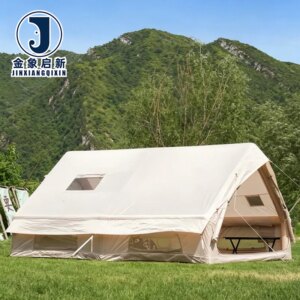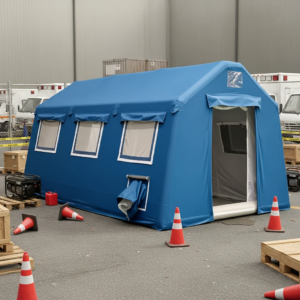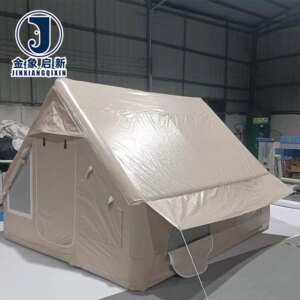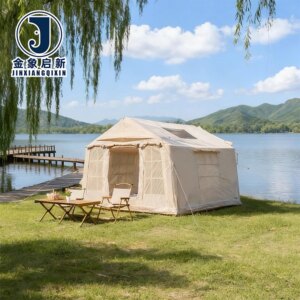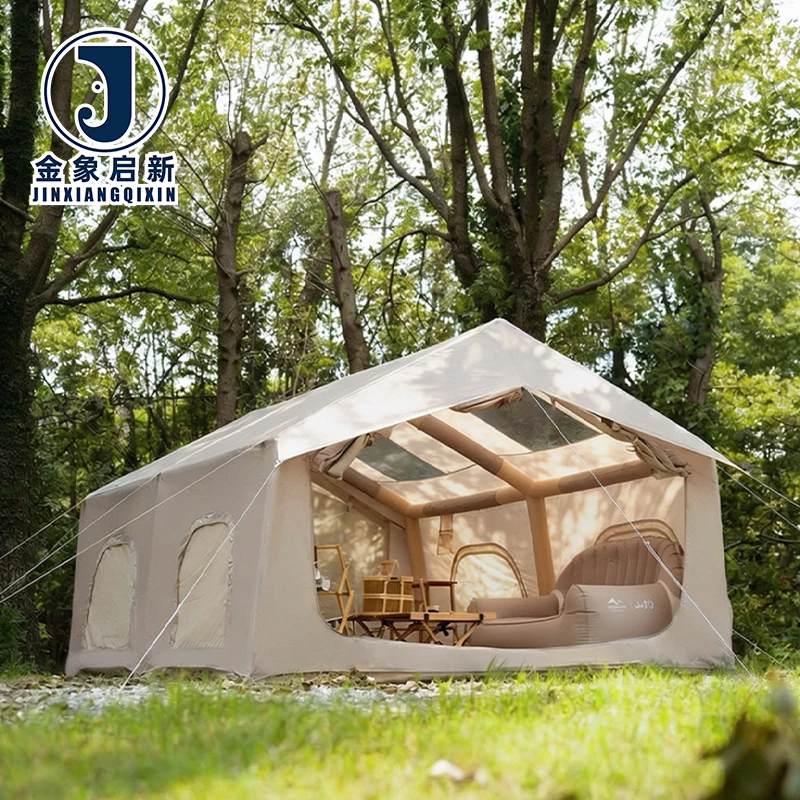
Rapid Deployment Expertise — 3 full production lines and 36 sets of processing equipment ensure time-critical inflatable tent orders ship on schedule for logistics and emergency response operations.
Technical Specifications
| Parameter | Value |
|---|---|
| Product Type | PVC Tent |
| Core Material | PVC Tarpaulin |
| Capacity | 2–8 Person |
| Season Rating | 4-Season |
| Opening System | Quick Automatic Opening |
| Construction | Single Layer |
| Configuration | Extended Type |
| Waterproof | Yes (grade not stated in source) |
| UV-resistant | Yes (test basis not stated in source) |
| Tear-resistant | Yes (test basis not stated in source) |
| Fire-retardant | Yes (grade not stated in source) |
| Anti-static | Yes (surface resistance or standard not stated in source) |
| Customization | OEM & ODM — sample customization, pattern printing available |
| Certifications | ISO 9001, ISO 14001, ISO 45001, CE |
Application Suitability
| Application | Exposure & Requirement |
|---|---|
| Disaster relief field shelters | Rapid deployment under time pressure, exposure to rain, wind and variable terrain — demands quick automatic opening and 4-season weather protection |
| Temporary site shelters at logistics yards | Constant UV exposure, forklift proximity, dust and debris — requires tear-resistant and anti-static PVC tarpaulin with fire-retardant compliance |
| Mobile command posts for transport depots | Extended occupancy by fleet coordinators, repeated inflation and deflation cycles, vehicle exhaust exposure — needs durable single-layer construction with sealed seams |
| Equipment storage enclosures for fleet operators | Standing water contact, abrasion from loading operations, long-term sun exposure — calls for waterproof and UV-resistant fabric with reinforced anchoring points |
Why Off-the-Shelf Tents Fail Transport and Relief Operations
Generic inflatable tents rarely align with the exact footprint, anchoring, and reinforcement requirements of a specific fleet staging area or disaster relief zone — just as a truck cover cut to a generic size does not fit a particular trailer model.
An Inflatable Tent for truck and transport operations must match the deployment footprint precisely, withstand repeated inflation cycles without seam fatigue, and carry the fire-retardant or anti-static documentation your site demands. Off-the-shelf units force compromises on size, reinforcement placement, and compliance paperwork — compromises that surface as failed inspections or premature fabric breakdown in the field [NEED_CITE: site compliance requirements for temporary structures in transport and logistics zones]. When the tent does not match the operational scenario, operators spend more time adapting the shelter than using it.
Anchoring and Reinforcement for Fleet Staging Environments
Transport depots and logistics yards present ground conditions that generic tent anchoring systems cannot handle. Concrete aprons, compacted gravel, and steel-reinforced flooring each demand different tie-down strategies. An Inflatable Tent custom manufacturer addresses this by configuring anchoring points to match the specific surface and wind-load profile of the deployment site. Extended-type configuration provides the footprint coverage needed for vehicle maintenance bays or temporary dispatch offices without requiring multiple units joined together.
Rapid Inflation Under Operational Time Pressure
Disaster relief and emergency logistics scenarios leave no margin for complex assembly sequences. The quick automatic opening system on this PVC tent enables deployment by minimal personnel without specialized tools or training. Single-layer construction reduces packed weight and volume, a practical advantage when transport capacity is already constrained by relief supplies or fleet equipment [NEED_CITE: deployment time benchmarks for emergency inflatable shelters]. The 4-season rating means the same tent unit serves across climate zones without requiring seasonal inventory swaps.
Material Behavior Across Temperature and Inflation Cycles
PVC tarpaulin as a core material provides the structural rigidity needed for inflatable beam construction while remaining flexible enough for repeated packing and deployment. The coating formulation must balance low-temperature pliability — preventing brittle cracking when the tent is inflated in cold conditions — against high-temperature stability so the fabric does not soften and sag under direct sun. Available in fire-retardant grades and anti-static grades — confirm the specific grade required for your market and site compliance before order placement. Tear resistance depends on both the base fabric denier and the coating adhesion strength working together, not on coating thickness alone [NEED_CITE: tensile and tear test methods for coated fabrics per ISO 1421]. Waterproof and UV-resistant treatments are applied during the coating process; request test documentation to verify performance claims against your procurement specification.
The Cost of Underspecifying Tent Fabric for Field Use
Selecting an inflatable tent without verifying the fire-retardant grade against local site regulations leads to failed safety inspections and project delays. Fabric that lacks adequate UV treatment degrades visibly within the first season of continuous outdoor exposure, forcing replacement while the structure is still needed [NEED_CITE: UV degradation patterns in PVC-coated fabrics under continuous outdoor exposure]. Anti-static properties matter in environments where fuel handling or sensitive electronics are present — a tent that accumulates static charge becomes a liability, not a shelter. Color inconsistency across multiple units in a single order creates a disjointed appearance at organized relief camps or branded fleet depots, signaling poor procurement control to auditors and stakeholders.
What This Production Setup Delivers for Your Order
Three full production lines running 36 sets of professional processing equipment mean your inflatable tent order moves through cutting, welding, and finishing without waiting for machine availability. A 10-technician R&D team handles OEM and ODM customization — sizing the tent to your exact deployment footprint, integrating pattern printing for fleet branding, and developing samples within days for your approval before mass production runs begin. Dedicated QA and QC staff inspect at every stage rather than sampling at the end, catching seam alignment and coating consistency issues before they compound across a batch. The 9,180 square meter facility supports container-load quantities without subcontracting critical welding or coating steps to outside workshops. ISO 9001, ISO 14001, ISO 45001, and CE certifications underpin the quality management system governing every production decision.
Documentation & Verification
- Material specification sheet stating base fabric, coating type, and color reference matched to your purchase order
- Test reports for fire-retardant, UV-resistant, and anti-static properties supplied where applicable to your compliance requirements
- Pre-shipment inspection record with dedicated QA and QC sign-off covering seam integrity and inflation performance
- ISO 9001, ISO 14001, ISO 45001, and CE certificates included with dispatch documentation
- Certificate of origin and customs support documents prepared for cross-border shipment
Fabrication, Handling & Storage
- Heat-weld all seams using temperature and dwell settings matched to the PVC tarpaulin coating weight to prevent weld-line failure under inflation pressure
- Store packed tents flat or on wide-diameter rolls to avoid permanent crease marks in the single-layer PVC construction
- Allow the fabric to reach ambient temperature before inflation in cold conditions to prevent coating stiffness and stress cracking at fold lines
- Use mild detergent and soft cloth for cleaning — abrasive scrubbing damages the surface treatment that provides UV and waterproof protection
- Inspect anchoring points and tie-down reinforcements before each deployment cycle, repairing any coating delamination immediately
What to Include in Your Inquiry
Specify the deployment surface type, expected wind-load conditions, and any fire-retardant or anti-static grade required by your site safety regulations. Indicate the tent capacity needed per unit and whether multiple units must match in color for visual consistency across a fleet depot or relief camp. Confirm whether pattern printing or branding is required, and whether you need finished units or roll-stock fabric for your own fabrication line.
Frequently Asked Questions
Q: How is the tent size and reinforcement tailored to a specific truck or trailer footprint?
A: We size the inflatable tent to match the exact staging area or vehicle bay dimensions you provide, placing anchoring and reinforcement points based on your ground surface and wind-load conditions. Samples are produced for fitment verification before the full production run proceeds.
Q: What fire-retardant and anti-static certifications can be supplied for site compliance?
A: Fire-retardant and anti-static grades are available on request. We supply test reports documenting the specific grade achieved, which you can submit to your site safety officer or regulatory authority. Confirm the standard your market requires before order placement.
Q: How do you control color consistency across multiple tent units in one order?
A: All units in a single production batch use coating material from the same preparation run, with dedicated QA and QC staff checking color alignment at each stage. Pre-shipment inspection records document batch consistency before dispatch.
Q: What is the sample development and lead-time process for custom-sized inflatable tents?
A: Our 10-technician R&D team develops samples within days based on your size, capacity, and treatment requirements. Once you approve the sample, production scheduling begins on one of three full production lines with typical multi-week lead times depending on order volume.
Q: What documentation accompanies each shipment for quality assurance?
A: Each dispatch includes a material specification sheet, pre-shipment inspection record, relevant test reports, ISO and CE certificates, certificate of origin, and a detailed packing list. This documentation package supports your receiving inspection and site compliance filings.