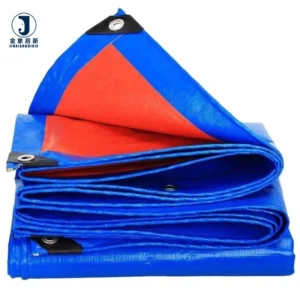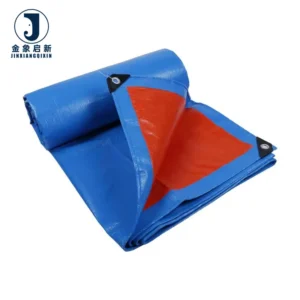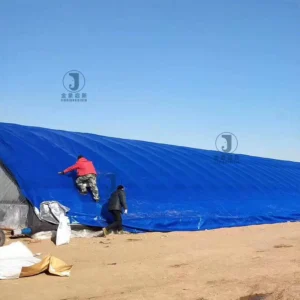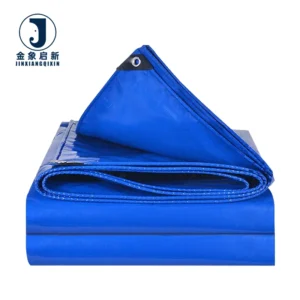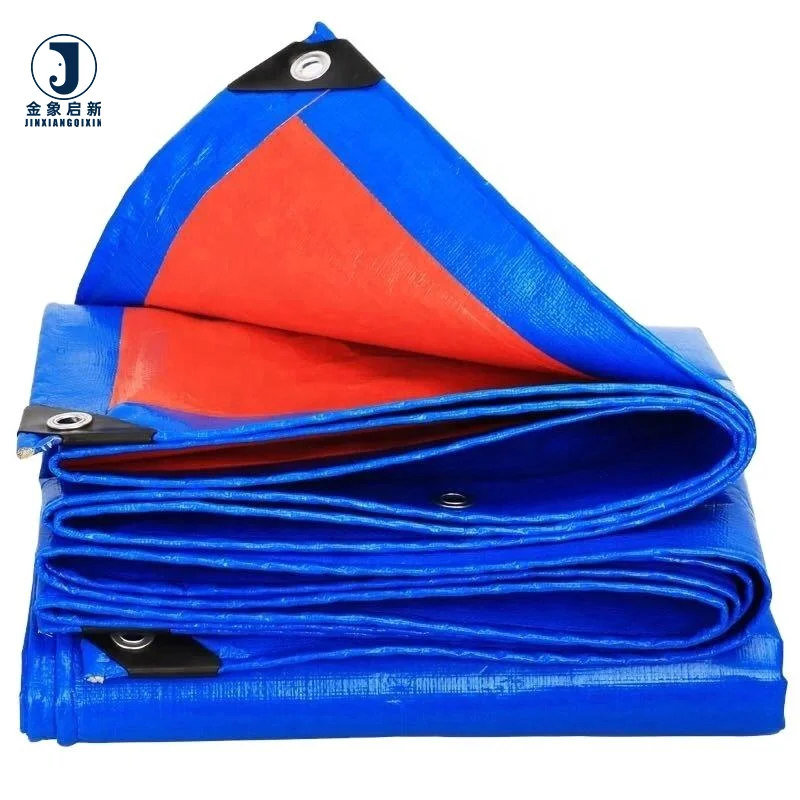
Batch Consistency Assured — Every roll of PE Tarpaulin undergoes 100% pre-shipment inspection to verify GSM, colour match, and reinforcement integrity before dispatch, addressing the transport sector’s demand for reliable, uniform coverage material.
Technical Specifications
| Parameter | Value |
|---|---|
| Product Type | PE Tarpaulin Roll / Finished PE Tarpaulin |
| Coating Material | HDPE weaving with LDPE lamination on both sides |
| Weight (GSM) | 50gr/m2 ~ 220gr/m2 available (range covers product family — confirm the grade for this item) |
| Total Thickness | 0.2-0.4mm / 8 mil-16 mil / Custom |
| Roll Width | 6ft, 8ft, 10ft, 12ft or 2m, 4m, 6m |
| Roll Length | 100 yards, 100 meters, or as per buyer’s wish |
| Color | Blue, Blue/Orange, Green, Grey, Black, Clear, Grey/Green, Orange, or any other color |
| Waterproof | Yes |
| UV Treatment | Available (test basis not stated) |
| Anti-Mildew | Mildew proof stated |
| Anti-Aging | Anti-oxidants added, anti-aging stated |
| Corrosion Resistance | Acid and alkali resistance stated |
| Edge Reinforcement | All four edges reinforced with PP rope in hem |
| Eyelets | Galvanized eyelets every 3ft or 1 meter interval |
| Corner Reinforcement | Reinforced plastic corners |
| Finished Tarpaulin Regular Sizes | 2x2m, 3x3m, 3x5m, 4x4m, 4x5m, 4x6m, 4x8m, 4x10m, 5x5m, 5x6m, 5x8m, 5x10m, 6x6m, 6x8m, 6x10m, 8x10m (and corresponding ft sizes) |
| Printing Option | Custom brand printing available |
| Standards | ISO and CE certified |
Application Suitability
| Application | Exposure & Requirement |
|---|---|
| Truck and trailer load cover | Constant flexing at load points, road abrasion, tie-down tension, rain and debris impact |
| Side curtain fabric for transport | Repeated rolling and folding, UV exposure, aerodynamic stress at highway speed |
| Flatbed cover for logistics | Palletised cargo protection, yard storage weather exposure, forklift contact abrasion |
| Construction site material cover | Wind uplift, UV degradation, puncture from stacked building materials |
| Scaffolding enclosure | Wind load, scaffolding tube abrasion, prolonged outdoor weather exposure |
| Agricultural stock cover | Moisture ingress, UV breakdown, mildew in humid storage conditions |
Why PE Tarpaulin Fails at the Flex Point Before the Fabric Itself Does
Reinforced hems and closely spaced eyelets distribute tie-down tension across the entire edge, preventing stress concentration at the flex point.
Sourcing PE tarpaulin for transport coverage often reveals a pattern: the fabric body remains intact while welded seams or unreinforced edges split under load movement. This failure mode is especially common on flatbed and curtain-side trailers where the load flexes during transit. Generic sizing compounds the problem — a cover cut to a standard dimension rarely fits a specific trailer model, leaving excess material to flap or insufficient material to anchor securely. The consequence is premature replacement, cargo exposure, and driver downtime. [NEED_CITE: weld and seam failure modes in transport tarpaulin applications]
Tie-Down Compatibility for Moving Loads
The PE Tarpaulin for Truck and Transport range addresses tie-down tension with PP rope reinforcement sewn into all four hems. Galvanized eyelets set at 3ft or 1 meter intervals provide multiple anchor points, allowing fleet operators to match tie-down spacing to their specific trailer configuration. Reinforced plastic corners prevent tearing at the highest-stress junctions where tension concentrates during cornering and braking.
Load Protection Against Road and Weather Exposure
HDPE weaving with LDPE lamination on both sides delivers a fully waterproof barrier against rain, road spray, and debris impact during transit. Acid and alkali resistance extends the material’s suitability to loads that may off-gas or leak during transport. Anti-oxidants added during production provide anti-aging protection, while mildew-proof treatment prevents degradation during prolonged yard storage between trips.
How HDPE Weave Density and LDPE Lamination Work Together
The base HDPE weave provides the structural skeleton — its denier and weave density determine tensile and tear resistance independently of the lamination weight. LDPE lamination on both sides seals the weave, delivering waterproof integrity and surface durability. The GSM value reflects the combined weight of base fabric plus lamination; a higher GSM does not automatically mean a stronger base weave, as lamination thickness can inflate the number without improving tear resistance. Buyers specifying for transport applications should request the material specification sheet to understand the base fabric contribution versus the lamination contribution to total GSM. [NEED_CITE: relationship between HDPE weave density and tensile strength in PE tarpaulin]
The Hidden Cost of Colour Drift Across Rolls
When ordering multiple rolls for side-by-side installation on fleet vehicles or large scaffolding enclosures, colour variation between rolls becomes immediately visible once installed. This aesthetic inconsistency can trigger rejection by end clients or fleet branding compliance audits. The root cause is often insufficient pigment control during masterbatch compounding or inconsistent lamination temperature affecting final colour appearance. Batch colour consistency must be verified at the pre-shipment inspection stage against a confirmed colour reference, not assumed from the product label. [NEED_CITE: colour matching standards for coated fabric in fleet branding]
Why Procurement Teams Specify This Material
Three full production lines and 36 sets of professional equipment support bulk roll output with reliable on-time delivery for scheduled fleet maintenance cycles. A dedicated 10-person R&D team handles custom sizing for specific truck and trailer models, eliminating the generic-size mismatch problem. Every roll undergoes 100% pre-shipment inspection, verifying GSM, eyelet spacing, hem reinforcement, and corner patches before packing. The QA/QC process operates at every production stage, from base fabric weaving through lamination to finished roll packing. Samples are developed within days for custom colour or print requirements, allowing fleet operators to approve material before committing to full production.
Documentation & Verification
- Material specification sheet stating exact GSM, base fabric weave, and lamination weight for the ordered grade
- Pre-shipment inspection record confirming eyelet spacing, PP rope hem reinforcement, and corner patch integrity
- UV and anti-aging treatment test report where applicable to validate outdoor service life claims
- Colour reference document and batch consistency confirmation for multi-roll orders
- Roll packing list with individual roll dimensions, net weight, and colour code per roll
- Certificate of origin and customs documentation for cross-border shipment
Fabrication, Handling & Storage
- Heat-seal parameters must match LDPE lamination melting point to avoid delamination at seams
- Eyelet setting should align with galvanized eyelet pre-punched intervals to avoid damaging the HDPE weave
- Store rolls horizontally on pallets to prevent permanent creasing in the LDPE lamination layer
- Avoid dragging finished covers over abrasive surfaces that can scratch the lamination and expose the weave
- Clean with mild detergent only; solvents may degrade the LDPE surface and compromise waterproof integrity
- Allow cold-stored rolls to reach ambient temperature before unrolling to prevent lamination cracking
Requesting the Right Specification for Your Fleet
To ensure the PE Tarpaulin for Truck and Transport matches your operation, provide the specific truck or trailer model dimensions, the expected load profile and tie-down configuration, and the typical weather and road exposure conditions your fleet encounters. Specify whether you require roll stock for in-house fabrication or finished cut sizes with hem and eyelet reinforcement already applied. Confirm your target market’s compliance requirements for UV treatment or flame-retardant grades, and indicate your annual volume to determine batch consistency planning.
Frequently Asked Questions
Q: How do I verify GSM matches the quotation when rolls arrive?
A: Request the material specification sheet before shipment stating the exact GSM for your ordered grade. Upon arrival, conduct a sample cut-and-weigh test from a random roll. If the measured GSM deviates from the specification, the pre-shipment inspection record provides a baseline for comparison. Discrepancies should be reported with photographic evidence and sample weight data for resolution.
Q: What test basis supports the UV treatment claim?
A: UV treatment is available as an option, but the specific test standard and exposure duration should be confirmed before ordering. Request the test report documenting the UV stabiliser type and validated exposure hours. For fleet applications involving prolonged outdoor parking and highway sun exposure, specifying the required UV performance level ensures the treatment matches your operational conditions.
Q: Can eyelet spacing be adjusted for my trailer tie-down configuration?
A: Standard eyelet spacing is set at 3ft or 1 meter intervals with galvanized hardware. For trailers with non-standard tie-down rail spacing, custom eyelet intervals can be specified during the order process. Provide your tie-down configuration drawing, and the production team will adjust eyelet placement to match. Sample approval is recommended before full production.
Q: How is batch colour consistency maintained across multiple rolls?
A: Colour consistency is controlled through pigment masterbatch dosing and lamination temperature monitoring during production. A colour reference is established at sample approval stage, and each roll is checked against this reference during pre-shipment inspection. For orders spanning multiple production batches, request a batch colour consistency report confirming all rolls fall within the agreed tolerance before dispatch.
Q: What is the process for custom-sized truck covers?
A: Provide the exact truck or trailer model dimensions, including any protrusions or irregular shapes. The R&D team develops a cutting pattern and produces a sample for fitment approval. Once approved, production proceeds with PP rope hem reinforcement and galvanized eyelets at your specified intervals. Minimum order quantities and lead times for custom sizing are confirmed during the quotation stage.