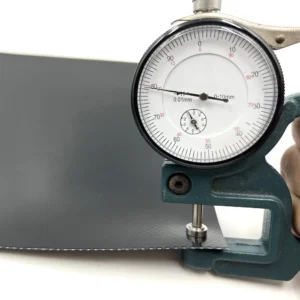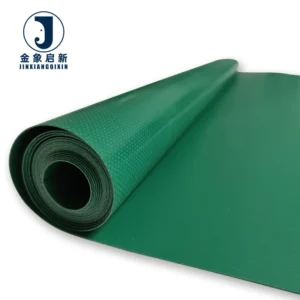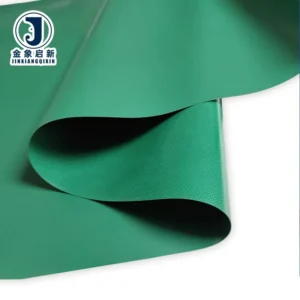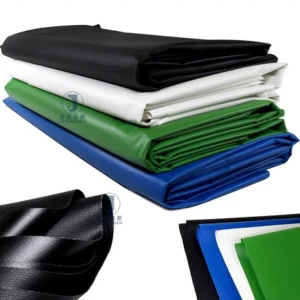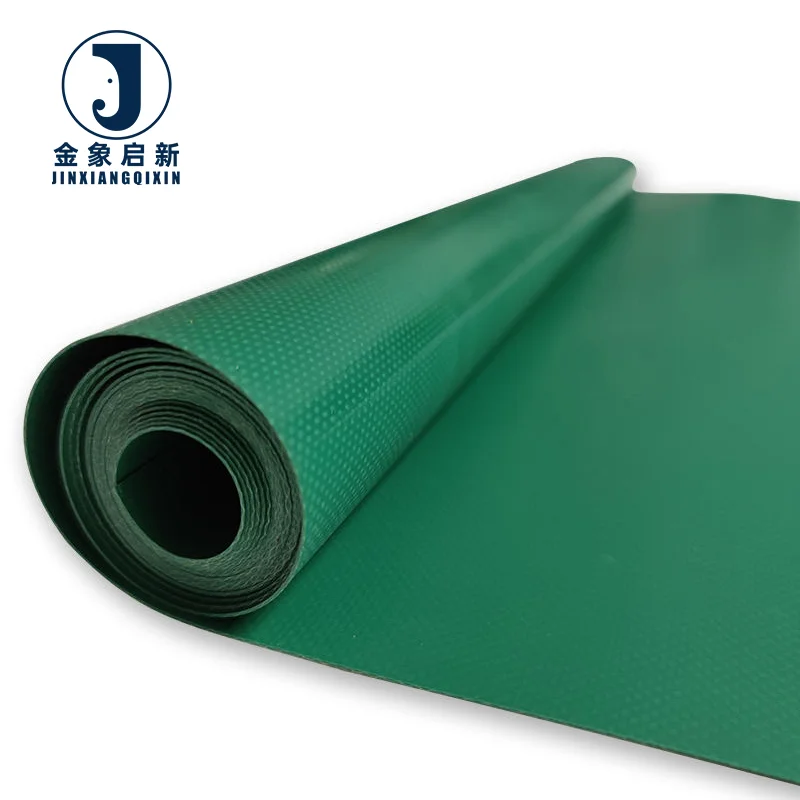
Coating Weight Control — every roll verified against quoted GSM before dispatch, eliminating the weight shortfall that causes premature cover failure.
Technical Specifications
| Parameter | Value |
|---|---|
| Product Type | PVC Coated Tarpaulin |
| Material | PVC & Polyester |
| Yarn Count Options | 500D×840D / 500D×1000D / 1000D×1000D / 1000D×1300D / 1300D×1300D / 1000D×2000D |
| Weight Grades | 350 GSM / 400 GSM / 420 GSM / 500 GSM / 600 GSM / 650 GSM / 750 GSM / 900 GSM |
| Thickness Range | 0.29 mm – 0.65 mm |
| Density Options | 20×20 / 30×19 / 30×15 |
| Tensile Strength (Warp) | 1650 N – 3900 N |
| Tensile Strength (Pick) | 1600 N – 3500 N |
| Key Features | Water Resistant, Waterproof, Flame Retardant, Anti-UV |
| Edge Finish | High temperature heat sealed seamless edge wrapping |
| Reinforcement | Reinforced corners on all sides |
| Eyelets | 3 cm enlarged aluminum alloy buttonhole |
| Rope | 5 mm thick rope without splicing |
| Package Options | Roll packing, Bale packing, Carton |
| Standards | ISO, CE |
Application Suitability
| Application | Exposure & Requirement |
|---|---|
| Truck side curtain | Constant flexing at load points, road debris abrasion, UV exposure during long-haul transit |
| Flatbed trailer cover | Tie-down strap tension, wind lift, water ingress at high speed |
| Machine and equipment cover | Outdoor storage, dust and moisture ingress, handling abrasion from repeated removal |
| Industrial shelter roof | Permanent UV and rain exposure, wind load tension on welded panels |
| Tent and awning structure | Multi-season weathering, repeated folding and deployment, fire code compliance for public venues |
Why a Heavier PVC Coated Tarpaulin Roll Can Still Tear at the Weld Line
Weld integrity depends on coating adhesion and heat-seal parameters, not only base fabric weight.
In fleet operations, I have watched side curtains fail not in the middle of the panel but right along the heat-welded seam. The fabric itself holds, yet the bond between coating layers separates when the load shifts and the curtain flexes repeatedly. A heavy-grade coated roll with poor adhesion between the PVC layers will delaminate at the weld before the base fabric reaches its tensile limit. That is why specifying a PVC Coated Tarpaulin Roll by GSM alone leaves the most critical failure point unchecked. [NEED_CITE: tensile and tear test methods for coated fabrics per ISO 1421]
Roll-to-Roll Consistency Across a Fleet Order
When a transport company orders enough PVC coated tarpaulin material to cover an entire fleet, even a slight colour shift between rolls becomes visible once the curtains hang side by side on adjacent trailers. Batch consistency starts at the coating stage — controlling plastisol viscosity, oven temperature profile, and line speed so that each metre receives the same coating thickness. Our three full production lines run dedicated batches per order, and QA checks colour against the reference standard at the start, middle, and end of every run.
Sizing to the Trailer, Not to a Generic Template
A side curtain cut to a generic dimension rarely fits a specific trailer model correctly. The distance between tie-down rails, the height of the headboard, and the position of the buckle straps all change between an Euroliner, a Curtainsider, and a flatbed with drop sides. We ask for the exact vehicle model and body builder drawing before cutting, then adjust heat-seal parameters to match the fabric weight grade chosen for that fleet. This prevents the corner stress concentrations that cause early tearing around eyelet patches and reinforced edges. [NEED_CITE: DIN 4102 fire classification for building materials]
Reading the Specification Sheet Beyond the GSM Number
A coated fabric specification sheet lists more than weight. The yarn count — for instance 1000D×1000D versus 500D×840D — tells you the denier of the polyester yarns in warp and weft. Higher denier yarns resist tearing propagation because each individual yarn carries more load before breaking. Density figures such as 30×19 show how many yarns sit in each direction per unit area; a tighter weave distributes point loads across more yarns. Together, yarn count and density explain why two rolls with identical GSM can show very different tear behaviour. Coating method matters as well: knife-over-roll coating produces a thicker, more uniform PVC film with stronger adhesion to the base fabric than simple dip coating, which directly affects how well a heat-welded seam holds under cyclic flexing. Thickness values from 0.29 mm to 0.65 mm across the available weight grades reflect this coating build-up, and selecting the correct thickness for your application determines both flexibility during installation and resistance to puncture from sharp-edged cargo.
The Hidden Cost of Specifying on Price per Kilogram Alone
When the buying decision centres only on cost per kilogram, the supplier has an incentive to reduce coating weight while keeping the base fabric the same. The roll arrives at the agreed GSM on paper, but the coating film is thinner than required for long-term weathering. Within the first season of outdoor exposure, the PVC surface chalks, micro-cracks propagate through the thin coating, and moisture reaches the polyester base fabric. The result is a cover that looks correct on delivery yet fails in service far sooner than expected. Colour inconsistency across rolls in the same shipment compounds the problem when installers hang panels side by side and the mismatch is immediately visible. [NEED_CITE: coating adhesion and delamination failure modes in PVC tarpaulin]
Why Buyers Source This PVC Coated Tarpaulin Roll Here
Three full production lines and thirty-six sets of professional equipment give us the capacity to run large fleet orders without splitting them across external workshops. A ten-person R&D team develops custom width, colour, and treatment formulations, producing samples within days so you can verify hand feel and weld behaviour before committing to bulk. Dedicated QA inspection at every production stage — from base fabric incoming check through coating, winding, and cutting — catches defects before they reach the packing area. Every roll undergoes hundred-percent pre-shipment inspection with GSM verification against the quoted specification. Nearly thirty years of focused coated fabric production means the process parameters for each yarn count and weight grade are already established, reducing trial-and-error on repeat orders.
Documentation & Verification
- Material specification sheet stating confirmed GSM, base fabric yarn count, and coating type for each roll
- Colour reference card matched to the batch for side-by-side visual verification on arrival
- Test report for flame retardant and anti-UV grades where applicable to the order
- Pre-shipment inspection record documenting GSM and thickness readings per roll
- Roll packing list with certificate of origin and customs documentation included in every shipment
Fabrication, Handling & Storage
- Heat-weld temperature must match the selected GSM grade to ensure coating fusion without scorching the polyester base
- Reinforced corners and aluminum alloy eyelets distribute tie-down load away from the cut edge of the fabric
- Store rolls upright on pallets to prevent flat spots that cause visible creasing when unrolled on site
- Allow cold-stored rolls to reach ambient temperature before unrolling to avoid cracking the PVC coating surface
- Clean with mild detergent only; solvents can dissolve the plasticiser in the PVC coating layer
- Cut patterns should nest panels along the warp direction to maximise tensile strength across the load-bearing axis
What We Need to Quote Your PVC Coated Tarpaulin Roll Accurately
Send the trailer model or structure drawing, the exposure conditions the cover will face, and your target market so we can confirm any fire code or compliance requirement. Specify the width and GSM grade you prefer, or let us recommend based on the application. If you need colour matching or printed branding, provide the Pantone reference and we will prepare a sample roll section for your approval before production.
Frequently Asked Questions
Q: How do you verify GSM matches the quotation on arrival?
A: Every roll is weighed and measured during pre-shipment inspection. We record the actual GSM and thickness against the specification sheet, and the inspection report travels with the shipment. If a roll falls outside the agreed tolerance, it is pulled from the batch before packing. You receive the full record so your receiving team can cross-check without delay.
Q: Can you guarantee colour consistency across multiple rolls in one order?
A: We run each order as a single dedicated batch on one production line. QA checks colour against the approved reference at three points during the run — start, middle, and end. If your fleet requires panels hung side by side, we can supply a signed colour consistency certificate confirming all rolls fall within the agreed Delta E range.
Q: What test reports support flame retardant claims?
A: Where a flame retardant grade is specified on your order, we provide the corresponding test report from an accredited laboratory. The report states the test standard and the classification achieved. Always confirm the grade required by your local building or vehicle safety code before placing the order so we select the correct formulation.
Q: How are welded seams tested to prevent failure at flex points?
A: We adjust heat-seal temperature, pressure, and dwell time to match the GSM and coating thickness of the fabric ordered. Sample welds are peel-tested before production starts. During the run, operators re-test weld strength at set intervals, and any section that does not meet the peel strength threshold is rejected before the roll is packed.