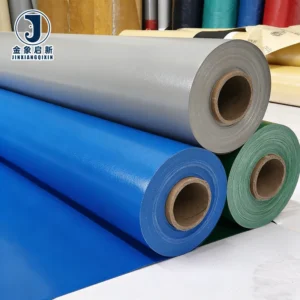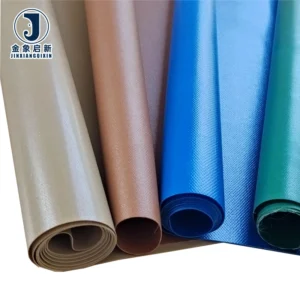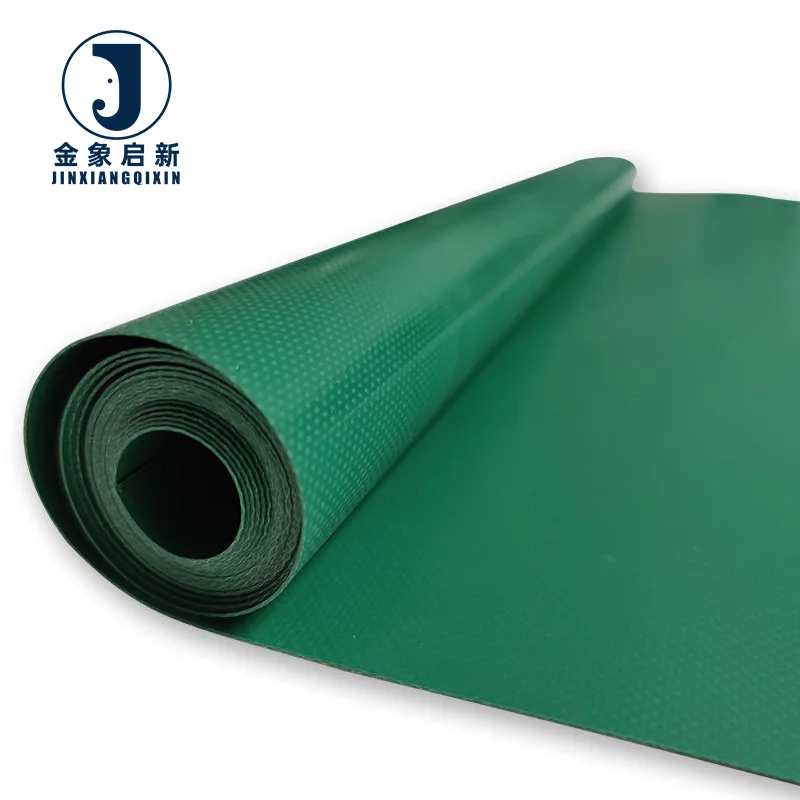
Verified Coating Weight Control — every roll undergoes 100% pre-shipment inspection to confirm the PVC coating mass matches the quoted GSM before it leaves the facility.
Technical Specifications
| Parameter | Value |
|---|---|
| Product Type | PVC Coated Tarpaulin |
| Material Composition | PVC coating on polyester base fabric |
| Yarn Count Options | 500D500D / 500D840D / 500D1000D / 1000D1000D / 1000D1300D / 1300D1300D / 1000D*2000D |
| Weight Range | 350 g/m² – 900 g/m² (confirm grade for application) |
| Thickness Range | 0.29 mm – 0.65 mm |
| Tensile Strength (Warp) | 1650 N – 3900 N (test basis not stated in source) |
| Tensile Strength (Weft) | 1600 N – 3500 N (test basis not stated in source) |
| Material Density | 1.15 – 2.00 g/cm³ |
| Brittle Temperature | ≤ -50 °C to -60 °C |
| Softening Temperature | ≥ 80 °C |
| Melting Point | 212 °C |
| Key Features | Water resistant, waterproof, available in anti-UV and flame retardant grades — confirm the grade required for your market |
| Edge Finishing | High temperature heat sealed seamless edge wrapping |
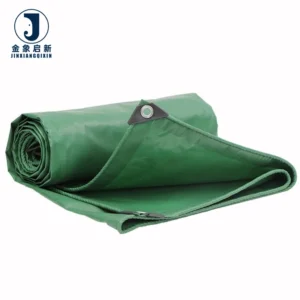
| Eyelet Specification | 3 cm enlarged aluminum alloy buttonhole |
| Corner Reinforcement | Reinforced corners on all sides |
| Rope Hem | 5 mm thick rope without splicing |
| Package Options | Roll packing, bale packing, carton |
| Certification | ISO, CE (certificate numbers not stated) |
Application Suitability
| Application | Exposure & Requirement |
|---|---|
| Flatbed trailer side curtain | Constant flexing at load points, road debris abrasion, multi-directional wind drag on highway routes |
| Curtain-sider truck top cover | Continuous UV exposure, rain pooling risk, thermal expansion and contraction across seasons |
| Construction plant transport wrap | Abrasion from steel edges and protrusions, tie-down strap pressure at irregular contact points |
| Timber and bulk load haulage | Sap and resin contact, moisture ingress risk, heavy tie-down tension across uneven surfaces |
| Open-bed equipment cover | High-speed airflow lift, vibration fatigue at eyelet and hem points, loading crane contact damage |
Why a Tarpaulin Fails at the Seam Before the Fabric Does
When a truck cover splits open on the motorway, the tear almost always starts at a welded seam or hem line, not in the middle of the fabric panel. A PVC coated tarpaulin for truck and trailer cover applications must transfer tie-down loads through the edge finishing without the coating delaminating from the base fabric under repeated flex cycles.
Fleet operators regularly report that generic-size covers leave slack material that flaps at highway speed, concentrating stress at the corners and eyelet rows until the heat-sealed joint gives way. The base fabric may still have years of service left, but the cover is written off because the edge construction could not handle the dynamic load. [NEED_CITE: fatigue failure at welded seams in PVC coated fabrics under cyclic loading]
Load-Bearing Edge Construction for Highway Speeds
The heat-sealed edge wrapping on this PVC coated tarpaulin for truck and trailer cover uses high-temperature fusion rather than adhesive bonding, creating a joint where the PVC coating fuses into a single mass at the seam. This eliminates the glue layer that typically cracks after repeated cold-flex cycles on winter routes.
The 5 mm rope hem runs the full perimeter without splicing, so tie-down tension distributes evenly along the entire cover length rather than concentrating at the nearest eyelet. When a strap is tensioned across a loaded flatbed, the load path travels through the rope, into the heat-sealed channel, and spreads across the base fabric weave.
Tie-Down Hardware That Survives Multi-Directional Pull
The 3 cm aluminum alloy eyelets are set into reinforced corners on all sides, addressing the most common failure mode at tie-down points: the fabric tearing radially from the eyelet hole under cross-wind load. Aluminum alloy resists corrosion from road salt and rain exposure while maintaining structural integrity under repeated strap tension and release cycles.
Reinforced corner panels add extra fabric layers where two edges meet and where multi-directional forces converge during transit. [NEED_CITE: tie-down point load distribution standards for transport covers in EN 12195]
Reading the Yarn Count and What It Means for Your Fleet
The base fabric denier directly governs how the PVC coated tarpaulin behaves under the specific stress profile of a moving load. A 1000D*1000D base fabric provides a balanced tensile response in both warp and weft directions, suited to side curtains that experience roughly equal stress from wind drag and vertical tie-down straps.
A 1300D1300D or 1000D2000D construction shifts the strength profile, giving heavier resistance where the cover bears against sharp-edged cargo such as steel profiles or precast concrete elements. The mesh count, ranging from 2020 to 3019 depending on grade, determines how tightly the yarns interlock and therefore how well the coating locks into the weave under peel stress at heat-sealed joints.
Thickness and weight must be read together: a 0.55 mm fabric at 650 g/m² indicates a different coating-to-fabric ratio than a 0.55 mm fabric at 750 g/m², which affects both flexibility at cold temperatures and resistance to abrasion from cargo contact. The brittle temperature threshold of ≤ -50 °C to -60 °C confirms the PVC formulation remains pliable on cold-climate routes, while the softening point of ≥ 80 °C sets the upper boundary for heat-sealing parameters during fabrication.
The Hidden Cost of Specifying by Weight Alone
Ordering a truck cover based solely on a GSM figure invites a predictable failure pattern: the material arrives within tolerance on a scale, but the base fabric denier is lighter than what the fleet’s load profile demands. The coating thickness makes up the difference in weight, and the cover passes incoming inspection, but the tensile strength at the warp yarns is insufficient for the dynamic loads encountered on long-haul routes.
Within weeks, the fabric stretches at high-stress zones — particularly around eyelet rows and where the cover wraps over load edges — and the stretched zones become thin spots that abrade through first. The entire cover is then replaced at the fleet operator’s cost, not the supplier’s. [NEED_CITE: relationship between base fabric denier and long-term tensile retention in PVC coated textiles]
Batch-to-batch colour variation presents a different problem: when covers for a fleet of twenty trailers are fabricated from rolls produced in separate batches, the shade difference becomes visible the first time two vehicles are parked side by side at a depot, undermining the fleet’s professional appearance.
What This Production Setup Delivers for Transport Buyers
Three full production lines with dedicated coating control ensure that PVC coating weight is monitored continuously during manufacture, not sampled after the fact — the GSM on the roll matches the GSM on the quotation.
The 10-person R&D team develops samples cut to your specific trailer model dimensions within days, so you verify the fit and the edge construction before committing to a bulk order rather than discovering a sizing error on the production floor.
Every roll undergoes 100% inspection before dispatch, with a pre-shipment record confirming weight, base fabric grade, and coating integrity — no lighter material slips through to your receiving dock.
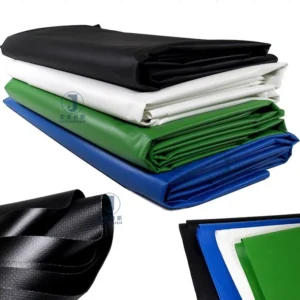
Colour matching is controlled at the compounding stage for each production run, so rolls destined for the same fleet order are produced together and carry the same batch reference for traceability.
Documentation & Verification
- Material specification sheet listing base fabric denier, coating weight, and colour reference per roll
- Pre-shipment inspection record confirming GSM and tensile values match the original quotation
- UV and flame retardant test reports provided where applicable to your transport regulation
- Roll packing list with batch traceability for customs clearance and inventory management
- Certificate of origin included for import documentation in destination market
Fabrication, Handling & Storage
- Heat-seal parameters must be calibrated to the specific 0.29 mm to 0.65 mm thickness range of the ordered grade
- Store rolls upright on end cores to prevent flat-spot deformation of the PVC coating surface
- Allow rolls to acclimatize to workshop temperature before unrolling to avoid cold-cracking below -50 °C brittle threshold
- Use compatible PVC welding tape for field repairs to maintain coating adhesion at patch edges
- Cut patterns with nested layout software to maximize yield from the roll width and minimize waste at seams
- Clean with pH-neutral detergent only to preserve the PVC surface and any applied treatment layers
Specifying Your Truck Cover Order
Provide the trailer make, model, and body type so the cover pattern can be cut to exact vehicle dimensions rather than a generic rectangle. Include the primary cargo type and typical route conditions — highway speed, coastal salt exposure, or high-altitude UV intensity — so the appropriate grade and treatment are selected.
State the quantity per vehicle and total fleet size to allow batch production planning that holds colour consistency across the entire order.
Frequently Asked Questions
Q: How do I specify a truck cover cut to my exact trailer model rather than a generic size?
A: Provide the vehicle make, model year, and body configuration including any roof-mounted equipment or side fixtures. Our R&D team develops a cut pattern from these dimensions and produces a sample cover for fitment verification before bulk production proceeds. This eliminates the slack material that causes wind flap damage on generic-size covers.
Q: Why do welded seams fail before the fabric does on truck covers?
A: Standard welded seams rely on adhesive layers that crack under repeated cold-flex cycles and vibration. Our heat-sealed edge wrapping fuses the PVC coating into a single mass at the joint without adhesive, so the seam flexes with the base fabric rather than separating at a rigid glue line under dynamic highway loads.
Q: How is GSM verified on arrival to ensure the material matches the quotation?
A: Every roll carries a pre-shipment inspection record with measured coating weight values. On arrival, you can verify by cutting a measured sample and weighing it against the documented specification sheet, which lists the base fabric denier and coating weight separately for full transparency.
Q: What eyelet spacing and reinforcement options are available for high-wind transport routes?
A: Standard specification includes 3 cm aluminum alloy eyelets with reinforced corner panels. Spacing can be adjusted based on your tie-down system and route wind conditions. Provide your strap configuration and maximum route wind speed so the reinforcement layout matches the actual load profile at each fixing point.
Q: How do you control colour consistency across rolls when ordering covers for an entire fleet?
A: All rolls for a single fleet order are produced in the same batch run from colour compound mixed at the start of that run. Each roll carries a batch reference number tied to the production record, so colour shade remains consistent across every cover installed across your fleet.