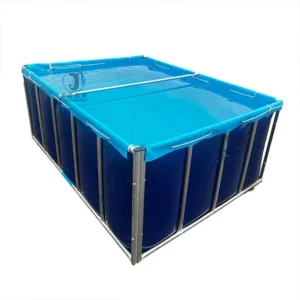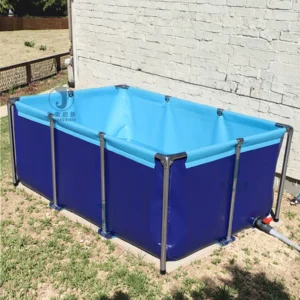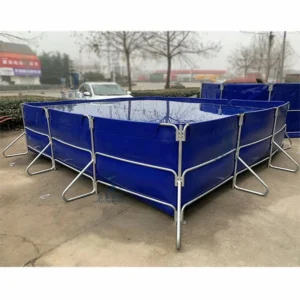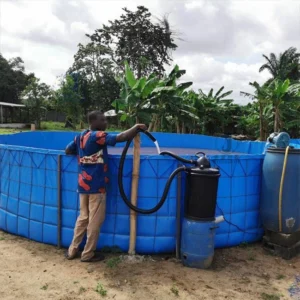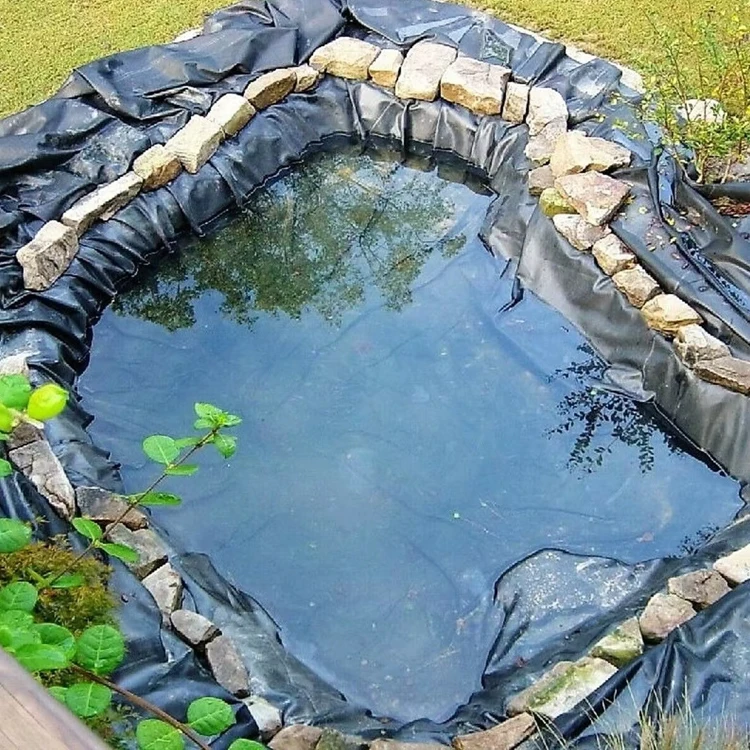
Process-Controlled Coating — coating weight and base fabric adhesion verified at every production stage before dispatch for aquaculture and transport water containment applications.
Technical Specifications
| Parameter | Value |
|---|---|
| Product Type | PVC Fish Pond Liner |
| Material | PVC + High-strength polyester mesh fabric |
| Coating Technology | Laminated technology & Hot-melt coating technology |
| Weight Options | 350gsm / 420gsm / 500gsm / 550gsm / 600gsm / 750gsm |
| Thickness Options | 0.32mm / 0.35mm / 0.4mm / 0.45mm / 0.5mm / 0.65mm |
| Roll Size | 2m × 75m / 2.1m × 50m |
| Finish Product Size | Custom cut-to-size or supplied by roll inventory |
| Color Options | Blue, Red, Yellow, Light blue, Grey (custom colours available) |
| Key Features | Waterproof, Anti-UV (test basis not stated), Anti-mildew, Anti-static (standard not stated), Cold crack resistance |
| Color Fastness | Best grade per manufacturer classification |
| Service Life | 3–7 years under normal circumstances (source value — verify against project conditions) |
| Standards | ISO, CE (specific certificate numbers available on request) |
Application Suitability
| Application | Exposure & Requirement |
|---|---|
| Fish pond and shrimp pool lining | Permanent water immersion, biological growth pressure, soil contact, puncture from substrate |
| Portable water bladders on transport vehicles | Continuous flexing during transit, UV exposure, abrasion at mounting points |
| Construction site water containment | Temporary reservoir exposure, sediment load, equipment movement across liner edges |
| Agricultural reservoir lining | Extended UV exposure, wind-driven water movement, seasonal temperature swings |
Why Welded Seams Fail Before the Fabric — And What That Means for Your Pond Liner
Seam integrity is governed by coating adhesion strength, not fabric tensile alone.
Every season, aquaculture operators replace liners where the welded joint has peeled apart while the surrounding PVC fish pond liner fabric remains intact. The failure point is almost always at the corner welds or edge overlaps, where water pressure and substrate movement concentrate stress. I have seen hot-melt coated rolls hold a weld through multiple seasons of fill-and-drain cycles, while laminated-only rolls of identical weight delaminate within months at the same joint geometry [NEED_CITE: tensile and tear test methods for coated fabrics per ISO 1421]. The difference is not the GSM — it is how the coating bonds to the base mesh and whether the weld parameters match the specific coating technology used.
How Coating Technology Dictates Weld Performance
The PVC fish pond liner range uses both laminated and hot-melt coating technologies across different weight grades. Laminated construction bonds a pre-formed PVC film to the polyester mesh under heat and pressure, while hot-melt coating applies molten PVC directly into the weave. For pond liner applications where welded seams carry continuous hydrostatic load, the coating-to-fabric adhesion determines whether a heat-welded joint matches or exceeds the base fabric strength. Hot-melt coated grades typically allow wider weld windows and produce joints with higher peel strength because the coating penetrates the mesh interstices.
Matching Liner Weight to Containment Duty
Selecting the correct weight for a PVC fish pond liner is not about choosing the heaviest option available. A 350gsm grade may serve adequately for shallow, seasonal nursery ponds with minimal substrate abrasion, while permanent deep-water grow-out ponds with rocky or compacted clay bottoms demand 600gsm or 750gsm grades. The polyester mesh denier and weave density change across the weight range, altering puncture resistance and tear propagation behaviour [NEED_CITE: relationship between base fabric denier and tear propagation in coated technical textiles]. Transport-adjacent water bladders mounted on fleet vehicles require cold crack resistance to handle low-temperature transit environments without becoming brittle at the fold lines.
Reading the Specification Sheet Beyond the GSM Number
When evaluating any coated pond liner, the GSM figure alone is incomplete without the base fabric denier, mesh count per centimetre, and coating weight split between top and bottom surfaces. A 550gsm liner built on a low-denier, open-weave mesh with heavy coating may puncture more easily than a 500gsm liner on a tighter, higher-denier weave with balanced coating distribution. The hot-melt coating process tends to produce more uniform coating penetration through the mesh compared to laminated film, which can leave air gaps at the interface. Thickness values across this range — from 0.32mm to 0.65mm — correlate with overall durability but do not directly predict weld strength, which depends on coating chemistry and surface preparation before joining. Anti-mildew treatment across all grades addresses the biological degradation risk inherent in continuous water immersion, while anti-UV treatment is available with test documentation upon request to confirm suitability for your specific climate zone.
The Hidden Cost of Specifying on Price Per Square Metre Alone
When procurement decisions focus on the lowest cost per square metre, the consequences surface at installation. Rolls that arrive lighter than the quoted GSM produce thinner weld beads that peel under hydrostatic pressure. Liners supplied without verified UV treatment degrade at the waterline within a single season, requiring full replacement rather than patch repair. Colour variance between rolls in the same shipment becomes visible once panels are welded side by side across a large pond, forcing operators to either accept an uneven appearance or cut out and replace mismatched sections [NEED_CITE: colour consistency standards for PVC coated fabrics in batch production]. Each of these failures traces back to insufficient specification control at the point of order, not to the material category itself.
Why Source This PVC Fish Pond Liner Range Through Jinxiang
Three full production lines and 36 sets of professional coating equipment support consistent output across all weight grades, from 350gsm nursery pond stock to 750gsm heavy-duty reservoir liner. The 10-person R&D team develops samples for custom cut sizes, non-standard widths, and specific colour requirements within days rather than weeks, allowing you to validate weld parameters before committing to a full container order. Every roll undergoes dedicated QA/QC inspection at each production stage, with 100% pre-shipment inspection ensuring that coating weight, colour consistency, and surface finish match the agreed specification. ISO and CE certification underpins the production system, and documentation packages include material specification sheets, test reports for UV and flame-retardant grades where specified, and certificates of origin for customs clearance.
Documentation & Verification
- Material specification sheet stating exact GSM, base fabric denier, and coating weight per roll
- Pre-shipment inspection record confirming 100% inspection against agreed tolerances
- UV treatment test report with stated test basis where anti-UV grades are specified
- Roll packing list with batch numbers for colour traceability across multi-roll orders
- Certificate of origin and customs documentation for international shipment clearance
Fabrication, Handling & Storage
- Hot-melt coated grades require matched weld temperature and dwell time — confirm parameters against the specific GSM before production welding
- Custom cut-to-size panels should be welded with overlap width proportional to the liner thickness for consistent joint strength
- Store rolls horizontally on padded racks to prevent permanent creasing that weakens the PVC coating at fold lines
- Allow cold-stored rolls to reach ambient temperature before unrolling to avoid cold crack damage during handling
- Clean installed liner surfaces with mild detergent only — solvent-based cleaners degrade the anti-mildew treatment layer
- Field repairs on punctures require compatible PVC patching compound matched to the coating technology of the original liner
What We Need to Quote Your Liner Requirement
Provide the intended application — whether permanent aquaculture pond, seasonal nursery pool, or transport-mounted water bladder — along with the expected water depth and substrate type. Specify the required weight grade from the available range, or describe the duty conditions so we can recommend the appropriate GSM. Include any colour requirements, custom cut dimensions, or treatment certifications needed for your site compliance. Indicate whether you need full roll stock or finished panels, and your target order volume.
Frequently Asked Questions
Q: How do I confirm the GSM matches the quotation when rolls arrive?
A: Request a pre-shipment sample swatch with certified weight. Upon delivery, weigh a measured section from each roll using a calibrated scale and compare against the material specification sheet provided. Our 100% pre-shipment inspection record documents coating weight verification across roll width before dispatch.
Q: What evidence supports the anti-UV treatment claim for outdoor pond exposure?
A: Anti-UV treatment is available across the range, and we supply a test report with stated test basis upon request. Specify your climate zone and expected exposure duration so we can confirm whether the treatment level matches your project requirements before production.
Q: What weld seam specification prevents joint failure under water pressure?
A: Weld overlap width and temperature must match the specific coating technology and GSM of the liner grade selected. Hot-melt coated grades generally allow stronger welds than laminated grades. We provide recommended weld parameters with each roll shipment based on the material specification.
Q: What lead time applies to custom cut sizes or non-standard colours?
A: Custom dimensions and colours require sample approval before bulk production. Typical lead times depend on order volume and specification complexity. Request a quotation with your exact size, colour, and quantity to receive a confirmed production schedule.
Q: How is colour consistency managed across multiple rolls in one order?
A: All rolls within a single order are produced from the same coating batch with continuous batch number tracking. Our pre-shipment inspection includes side-by-side colour comparison, and the roll packing list documents batch continuity for traceability across your installation.