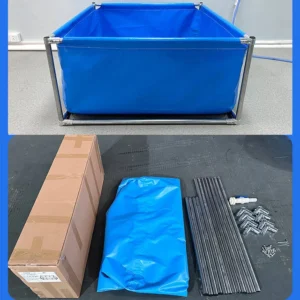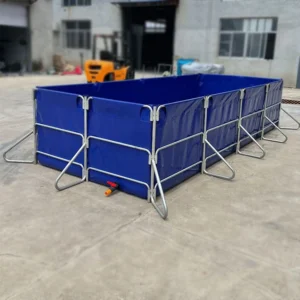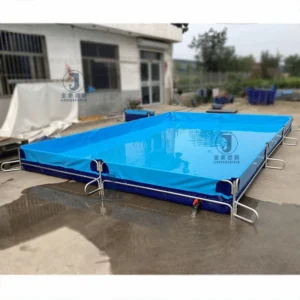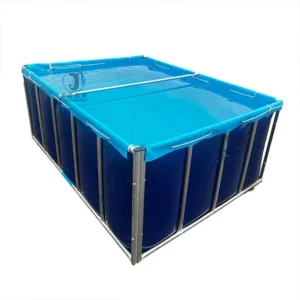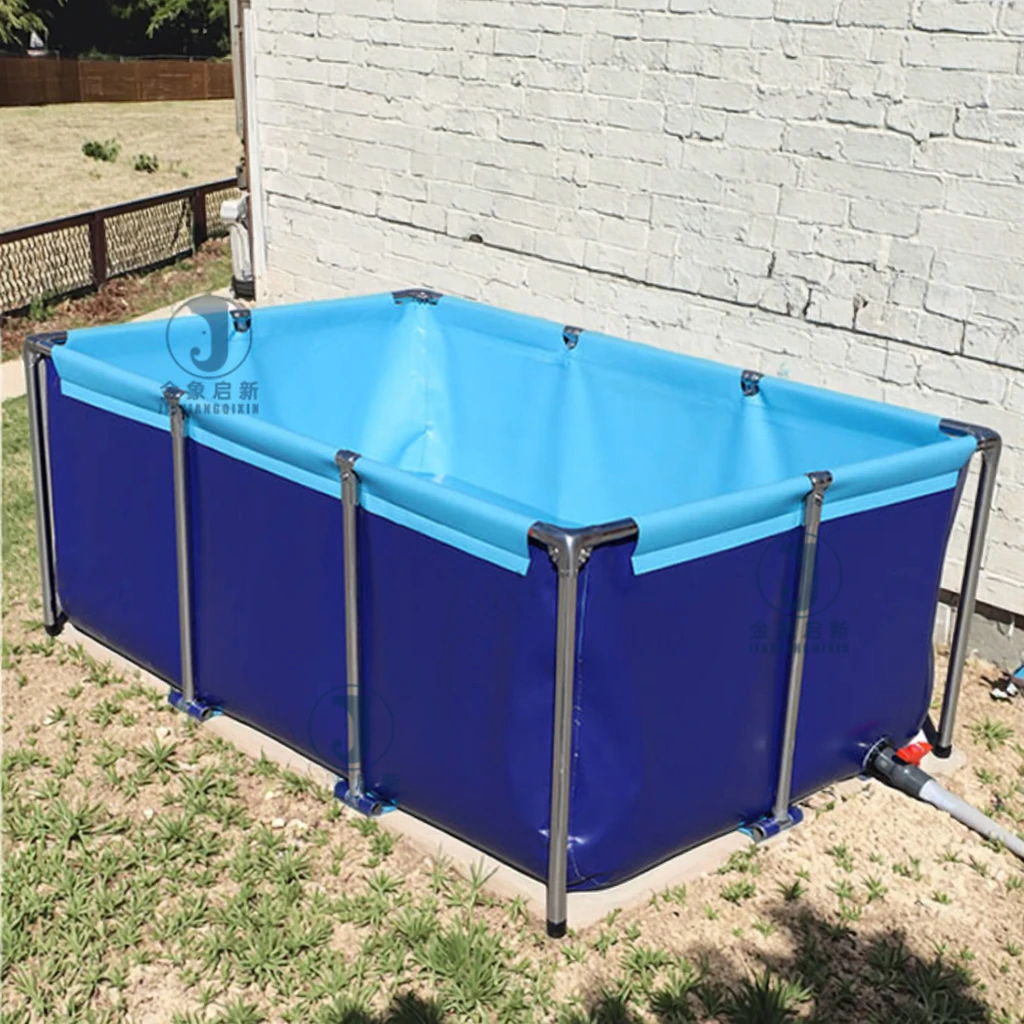
Proven Coating Adhesion — Every PVC Tarpaulin Roll for Fish Pond undergoes 100% pre-shipment inspection to verify coating weight and adhesion against the quoted specification before dispatch.
Technical Specifications
| Parameter | Value |
|---|---|
| Product Type | PVC Tarpaulin Roll for Fish Pond Lining |
| Material | Polyester Base Fabric + Double-Sided PVC Coating |
| Yarn Count Options | 500D840D / 500D1000D / 1000D1000D / 1000D1300D / 1300D1300D / 1000D2000D |
| Weight Range | 350 GSM to 900 GSM |
| Thickness Range | 0.29mm to 0.65mm |
| Density | 2020 to 3019 |
| Tensile Strength (Warp) | 1650 N to 3900 N (test basis not stated) |
| Tensile Strength (Pick) | 1600 N to 3500 N (test basis not stated) |
| Key Features | Water Resistant, Waterproof, Anti-UV (test basis not stated), Flame Retardant (grade not stated), Anti-Bacteria, Abrasion-Resistant |
| Surface | Smooth and soft surface with leather-like texture |
| Repairability | Repairable by hot air welding |
| Package | Roll packing, bale packing, carton |
| Standards | ISO, CE |
Application Suitability
| Application | Exposure & Requirement |
|---|---|
| Commercial fish pond lining | Permanent water immersion, substrate abrasion, biological growth pressure, UV exposure at waterline |
| Above-ground aquaculture tanks | Constant hydrostatic load, seam stress at corners, repeated drain-and-refill cycles |
| Agricultural water reservoirs | Soil chemistry contact, root and rock puncture risk, seasonal temperature fluctuation |
| Shrimp farm containment | Saline water exposure, biofilm accumulation, frequent cleaning and disinfection |
| Nursery and hatchery ponds | Strict hygiene requirements, anti-bacteria surface demand, minimal leaching tolerance |
Why Liner Thickness Alone Cannot Predict Pond Performance
A 500 GSM liner with weak coating adhesion will delaminate faster than a lighter fabric with proper bond strength.
Many aquaculture operators select pond liner purely by weight, assuming heavier always means longer-lasting. In practice, the interface between the PVC coating and the polyester base fabric determines whether the liner survives installation over rough substrate and years of continuous water contact. A roll that measures correct on the scale but shows poor peel strength at the coating-to-yarn bond will blister, separate, and leak long before the fabric itself breaks down. PVC Tarpaulin Roll for Fish Pond lining must be evaluated on coating adhesion and base fabric integrity together — not on GSM alone [NEED_CITE: peel strength test methods for coated fabrics].
Coating Bond Integrity Under Continuous Water Exposure
Double-sided PVC coating over high-denier polyester base fabric creates a sealed barrier that resists water penetration through the weave. The critical factor for pond liner service is not just the coating thickness but how thoroughly the PVC penetrates and locks into the yarn structure during manufacturing. When adhesion is insufficient, water migrates between the coating and base fabric at cut edges or puncture points, causing hidden delamination that surfaces only after the pond is filled and operational.
Seam Welding as the Primary Failure Boundary
Hot-air welded seams on PVC Tarpaulin Roll for Fish Pond installations must match or exceed the parent fabric strength. The most frequent liner failures occur at field joints where two rolls overlap — if welding temperature or pressure is inconsistent, the seam peels apart under hydrostatic load while the surrounding fabric remains intact. Properly executed hot-air welds fuse the PVC coating layers into a continuous bond, eliminating the weak line that adhesive or solvent joins leave behind [NEED_CITE: hot air welding parameters for PVC coated fabrics].
Reading GSM and Yarn Count Together for Pond Specification
Weight in GSM tells you how much material is present per square metre, but yarn count and weave density reveal how that material is distributed. A 650 GSM fabric woven at 2020 with 1000D1000D yarn concentrates strength in fewer, heavier threads — suitable for deep ponds where puncture resistance from rocks and roots is the primary concern. A 650 GSM fabric at 30*19 density with finer yarn spreads the load across more intersection points, offering better tear propagation resistance for above-ground tank walls under constant tension. Selecting the correct combination depends on whether the installation faces concentrated point loads or distributed stress across the liner surface.
The Hidden Cost of Ordering Liner on Nominal Weight Alone
Receiving rolls that measure lighter than the quoted GSM means paying for material that was never delivered, but the real cost surfaces during installation. A pond liner that arrives underweight often shows thinner coating at the edges, weaker heat-seal response at field joints, and earlier abrasion wear where the fabric contacts rough substrate. By the time these problems become visible, the pond is already excavated, water is on-site, and the replacement lead time translates directly into lost production cycles. Batch-to-roll colour and thickness variation compounds the problem when multiple rolls must be welded together for a single pond — visible inconsistency signals process instability that may extend to coating adhesion as well [NEED_CITE: quality consistency standards for coated fabric rolls].
Why Aquaculture Operators Source PVC Tarpaulin Roll for Fish Pond From This Line
Deep process control over coating weight and adhesion means the GSM stated on the quotation is the GSM verified on the pre-shipment inspection record — no material shortfalls discovered at the container door.
Three full production lines and 36 sets of professional equipment support bulk roll orders with consistent coating thickness across the entire batch, reducing the seam failures that arise when one roll welds differently from the next.
A 10-person R&D team develops samples within days when a specific anti-bacteria formulation or custom width is required for a pond project, allowing specification confirmation before full production commitment.
Dedicated QA/QC at every production stage catches coating defects, density variation, and surface blemishes before rolls are packed — not after the buyer opens the container.
ISO and CE certified manufacturing with complete documentation packages supports import compliance and project specification audits across international aquaculture markets.
Documentation & Verification
- Material specification sheet stating actual GSM, base fabric denier, yarn count, and coating weight for every roll
- Anti-UV and anti-bacteria test reports provided with shipment where applicable to support claimed treatments
- Pre-shipment inspection record confirming roll weight matches the quoted grade upon measurement
- Roll packing list with individual roll dimensions and weights for container loading audit
- ISO and CE certificates included in the dispatch documentation package
- Certificate of origin and customs support documentation for international shipment clearance
Fabrication, Handling & Storage
- Hot-air welding at recommended temperature and speed settings to fuse the PVC coating layers at overlap joints
- Store rolls upright on end cores to prevent flat-spot deformation of the polyester base fabric under self-weight
- Avoid dragging cut sheets over rough ground during installation to protect the smooth PVC surface from scoring
- Clean pond liner surfaces with mild detergent only — abrasive cleaners can damage the leather-like texture finish
- Field repairs using hot-air weld patches on the PVC coating restore waterproof integrity at puncture points
- Plan roll layout before cutting to minimise transverse welds across the pond floor where hydrostatic load concentrates
Before You Request a Quotation
Provide the pond dimensions, depth, and substrate type so the correct GSM and yarn count combination can be recommended for your specific containment requirements. Confirm whether your local regulations require flame retardant or anti-bacteria certification for aquaculture liner materials, as this affects formulation selection and documentation. Specify roll width and length preferences based on your welding capacity and installation method to minimise field joints. Indicate whether you need sample rolls for on-site weld testing before committing to full production volume.
Frequently Asked Questions
Q: What GSM range is appropriate for fish pond lining versus above-ground aquaculture tanks?
A: The available range spans 350 GSM to 900 GSM. Earthen ponds on prepared substrate typically use lighter grades, while above-ground tanks under hydrostatic tension and above-ground frame structures require heavier grades with higher yarn counts. Provide your pond depth and construction method so the correct grade can be matched to your structural and puncture-resistance requirements.
Q: Can you supply test reports for anti-UV and anti-bacteria treatments?
A: Anti-UV and anti-bacteria treatments are available, and test reports are provided with the shipment documentation where these treatments are specified on the order. Confirm your local aquaculture regulations and any third-party certification requirements at the inquiry stage so the correct formulation and testing protocol can be arranged before production.
Q: How strong are the welded seams compared to the parent PVC coated fabric?
A: Hot-air welded seams fuse the PVC coating layers into a continuous bond. When executed at correct temperature and speed, the weld strength approaches or matches the fabric tensile strength. Seam integrity depends on welding parameters, overlap width, and surface preparation — request sample material for weld testing on your equipment before placing a full production order.
Q: What custom roll widths and lengths are available for large pond projects?
A: Custom widths and lengths are produced to minimise field joints on large pond installations. Provide your pond dimensions and preferred roll layout so the optimum width can be determined. Minimum order quantities apply for custom widths, and sample development is available to confirm handling and welding characteristics before bulk production begins.