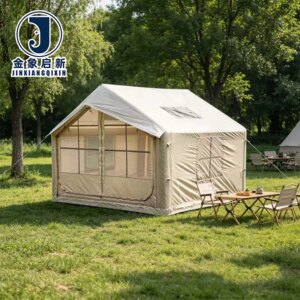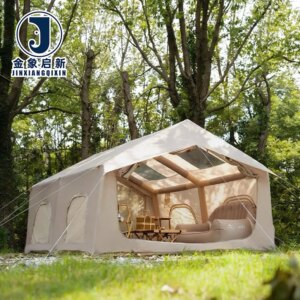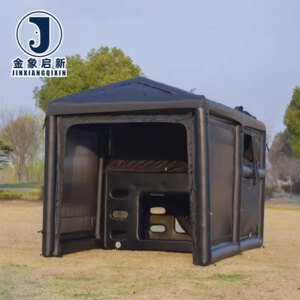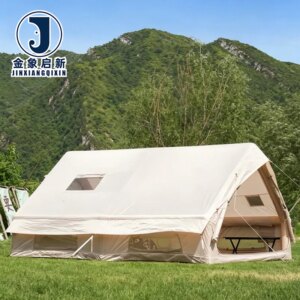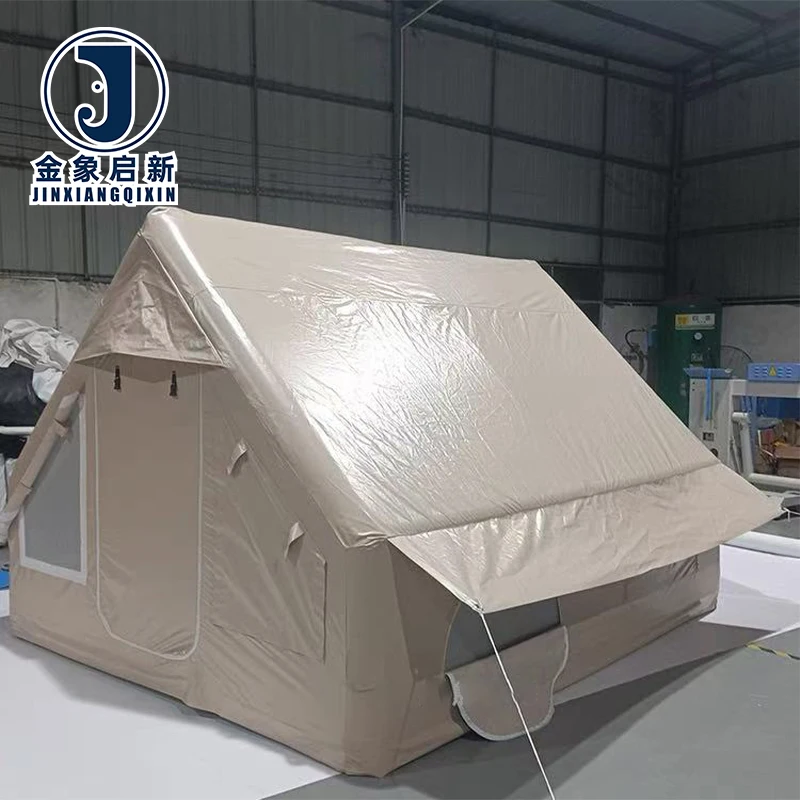
Precision Coating Control — Three dedicated production lines with 36 sets of processing equipment ensure batch-to-batch material consistency across every inflatable tent order, eliminating the durability variations that trigger warranty claims for commercial outdoor gear brands.
Technical Specifications
| Parameter | Value |
|---|---|
| Product Type | Inflatable Tent |
| Core Material | PVC knife-coated tarpaulin |
| Coating Thickness | 0.4mm |
| Available Thickness Range | 0.3–0.6mm (OEM selection) |
| Capacity | 5–8 person (customizable 3–10 person) |
| Construction | Single layer |
| Seam Treatment | Heat-sealed seams |
| Deployment Mechanism | Quick automatic inflation |
| Fire-retardant Grade | EN 13501-1 |
| Key Features | Waterproof, UV-resistant, tear-resistant, anti-static |
| Customization | Size, Pantone color matching, pattern printing, OEM & ODM |
| Quality Protocol | 7-point inspection including air pressure retention and UV aging simulation |
| Certifications | ISO 9001, ISO 14001, ISO 45001, CE |
Application Suitability
| Application | Exposure & Requirement |
|---|---|
| Commercial camping gear rental fleets | Repeated inflation cycles, constant UV exposure, frequent packing and transport abrasion |
| Expedition operator base camps | Extended all-season deployment, wind-driven rain, ground moisture contact |
| Outdoor adventure company equipment | High-frequency setup and teardown, variable terrain puncture risk, brand color consistency across units |
| Retail camping product lines | Consumer safety compliance, fire-retardant certification for enclosed markets, shelf-ready print quality |
What "Flame Retardant" Means When You Cannot See the Test Report
A flame-retardant claim without a documented grade leaves your product exposed at the point of market entry inspection.
Commercial outdoor gear manufacturers sourcing PVC inflatable camping tents frequently receive supplier quotations that state fire resistance as a feature, yet the shipment arrives without a batch-specific test report. When a rental operator or expedition company faces a site safety audit, a certificate number alone does not satisfy the inspector — the documented grade does. We have seen entire container loads held at EU customs because the fire classification paperwork did not match the product labeling on the tent carry bag [NEED_CITE: EN 13501-1 fire classification for construction and outdoor membrane products]. The PVC inflatable tent aftermarket supplier you choose must ship documentation that traces from the coating formulation through to the finished unit.
Coating Integrity at Every Seam Junction
Heat-sealed seam construction is the structural backbone of any inflatable tent. Unlike stitched panels that rely on thread tensile strength, a thermal weld fuses the PVC coating layers into a continuous membrane. Our process control ensures that weld temperature and dwell time are calibrated to the specific 0.4mm coating thickness, preventing the two failure modes that dominate field returns: incomplete fusion that leaks under inflation pressure, and thermal degradation that embrittles the joint. Every seam on this PVC inflatable camping tent undergoes integrity verification as part of the 7-point inspection before the unit leaves the production floor.
Pressure Retention as a Durability Metric
An inflatable tent holds its shape only as long as the air chambers maintain pressure under load. The knife-coated PVC fabric provides dimensional stability that resists the stretching and deformation common in lighter-weight alternatives. During the 7-point quality protocol, each unit is inflated to operating pressure and monitored for retention over a defined interval. This catches micro-leaks at valve interfaces and seam intersections that visual inspection alone would miss [NEED_CITE: air pressure retention testing methodology for inflatable membrane structures]. For commercial rental operators cycling tents through dozens of deployments per season, pressure retention consistency directly determines replacement frequency and customer complaint rates.
Reading the Specification Sheet Beyond Thickness
The 0.4mm coating thickness on this PVC inflatable camping tent governs waterproof performance and puncture resistance, but coating thickness alone does not define tear propagation behavior. The base fabric denier and weave density determine how a puncture spreads once the surface is compromised. A thicker coating on a low-denier base will resist abrasion but tear rapidly once cut. Our PVC knife-coated construction balances coating mass against base fabric specification so that the material fails progressively rather than catastrophically — a critical distinction for expedition operators pitching in high-wind environments where a single rock strike must not compromise the entire chamber. Fire-retardant compliance to EN 13501-1 is formulated into the coating compound itself, not applied as a topical finish that degrades with cleaning and UV exposure.
The Hidden Cost of Skipping Pre-Production Validation
When a commercial outdoor brand approves a PVC inflatable camping tent based on a catalog photograph and proceeds directly to bulk production, the most common failure is color drift across the production run. Pantone matching verified on a small sample swatch does not guarantee consistency when the coating line runs full-width rolls days apart. The second frequent issue is seam strength variation — weld parameters optimized for a sample unit may not transfer identically to production-scale volumes without documented process sheets [NEED_CITE: coated fabric weld strength variance across production batches]. Brands that skip the pre-production sample stage absorb these costs as retail returns and damaged distributor relationships, problems that compound across each selling season.
Why Outdoor Gear Manufacturers Source Here
The 10-technician R&D team handles material selection, pattern printing layout, and structural design adjustments specific to inflatable tent geometry — not generic tarpaulin conversion. Three full production lines with 36 sets of professional processing equipment allow dedicated capacity allocation for tent orders without competing against bulk roll stock runs. The 7-point inspection protocol includes air pressure retention testing and UV aging simulation, two checks that most PVC tent suppliers omit from standard QC checklists. Pantone color matching is verified against coated fabric output rather than uncoated paper standards, eliminating the hue shift that appears once material is produced at scale. Every PVC inflatable camping tent order ships with batch-specific inspection records that trace coating thickness, seam integrity, and dimensional accuracy back to the production date.
Documentation & Verification
- Batch-specific material specification sheet stating coating thickness, base fabric construction, and color reference
- EN 13501-1 fire-retardant test report issued per production batch, not a generic blanket certificate
- Pre-shipment inspection record covering air pressure retention, seam integrity, and dimensional accuracy
- CE certification documentation supporting EU market entry for inflatable camping equipment
- Roll-level coating thickness verification data available for OEM quality team review
Fabrication, Handling & Storage
- Heat-seal parameters must be matched to the 0.4mm PVC coating thickness; excessive temperature degrades the polymer bond at seam lines
- Store inflated or folded units away from sharp substrate contact to protect the single-layer PVC construction from puncture
- Clean with neutral pH detergent only; solvent-based cleaners attack the PVC coating surface and reduce UV additive effectiveness
- Transport in temperatures above freezing to prevent low-temperature stiffening that can crack folded PVC at crease points
- Field repair of minor punctures requires PVC-compatible adhesive patches applied to clean, dry coating surfaces
Starting a Technical Inquiry
Provide the target deployment environment, expected seasonal usage frequency, and any fire-retardant or anti-static compliance requirements specific to your destination market. Share the capacity range, Pantone references for color matching, and whether you require finished units or fabric-only supply for your own assembly line. Confirming these parameters at the inquiry stage allows the R&D team to recommend coating thickness and base fabric specifications before sample development begins.
Frequently Asked Questions
Q: What customization range is available for capacity and material thickness?
A: Capacity is configurable from 3-person to 10-person formats. Coating thickness is selectable between 0.3mm and 0.6mm depending on the deployment intensity and weight target. Pantone color matching and branded pattern printing are integrated into the production run, not applied as post-production finishes.
Q: Is fire-retardant test documentation provided with each shipment?
A: Yes. Each production batch ships with an EN 13501-1 fire-retardant test report specific to that batch. This documentation supports EU market entry and satisfies site safety audit requirements for commercial rental operators and expedition companies deploying inflatable tents in regulated environments.
Q: Can we evaluate a pre-production sample before committing to a bulk order?
A: Pre-production samples are developed for engineering team validation before mass production begins. The sample allows your team to verify inflation behavior, seam strength, color accuracy against Pantone targets, and overall dimensional conformance. Sample lead time is discussed during the specification recommendation stage.
Q: How is color consistency maintained across multiple units in the same order?
A: Color matching is verified against coated fabric production output rather than uncoated reference standards. Each production run follows documented coating formulation records, and the pre-shipment inspection includes visual comparison of panels from the start, middle, and end of the run to detect any hue drift before dispatch.