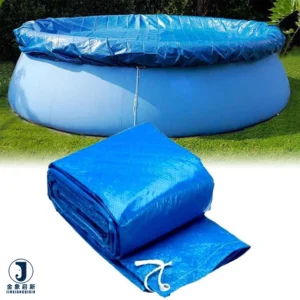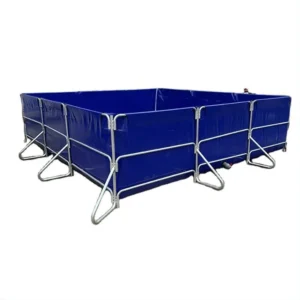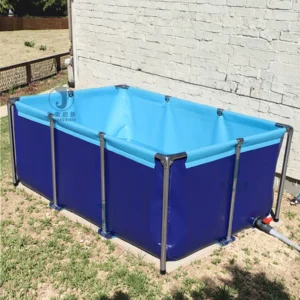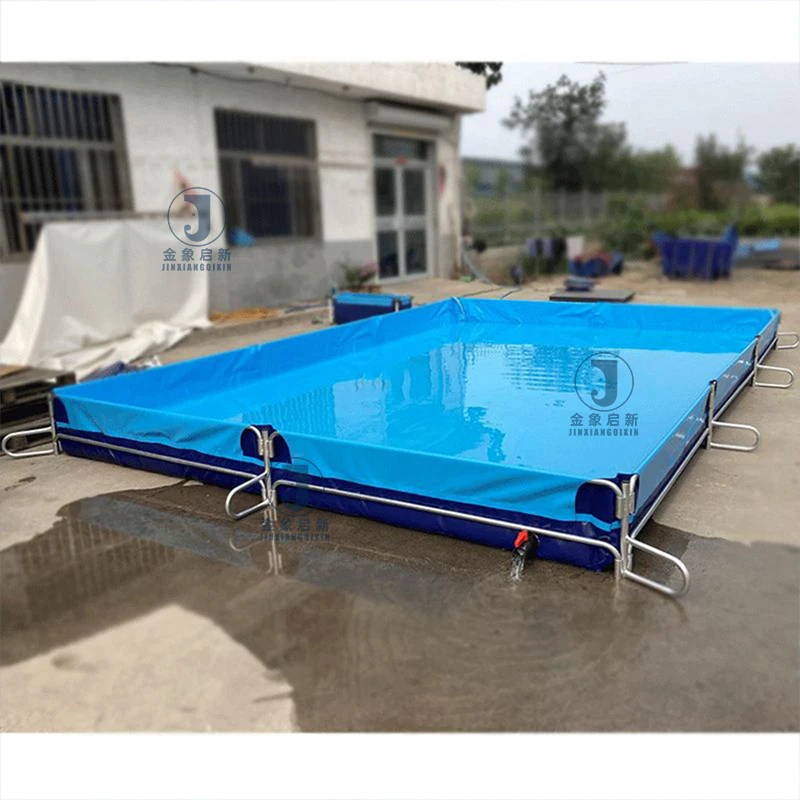
Integrated pressing construction — Every seam on this PVC Tarpaulin Fish Pond Liner for Aquaculture is heat-welded under controlled pressure, eliminating the stitched needle holes where water escapes first.
Technical Specifications
| Parameter | Value |
|---|---|
| Product Type | Pond Liner |
| Base Fabric | 500D-500D Polyester |
| Coating Material | Double-sided PVC over polyester scrim |
| Surface Texture | Smooth, leather-like finish |
| Waterproof Integrity | Fully coated, continuous PVC seal |
| Flame Retardancy | Available in flame retardant grades — confirm the grade required for your market |
| UV Resistance | Anti-UV treatment available — request test basis for your climate zone |
| Repairability | Field repairable by hot air welding |
| Standards | ISO, CE |
Application Suitability
| Application | Exposure & Requirement |
|---|---|
| Commercial aquaculture fish ponds | Permanent water contact, soil chemistry, UV exposure, puncture risk from substrate |
| Foldable above-ground pond tanks | Repeated assembly and folding, flex stress at fold lines, abrasion from frame contacts |
| Agricultural water reservoirs | Standing water retention, algae and biological contact, seasonal temperature swings |
| Nursery and hatchery containment | Frequent cleaning cycles, chemical disinfectants, controlled drainage |
Why Seam Integrity Matters More Than GSM in Water Containment
A liner holds water only as long as its weakest seam.
Most aquaculture operators I have worked with focus on fabric weight when specifying pond liners. Yet the majority of early containment failures trace back to stitched seams opening under hydrostatic pressure, not the base fabric tearing. [NEED_CITE: tensile and tear test methods for coated fabrics per ISO 1421]. A PVC tarpaulin fish pond liner for aquaculture can carry the correct GSM and still lose water within months if the joining method leaves needle perforations along every panel junction. Heat-welded seams fuse the coating layers into a single continuous membrane, so the joint strength tracks with the parent material rather than falling behind it. This matters especially at corners and drainage penetrations where stress concentrates and water pressure pushes outward constantly.
How Integrated Pressing Eliminates the Primary Leak Path
Traditional stitched-and-taped construction leaves a line of needle holes every few millimetres along the seam. Even when tape is applied over the stitch line, adhesion depends on surface preparation and ambient conditions at the time of fabrication. Our integrated pressing approach bonds PVC coating layers across the entire seam width under heat and pressure. The result is a PVC Tarpaulin Fish Pond Liner for Aquaculture where water encounters no mechanical fastener path through the material. This construction method also distributes load across a wider zone, reducing the chance of tear initiation at panel junctions during filling or drainage cycles.
Double-Sided Coating and the 500D Polyester Scrim
The 500D-500D polyester base provides dimensional stability when the liner is loaded with thousands of litres of water. Single-sided coated fabrics can absorb moisture through the uncoated face, leading to yarn swelling and loss of tensile strength over repeated wet-dry cycles. Double-sided PVC coating seals the scrim entirely, so the polyester yarns remain isolated from water, biological growth, and dissolved chemicals commonly present in aquaculture environments. This is particularly relevant for operations using copper-based algaecides or formalin treatments. [NEED_CITE: chemical resistance of PVC coated polyester in aquaculture water treatment].
Reading the Specification Sheet Beyond the Weight Number
Fabric weight in g/m² tells you how much material is present per square metre, but it does not tell you how that weight is distributed between base yarn and coating. A liner with a heavy coating over a light scrim may feel substantial but tear easily along the warp or weft. Conversely, a dense 500D-500D scrim with moderate coating weight delivers higher tensile and tear values than a heavier fabric built on a lower-denier base. Coating method also affects performance: knife-over-roll coating builds a thicker, more flexible layer suited to applications requiring foldability, while calendared coating produces a thinner, stiffer sheet better suited to flat installation. Understanding this balance helps buyers compare PVC tarpaulin fish pond liner for aquaculture options on structural merit rather than weight alone.
The Hidden Cost of Specifying on Price Per Square Metre
When procurement focuses on cost per unit area, suppliers reduce weight by thinning the coating or dropping scrim denier. The liner arrives looking correct and passes a hand-feel check. Six months later, UV degradation exposes the lighter scrim, punctures from sharp substrate propagate faster through thinner coating, and fold lines on above-ground tanks crack at the reduced coating thickness. [NEED_CITE: coating weight loss and PVC degradation mechanisms in outdoor pond environments]. These failures are expensive because replacing a liner in an active aquaculture operation means draining stock, disrupting biofiltration cycles, and halting production — consequences far exceeding the savings on the initial material purchase.
Why Aquaculture Operators Source This Liner Here
Three full production lines and dedicated coating equipment support consistent PVC application across the entire roll width, reducing the thickness variation that causes weak spots in pond liners.
A 10-person R&D team develops custom-cut pond shapes and foldable tank patterns, producing samples within days so operators can verify fit before committing to a full production run.
Dedicated QA at every coating and welding stage means each PVC tarpaulin fish pond liner for aquaculture receives 100 percent inspection before dispatch, with pre-shipment records available for review.
Hot air welding capability extends beyond fabrication — operators can request repair kits matched to the liner coating formulation for field maintenance of punctures or seam damage.
Documentation packages are assembled per order, not pulled from a generic library, ensuring the material data matches the specific batch shipped.
Documentation & Verification
- Material specification sheet stating 500D-500D base denier and double-sided PVC coating weight
- Pre-shipment inspection record confirming GSM verification per roll before dispatch
- UV and flame retardant test reports supplied when applicable grades are specified
- ISO and CE certificates included with each shipment documentation package
- Roll packing list detailing dimensions and weight for customs and logistics handling
Fabrication, Handling & Storage
- Hot air weld temperature must match the double-sided PVC coating formulation to ensure full fusion without scorching
- Fold lines on above-ground pond tanks should follow the 500D scrim weave direction to minimise coating stress
- Store rolls horizontally on pallets to prevent creasing that creates permanent weak points in the PVC surface
- Clean liner surfaces with neutral pH detergents only — acidic or alkaline cleaners attack the PVC coating layer
- Field puncture repair requires compatible PVC patch material applied by hot air welding at matched temperature
What We Need to Quote Your Pond Liner Correctly
To specify a PVC Tarpaulin Fish Pond Liner for Aquaculture accurately, provide the pond dimensions or tank pattern drawing, the intended installation method (in-ground, above-ground frame, or foldable), and the water treatment chemicals your operation uses. Confirm whether flame retardant or specific UV protection grades are required for your market compliance. Let us know if you need the liner supplied as cut-to-shape panels with welded seams or as full rolls for on-site fabrication, and whether you require samples before placing a bulk order.
Frequently Asked Questions
Q: How do I verify the liner GSM matches my order when it arrives?
A: Request the pre-shipment inspection record that documents coating weight measurement per roll. On receipt, use a calibrated scale to weigh a known-area sample cut from the roll edge. Compare the measured value against the specification sheet supplied with your shipment. Any significant discrepancy should be reported before installation begins.
Q: Can the liner be cut to custom pond shapes and dimensions?
A: Yes. Our R&D team develops cut patterns from your pond drawings, including irregular shapes, drainage penetrations, and inlet openings. Panels are heat-welded to your specified dimensions using integrated pressing. Samples are produced within days for fit verification before the full production run is released.
Q: How do I repair a puncture or seam damage in the field?
A: The double-sided PVC coating is repairable by hot air welding. Clean and dry the damaged area, apply a compatible PVC patch cut from matching material, and weld using a hot air gun at the recommended temperature. This restores waterproof integrity without requiring full liner replacement or returning the product to the factory.
Q: What anchoring methods work with this pond liner material?
A: The smooth PVC surface supports several anchoring approaches including brass anchoring systems, aluminium battens with stainless steel hooks, and heavy-duty water tube loops. The appropriate method depends on whether the liner is installed in-ground or above-ground. Specify your anchoring preference during inquiry so reinforced hems can be positioned accordingly.
Q: Is the PVC material safe for direct contact with fish and aquaculture water?
A: The double-sided PVC coating creates a continuous barrier between the polyester scrim and the water environment. Request the material specification sheet and any applicable test documentation for your market to confirm compliance with local aquaculture water contact regulations before ordering.