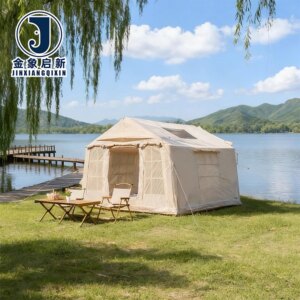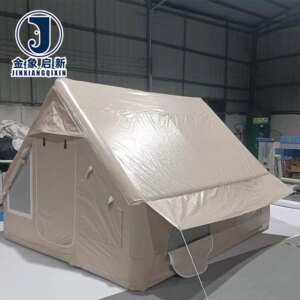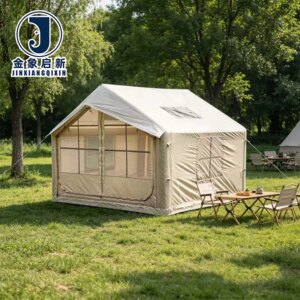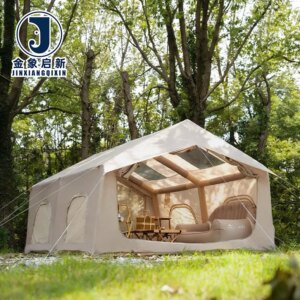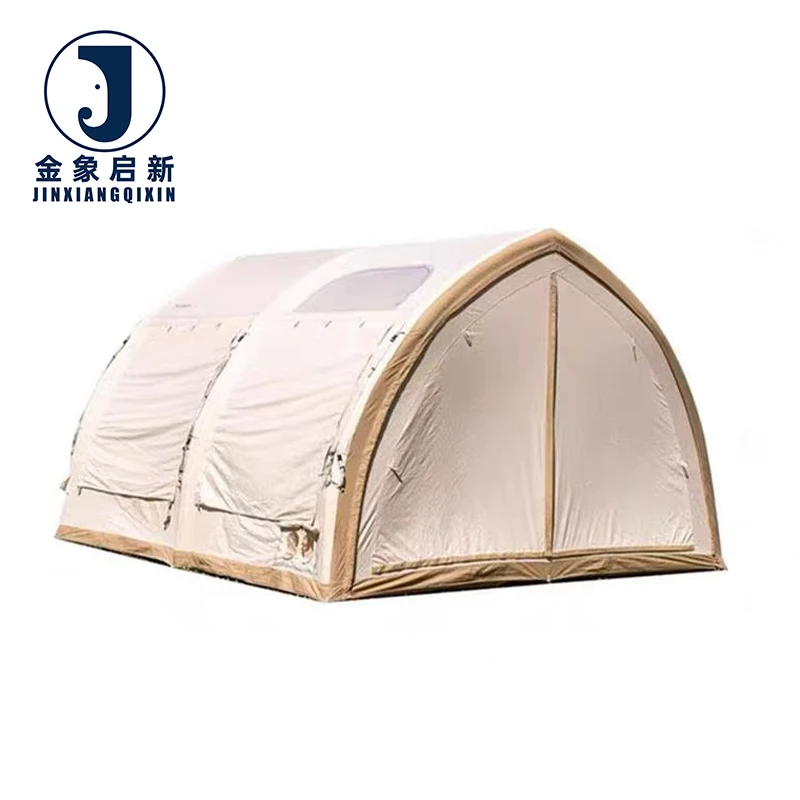
Industrial-Scale Inflation Testing — every inflatable tent unit undergoes a 24-hour pressure retention test to validate airtight welds before dispatch, catching seam failures that field deployment would otherwise expose.
Technical Specifications
| Parameter | Value |
|---|---|
| Product Type | Inflatable Tent |
| Core Material | PVC Tarpaulin (PVC knife-coated fabric) |
| Coating Material | PVC |
| Product Form | Inflatable structure with automatic opening |
| Construction | Single layer, extended type structure |
| Season Rating | Four-season |
| Key Features | Waterproof, UV-resistant (test basis not stated), Tear-resistant |
| Customization | OEM & ODM — sample customization, pattern printing |
| Certifications | ISO9001, ISO14001, ISO45001, CE |
| Quality Control | Full-process inspection, 24-hour inflation testing before shipment |
Application Suitability
| Application | Exposure & Requirement |
|---|---|
| Emergency command centers during disaster recovery | Rapid deployment, all-weather enclosure, structural airtightness under wind load |
| Temporary site offices at infrastructure project locations | Prolonged outdoor exposure, UV stability, waterproof integrity across seasons |
| Equipment storage shelters in remote industrial sites | Tear resistance against handling abrasion, waterproof protection for sensitive machinery |
| Field maintenance team workspaces | Frequent inflation and deflation cycles, seam durability under repeated pressurization |
Why Welded Seam Integrity Defines Inflatable Tent Reliability in the Field
An inflatable structure fails at the weld long before the fabric reaches its tensile limit.
When disaster recovery teams deploy temporary shelters, the first point of failure is rarely the PVC membrane itself — it is the heat-welded seam where two panels join. Inflatable tents operate under continuous internal pressure, meaning every welded joint carries a sustained load that flexes with temperature swings and wind gusts. A seam that holds during a five-minute factory test may develop micro-leaks after hours of pressurized exposure in the field. [NEED_CITE: heat-welded seam behaviour in pressurised PVC structures under sustained load] This is why procurement specifications for emergency and industrial inflatable shelters must demand documented inflation retention data, not merely a visual seam inspection at the end of the production line.
Airtight Weld Verification Through Sustained Pressure Testing
Every custom Inflatable Tent produced on our lines is inflated to its operating pressure and held for a continuous 24-hour period before shipment approval. During this window, inspectors monitor pressure decay across all welded seams — the air tube junctions, the floor-to-wall transitions, and the entry-point reinforcements. A unit that loses pressure beyond the acceptable threshold is pulled from the batch, deconstructed at the failing seam, and the welding parameters are recalibrated before the next unit is processed. This protocol exists because field conditions amplify any marginal weld: a seam that leaks slightly at the factory will leak substantially when ambient temperature drops overnight and the internal air contracts.
Rapid Deployment Architecture for Time-Critical Operations
The automatic opening mechanism built into this Inflatable Tent structure allows a small team to achieve full enclosure within a single deployment cycle — a critical advantage when disaster recovery timelines compress from days to hours. The single-layer, extended-type construction reduces the number of inflation chambers while maintaining structural rigidity, which in turn reduces the number of welded seams that could become potential leak paths. Fewer seams mean fewer failure points, and a simpler inflation sequence means less training required for the crews who deploy these units at remote infrastructure sites or disaster zones.
How PVC Knife-Coated Fabric Supports Structural Inflation
The PVC knife-coated fabric used in this Inflatable Tent delivers a continuous coating layer that bonds directly into the base weave, producing a membrane with consistent thickness across the entire panel surface. This uniformity matters for inflatable structures because any thin spot in the coating becomes a stress concentrator when the membrane is under tension from internal pressure. Knife coating also produces a surface that accepts heat-welded seams with predictable adhesion — the PVC layers on two panels fuse into a single continuous bond rather than relying on adhesive layers that can delaminate under sustained pressurization. [NEED_CITE: knife-coated versus laminated PVC behaviour in heat-welded inflatable applications]
Reading the Specification Sheet Beyond the Product Label
The performance of an inflatable tent membrane depends on the interaction between base fabric construction and coating weight, not on either parameter in isolation. A PVC tarpaulin with a dense base weave will resist tear propagation across the panel, while the coating weight determines waterproof integrity and the surface quality available for heat welding. When reviewing specifications for this Inflatable Tent category, buyers should request the base fabric denier and weave density alongside the coating weight — these two values together predict how the membrane will behave when inflation pressure loads every square centimetre of the surface. The four-season rating assigned to this construction reflects the membrane’s capacity to maintain flexibility and seam adhesion across the temperature range encountered in extended field deployment, rather than a single laboratory condition.
The Hidden Cost of Underspecified Inflatable Structures
Procurement teams sourcing inflatable shelters for emergency preparedness programmes often discover too late that a unit passing a brief factory inflation test develops progressive seam leakage within the first field deployment cycle. The consequences cascade: a command centre that slowly deflates during a storm forces personnel evacuation, equipment stored in a sagging shelter suffers water ingress, and the entire batch must be returned or patched at the project site — a process that is slow, unreliable, and visible to every stakeholder watching the recovery operation. [NEED_CITE: field failure rates of pressurised temporary shelters with unverified seam integrity] These outcomes trace back to a specification that defined the membrane material but did not define the inflation retention standard the finished unit must meet before it ships.
Why Industrial Buyers Source This Inflatable Tent Range Here
Three full production lines with 36 sets of professional equipment allow this Inflatable Tent manufacturer to run parallel batch production — one line cutting and welding while another completes inflation testing on finished units, keeping delivery schedules aligned with emergency procurement timelines. The 10-person R&D team handles OEM and ODM customization directly, translating site-specific sizing, pattern printing, and colour requirements into production-ready patterns without routing through external design agencies. Every unit passes through dedicated QA/QC at multiple production stages — base fabric inspection before cutting, weld parameter verification during assembly, and the 24-hour inflation hold before packing — rather than relying on a single end-of-line check. Sample development runs in parallel with the quotation stage, so buyers can validate material feel, weld quality, and inflation behaviour before committing to a bulk order.
Documentation & Verification
- Material specification sheet stating base fabric denier, coating type, and PVC weight for this Inflatable Tent membrane
- ISO9001, ISO14001, ISO45001, and CE certificates included in the shipment documentation package
- Pre-shipment inspection record covering dimensional accuracy and 24-hour inflation test results per unit
- UV and performance test reports provided where the specified grade requires third-party validation
- Roll-level packing list with batch traceability linking each tent unit back to its production run
Fabrication, Handling & Storage
- Heat-weld seams using temperature and dwell settings calibrated to the PVC knife-coated fabric weight to avoid under-fusion or coating burn-through
- Store inflated units in a dry, shaded staging area to prevent UV exposure from degrading the membrane surface before deployment
- Avoid folding the PVC tarpaulin membrane along the same crease line repeatedly, as permanent creasing weakens the coating bond at the fold
- Clean the Inflatable Tent surface with mild detergent and water — solvent-based cleaners attack the PVC coating and compromise weld integrity
- Repair minor field punctures using PVC-compatible adhesive patches applied to a clean, dry membrane surface
What to Include in Your Inflatable Tent Enquiry
Specify the deployment environment — climate zone, expected wind exposure, and whether the unit will remain inflated continuously or undergo repeated deflation cycles. Confirm the sizing and internal layout required for your intended use, whether that is an emergency command centre, equipment shelter, or field workspace. If your site requires specific UV or fire-performance grades for regulatory compliance, state the standard your market mandates so the correct membrane specification can be matched. Indicate whether you need pattern printing, branded panels, or colour-matched batches for multi-unit deployments, and whether sample approval is required before production begins.
Frequently Asked Questions
Q: How is the airtight integrity of welded seams tested before shipment?
A: Every Inflatable Tent unit is inflated to its designated operating pressure and held for a continuous 24-hour period. Inspectors monitor pressure decay across all welded seams — tube junctions, floor-to-wall transitions, and entry reinforcements. Any unit exceeding the acceptable leak threshold is pulled from the batch and the welding parameters are recalibrated before further production.
Q: What UV-resistance test basis supports the anti-UV claim for prolonged outdoor use?
A: The PVC tarpaulin membrane is produced with UV-stabilised coating formulations suited to extended outdoor exposure. However, the specific UV test standard and exposure duration rating should be confirmed against your site’s regulatory requirements. Request the UV test report for your batch to verify compliance with the performance level your project specifies.
Q: What OEM and ODM customization options are available for sizing, colour, and pattern printing?
A: The R&D team develops custom Inflatable Tent patterns to your specified dimensions, internal layout, and colour requirements. Pattern printing and branded panels are available for multi-unit deployments. A sample unit is produced for your approval before bulk production begins, allowing you to validate material specification, weld quality, and inflation behaviour against your field requirements.
Q: How does the factory ensure batch-to-batch consistency across large-scale emergency preparedness orders?
A: Base fabric is inspected for coating weight and weave consistency before cutting. Welding parameters are locked to the validated settings for the specified PVC knife-coated fabric grade. Every finished unit undergoes the same 24-hour inflation retention test, and pre-shipment inspection records are maintained per batch for full traceability across multi-container orders.
Q: What certifications and supporting documentation ship with each order for compliance and traceability?
A: Each Inflatable Tent shipment includes ISO9001, ISO14001, ISO45001, and CE certificates, a material specification sheet covering base fabric and coating details, a pre-shipment inspection record with inflation test data, and a roll-level packing list linking each unit to its production batch for audit traceability.