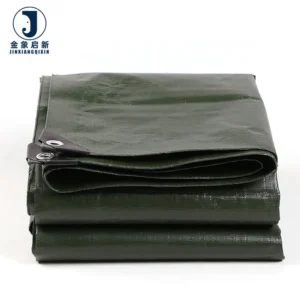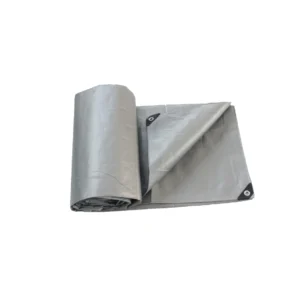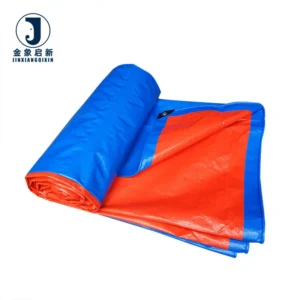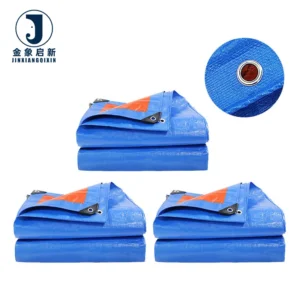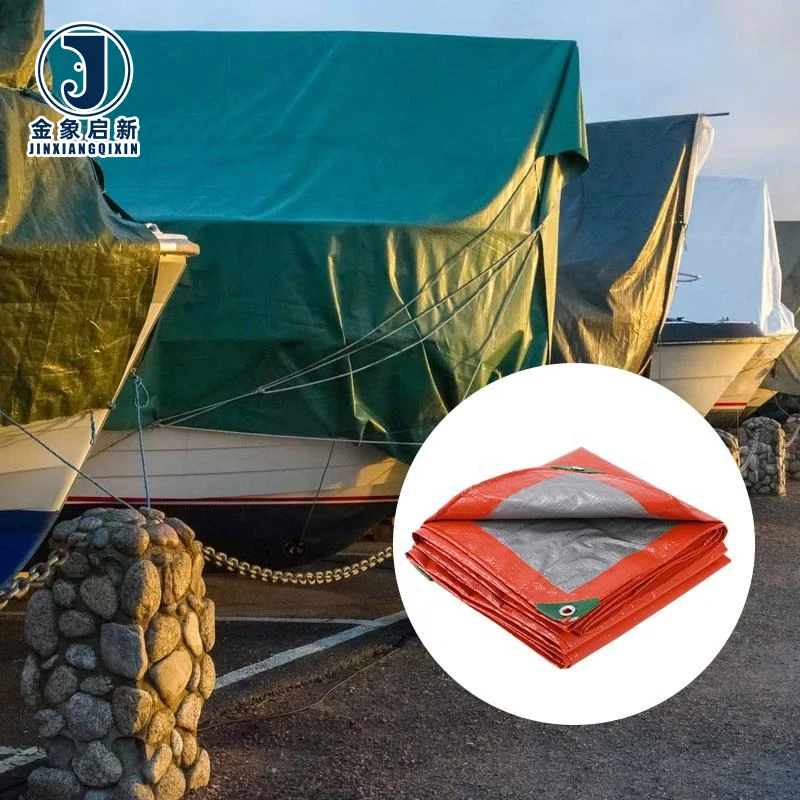
Deep Process Control — Coating weight and adhesion monitored at every production stage, with dedicated QA/QC inspecting every roll before dispatch to ensure the PE tarpaulin arrives exactly as specified.
Technical Specifications
| Parameter | Value |
|---|---|
| Product Type | PE Tarpaulin |
| Material | Polyethylene (HDPE fabric cross weaving, laminated both sides with LDPE) |
| Structure Option 1 | 3 layers (one layer of fabric, two layers of coating) |
| Structure Option 2 | 5 layers (two layers of fabric, three layers of coating) |
| Weight Range | 40g~500g/m² (confirm the grade for your application) |
| Lightweight Grade Weight | 80-110 g/m² |
| Medium Grade Weight | 120-150 g/m² |
| Heavy-duty Grade Weight | 160-240 g/m² |
| Lightweight Thickness | 0.18-0.22 mm |
| Medium Thickness | 0.22-0.28 mm |
| Heavy-duty Thickness | 0.30-0.35 mm |
| Lightweight Mesh Count | 8×8 |
| Medium Mesh Count | 10×10 |
| Heavy-duty Mesh Count | 12×12 |
| Tensile Strength (Lightweight) | Meridian 300-500 / Latitude 250-450 N/5cm |
| Tensile Strength (Medium) | Meridian 500-800 / Latitude 400-700 N/5cm |
| Tensile Strength (Heavy-duty) | Meridian 900-1200 / Latitude 700-1000 N/5cm |
| Water Resistance | Double waterproof surfaces |
| UV Treatment | Available (test basis not stated — confirm required standard) |
| Eyelet & Hem | Reinforced rustproof grommets, reinforced corners, 39.4-inch center-to-center spacing |
| Knitting Density Range | 5×5 to 20×20 |
| Size | Custom size |
| Color | Custom color |
| Standards | ISO, CE |
Application Suitability
| Application | Exposure & Requirement |
|---|---|
| Flatbed trailer load covering | High-speed wind load, constant tie-down tension, road debris abrasion, UV exposure |
| Side curtain fabric for trucks | Repeated flexing at fold points, lateral stress during cornering, weather sealing |
| Construction equipment transport | Heavy point loads from machinery edges, loading and unloading abrasion, outdoor staging |
| Palletized goods weather shielding | Rain ingress prevention, stacking compression, long-haul highway vibration |
| Temporary site enclosures | Wind loading, dust containment, short-term UV exposure, frequent repositioning |
Why Generic Sizing Fails Moving Loads — and What PE Tarpaulin for Truck and Transport Demands Instead
A tarp cut to a standard rectangle will always fail before one cut to the trailer’s actual dimensions.
The most common reason fleet operators replace covers is not material degradation — it is dimensional mismatch. A generic PE tarpaulin for truck and transport applications sits loose at the edges, flaps in crosswinds, and concentrates stress at the grommets rather than distributing it across the hem. Road vibration then works the loose fabric against sharp load edges, cutting through the laminate within weeks rather than seasons. [NEED_CITE: tensile and tear test methods for coated fabrics per ISO 1421] The fix is not a heavier grade — it is a pattern that accounts for the trailer’s crown height, side rail profile, and tie-down rail position.
Dimensional Fitment Over Generic Cutting
Every trailer model — flatbed, curtain-sider, low-loader — has a distinct profile. The crown height, the distance between coamings, and the tie-down rail geometry all dictate where the fabric must stretch, fold, and bear load. When a PE tarpaulin for truck and transport is cut to match these dimensions, the hems align with the rails and the grommets sit directly over the strap anchor points. This eliminates the slack that causes wind-flap fatigue and ensures the ratchet straps pull the cover tight against the load rather than bunching it.
Reinforcement at the Points That Actually Fail
Field returns consistently show two failure zones: the grommet perimeter and the hem weld line. These are the locations where cyclic loading from road vibration and strap tension concentrates. Rustproof grommets set at 39.4-inch spacing distribute the tie-down load across a wider section of the hem, while reinforced corners — typically an extra laminate patch — prevent the diagonal pull of corner straps from tearing through the eyelet. [NEED_CITE: DIN 53354 tear propagation testing for laminated fabrics] The spacing itself matters: too close and the fabric between grommets has no room to flex; too far apart and the unsupported span flutters and abrades against the cargo.
Reading GSM, Mesh Count, and Tensile Strength Together
GSM alone does not predict how a PE tarpaulin will perform under highway wind load. A 160 g/m² fabric with a 12×12 mesh count has more yarn crossover points per square inch than a heavier fabric woven at 8×8, giving it superior resistance to tear propagation even at a lower weight. The tensile strength figures — meridian 900-1200 N/5cm for the heavy-duty grade — represent the force needed to break a 5 cm strip, which correlates directly to how much strap tension the fabric can absorb before the weave distorts. For flatbed highway use, the warp direction (meridian) matters most because that is the axis along which ratchet straps pull. Coating thickness contributes to puncture resistance from sharp load edges but adds little to tensile performance, which is why specifying mesh count and GSM together is essential.
The Cost of Specifying Without Verifying
A cover that arrives lighter than the GSM stated on the quotation will feel right on day one but fail months early. The missing coating weight shows up first as reduced puncture resistance at load contact points, then as UV degradation because the thinner laminate has less pigment and stabilizer to absorb solar radiation. [NEED_CITE: effects of UV exposure on polyethylene laminates in transport applications] Batch color variation between rolls in a single order becomes visible only after installation, when two covers sit side by side on identical trailers — a problem that forces either full replacement or acceptance of a mismatched fleet appearance. Welded seams that separate before the fabric itself fails typically trace back to incorrect heat-seal temperatures for the specific laminate structure, not to the fabric quality.
Why Procurement Teams Source This Range Here
Three full production lines and 36 sets of professional equipment support bulk roll output with consistent coating weight across the batch, which is the variable that most affects downstream lamination quality. The 10-person R&D team develops cut patterns against specific vehicle model drawings rather than generic templates, ensuring the hem and eyelet layout matches the trailer’s tie-down geometry. Dedicated QA/QC at every production stage means coating adhesion, mesh count, and GSM are checked during the run — not just sampled from a finished roll. ISO and CE certification provides the documentation baseline that fleet compliance audits require, and 100% pre-shipment inspection catches color drift and grommet pull-out issues before the container is sealed. Samples for custom sizing and eyelet patterns are developed within days, allowing fitment verification before the full production run commits material.
Documentation & Verification
- Material specification sheet confirming GSM, base fabric denier, and mesh count for each roll in the shipment
- Weight verification record per roll against the quoted lightweight, medium, or heavy-duty grade before dispatch
- Test documentation for UV treatment and flame-retardant grades where applicable to the specified grade
- Pre-shipment inspection record covering grommet pull-out strength, hem weld integrity, and color consistency
- Roll packing list with net weight and roll dimensions for container loading calculations
- Certificate of origin and customs documentation for cross-border shipment
Fabrication, Handling & Storage
- Heat-seal parameters must match the LDPE laminate melting point — verify temperature against the specific GSM grade before welding hems
- Reinforced rustproof grommets require a backing patch of at least the same laminate thickness as the base fabric for load distribution
- Rolls of heavy-duty 160-240 g/m² grade must be stored upright on pallets to prevent compression creasing of the HDPE weave
- Unfold 5-layer structure tarps at ambient temperature above freezing to avoid stress-cracking the outer LDPE coating
- Clean double waterproof surfaces with neutral detergent only — solvents can dissolve the LDPE laminate bonding layer
- On-site repairs to the 3-layer structure respond well to hot-air patch welding using matching LDPE repair film
Requesting the Right Specification
To match the correct grade and cut pattern to your fleet, share the trailer model designation, the typical cargo profile, and the highway speed range your vehicles operate at. Specify whether you need finished cut-to-size covers with eyelets or roll stock for in-house fabrication, and indicate any color or branding requirements per vehicle. Confirm the UV treatment standard required by your operating region so the appropriate test basis can be referenced in the quotation.
Frequently Asked Questions
Q: How do I choose between the 3-layer and 5-layer PE tarpaulin structure for highway transport?
A: The 3-layer structure — one HDPE fabric layer with two LDPE coatings — suits standard flatbed loads where weight and cost are priorities. The 5-layer structure adds a second fabric layer and an intermediate coating, providing higher puncture resistance for heavy machinery transport. Choose based on cargo edge sharpness and expected strap tension rather than weight alone.
Q: What reinforcement options exist for high-stress tie-down points on truck covers?
A: Reinforced rustproof grommets set at 39.4-inch spacing handle standard ratchet strap loads. For higher tension applications, additional laminate patches can be applied at corner and mid-span grommet positions. The reinforced corners standard on this range prevent diagonal strap pull from tearing through the eyelet zone during transit.
Q: How is batch color consistency maintained when ordering multiple truck covers at once?
A: All rolls in a single order are coated from the same LDPE pigment batch and inspected side by side before dispatch. The pre-shipment inspection record documents color consistency across the order. If your fleet requires exact color matching to an existing RAL reference, a sample swatch is produced and approved before full production begins.
Q: Can tarps be cut to specific trailer model dimensions with custom eyelet patterns?
A: Yes. The R&D team develops cut patterns from vehicle model drawings, positioning eyelets to align with the trailer’s tie-down rail anchors. Custom sizes and eyelet spacing beyond the standard 39.4-inch interval are available. A physical sample is produced for fitment verification on the actual trailer before the production run is authorized.
Q: What UV resistance performance should I expect for long-haul outdoor exposure?
A: UV treatment is available across all weight grades, but the specific test standard must be confirmed for your market and exposure conditions. Request the applicable test report for the grade you specify. Heavier grades with thicker LDPE coating inherently provide more UV buffer than lightweight grades, independent of any additive treatment.