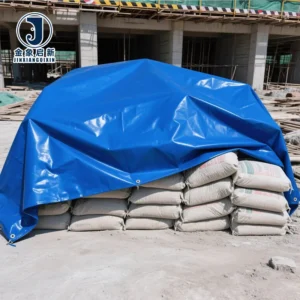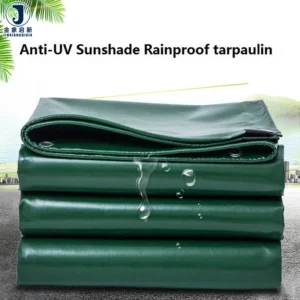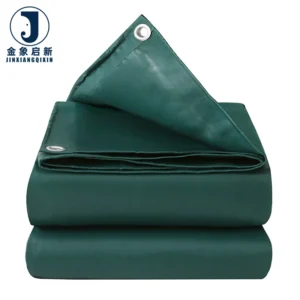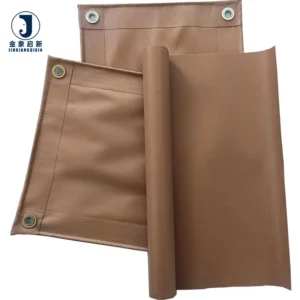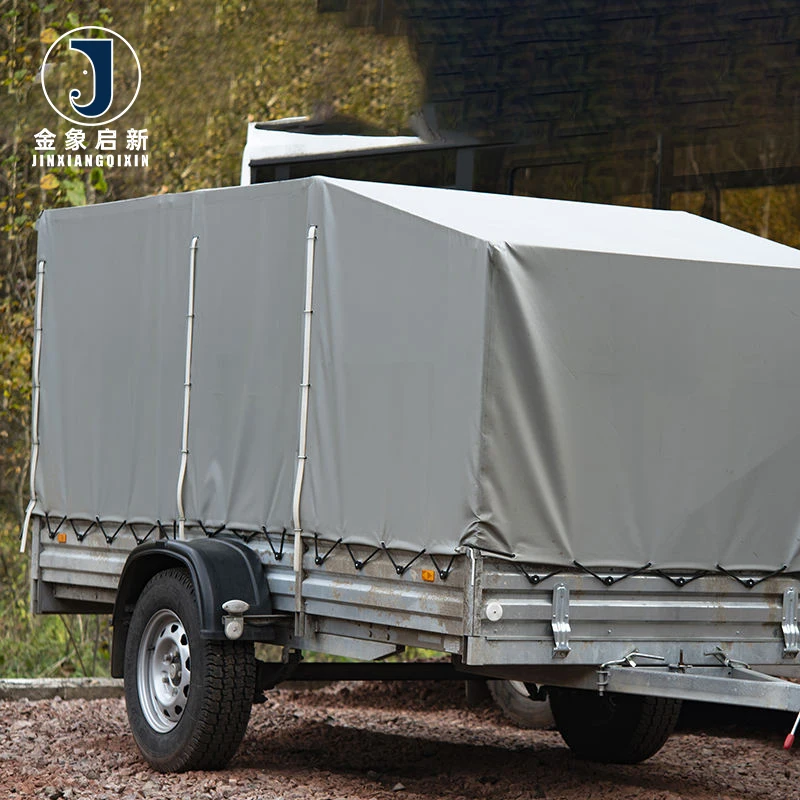
Hot-Melt Coating Adhesion — Controlled bond strength between polyester base fabric and PVC layers prevents weld seam failure at high-stress flex points during transport.
Technical Specifications
| Parameter | Value |
|---|---|
| Product Type | PVC Coated Tarpaulin |
| Base Fabric | 100% high toughness polyester yarn |
| Coating Technology | Hot melt coating and lamination technology |
| Weight (Medium-duty) | 400-500 g/m² |
| Thickness (Medium-duty) | 0.35-0.45 mm |
| Knitting Density (Medium-duty) | 500D |
| Tensile Strength (Medium-duty) | Warp 1500-2000 / Weft 1200-1800 N/5cm |
| Weight (Heavy-duty) | 700-1000 g/m² |
| Thickness (Heavy-duty) | 0.70-1.0 mm |
| Knitting Density (Heavy-duty) | 1000D |
| Tensile Strength (Heavy-duty) | Warp 2000-2500 / Weft 1800-2200 N/5cm |
| Weight (Super Heavy-duty) | 1100-1500 g/m² |
| Thickness (Super Heavy-duty) | 1.2-1.5 mm |
| Knitting Density (Super Heavy-duty) | 500D-2000D |
| Tensile Strength (Super Heavy-duty) | Warp 2500-3000 / Weft 2200-2800 N/5cm |
| Flame Retardant Grade | B1 (grade stated — confirm compliance for your market) |
| Key Features | Waterproof, cold resistant cracking, mold proof, anti-static (standard not stated), UV treatment available, color fastness rated |
Application Suitability
| Application | Exposure & Requirement |
|---|---|
| Truck side curtain fabric | Constant flexing at load movement points, road abrasion, tie-down stress at eyelet hems, UV and weather exposure |
| Trailer load cover | Cargo protection from road spray and weather, repeated folding and unfolding, wind flap fatigue |
| Flatbed equipment transport | Heavy machinery abrasion on fabric surface, puncture resistance at contact points, securement strap tension |
| Fleet vehicle branding panels | Consistent colour across multiple vehicles, printable surface for fleet livery, long-term UV colour retention |
Why Weld Seams Fail Before the Fabric Does on Truck Covers
The coating bond strength matters more than fabric tensile rating when a loaded trailer flexes on the road.
Fleet operators frequently report that truck side curtains split not across the fabric face but along the welded seam — precisely where the load shifts and the material bends under tension. When PVC coated tarpaulin for truck and transport applications is produced with insufficient coating adhesion, the heat-activated weld interface becomes the weakest link. The base fabric may carry a high tensile rating, yet the laminate layers delaminate under cyclic flexing. [NEED_CITE: cyclic flex fatigue on coated fabric weld seams per ISO 1421 testing protocols]
Hot-Melt Coating for Reliable Weld Lines
The hot melt coating process applied to this PVC coated tarpaulin for truck and transport use creates a direct bond between the polyester base yarn and the PVC surface layers without intermediate adhesive films. This means the weld seam made during curtain fabrication fuses into a homogenous coating layer rather than sitting on a weak boundary. When side curtain fabricators apply high-frequency welding, the coating melts and re-bonds across the joint with strength approaching the parent material.
Tensile Ratings Across the Weight Range
Medium-duty grades at 400-500 g/m² carry warp tensile strength of 1500-2000 N/5cm, suitable for standard truck side curtains on rigid body vehicles. Heavy-duty options at 700-1000 g/m² reach 2000-2500 N/5cm in the warp direction, matching the demands of articulated trailer covers where wind load and load shift create higher peak forces. Super heavy-duty grades extend to 2500-3000 N/5cm warp for flatbed equipment transport where abrasion and strap tension compound. [NEED_CITE: tensile test methods for coated fabrics per ISO 1421]
How Base Fabric Denier and Coating Weight Interact
The knitting density — 500D for medium-duty through 500D-2000D for super heavy-duty — determines how many polyester yarns carry the load per centimetre of fabric. A higher denier base with a proportionally heavier PVC coating distributes point loads across more yarn intersections, resisting tear propagation when a corner of cargo presses against the curtain. However, coating weight alone does not guarantee tear resistance; an over-coated low-denier base will crack at fold lines before the coating reaches its flex life. The three-tier range offered here pairs each denier with a matched coating thickness — 0.35-0.45 mm, 0.70-1.0 mm, and 1.2-1.5 mm respectively — so the base-to-coating ratio stays within the range that supports durable welding.
Flame retardant treatment to B1 grade is available for transport markets where fire safety documentation is required for vehicle compliance. Anti-static treatment addresses dust attraction on dry bulk haulage routes. Cold cracking resistance is specified across the range to prevent brittle failure when curtains are folded in freezing depot conditions. [NEED_CITE: B1 flame classification requirements for transport and temporary structure applications]
What Happens When Colour Drifts Between Rolls
Fleet operators ordering side curtains for twenty identical trailers expect uniform colour once the vehicles are parked in line. When PVC coated tarpaulin for truck and transport use is produced without batch-level pigment control, adjacent panels show visible shade variation under daylight — even though each roll individually passes a colour check. This forces operators to reject rolls after delivery or accept a mismatched fleet appearance. Dedicated QA/QC at every production stage addresses this by comparing rolls within the same production run against a single colour reference before dispatch, preventing the visible drift that only appears once curtains are installed side by side.
The Cost of Generic-Size Truck Covers
A truck cover cut to a standard rectangle and then trimmed on-site wastes material, leaves unsealed cut edges vulnerable to water ingress, and creates uneven tension across eyelet points. Transport equipment builders specifying PVC coated tarpaulin for truck and transport benefit from providing the exact trailer model and dimensions at inquiry stage so that cut sizes match the vehicle profile. Reinforced hems and eyelet spacing can then be planned around the actual tie-down rail positions rather than a generic grid, distributing strap load evenly and preventing eyelet pull-through at high-stress corners.
Why Procurement Consistency Matters for Fleet Operators
Three full production lines and 36 sets of professional equipment support bulk roll output with stable lead times across repeat orders. A 10-person R&D team handles custom width, colour matching, and pattern printing development — producing samples within days so that fleet operators can verify material before committing to container volumes. Dedicated QA/QC inspection at each production stage with 100% pre-shipment checking ensures that GSM, coating weight, and colour match the quotation specification on arrival. Nearly 30 years of coated fabric production experience informs the process controls that keep roll-to-roll characteristics stable. [NEED_CITE: ISO and CE certified production management for coated technical textiles]
Documentation & Verification
- Material specification sheet stating exact GSM, base fabric denier, coating weight, and colour reference per roll
- Flame retardant test report for B1 grade where applicable — confirm required grade for your transport market
- Pre-shipment inspection record verifying weight and coating thickness against quotation before container loading
- Roll packing list with individual roll identifiers for traceability across fleet installations
- Certificate of origin and customs documentation supporting cross-border shipment
Fabrication, Handling & Storage
- High-frequency welding parameters should be matched to coating thickness — 0.35-0.45 mm medium-duty requires lower energy than 1.2-1.5 mm super heavy grades
- Eyelet spacing along hems should align with vehicle tie-down rail positions to distribute strap tension evenly across the reinforced edge
- Store rolls horizontally on racking to prevent compression creasing that leaves permanent marks on the PVC coating surface
- Allow cold-stored rolls to reach ambient temperature before unrolling to prevent coating crack at fold lines in freezing conditions
- Clean printed fleet branding panels with mild detergent only — solvent-based cleaners degrade the PVC surface and reduce colour fastness
What to Provide With Your Inquiry
Share the specific truck or trailer models the fabric will cover, along with the tie-down system type and eyelet spacing your workshop uses. Indicate whether fire-retardant certification is required in your destination market and which grade applies. Confirm whether you need rolls at stock width or custom dimensions, and whether fleet colour matching across multiple vehicles is required so that samples can be developed before bulk production.
Frequently Asked Questions
Q: How is GSM verified on arrival and what happens if the material is lighter than stated?
A: Every roll undergoes weight verification against the stated GSM during 100% pre-shipment inspection. A pre-shipment inspection record ships with the order so you can cross-reference. If material arrives below the quoted specification, replacement rolls are produced at no additional cost under the quality guarantee.
Q: What fire-retardant documentation is provided for transport compliance?
A: Where B1 flame retardant grade is specified, a test report confirming the rating accompanies the shipment. Different markets require different classification systems — share your local compliance requirement at inquiry stage so the correct grade and documentation are prepared before production.
Q: How do you cut truck covers to fit specific trailer models?
A: Provide the vehicle model, body dimensions, and tie-down rail layout at inquiry stage. Cut sizes are then generated from those measurements rather than generic templates, ensuring hem reinforcement and eyelet positions align with your actual securement hardware on the trailer.
Q: How is colour consistency controlled across multiple rolls for a fleet?
A: Rolls within a single fleet order are produced in the same batch and compared against one colour reference during QA/QC inspection. This prevents the visible shade variation that appears when panels from different production runs are installed side by side on adjacent vehicles.