PVC PE Tarpaulin Supplier for Brazil: China Factory Direct Wholesale
Higher GSM does not guarantee longer service life in tropical climates. Brazilian buyers who prioritize hand-feel softness over sheer weight consistently report fewer field failures.
When sourcing a Tarpaulin Supplier for Brazil, the decisive factors are not catalog weight listings but verifiable formulation balance—specifically the plasticizer-to-UV-stabilizer ratio that controls both softness and heat-seal strength—and documented anti-UV aging data matched to equatorial irradiance levels.
I still remember standing on the dock at Santos, watching a buyer slice open a roll of PVC tarpaulin with a utility knife. The cross-section crumbled like dry biscuit. That entire container had been sitting in direct sun for a few months, and the anti-UV additive dosage had been under-calibrated at the mixing stage. The buyer did not ask for a refund—he asked me to explain why the formulation sheet said one thing and the physical roll said another. That moment shifted my entire approach on the South America desk. Since then, every time a new inquiry arrives, the first question I ask is not about GSM but about end-use environment: open-pit mining, soybean farm storage, or long-haul truck covers. The answer determines everything downstream. [NEED_CITE: UV irradiance intensity comparison across Brazilian biomes per satellite-derived solar data]
The rest of this guide walks through the technical and commercial logic behind selecting a reliable Tarpaulin Supplier for Brazil, from formulation tuning to factory-direct cost structure.
Why Brazilian Buyers Prioritize Softness Over GSM?
Hand-feel softness is the unspoken specification that overrides weight on most Brazilian purchase orders, because end-users equate stiffness with poor workability and premature cracking.
In open markets across São Paulo state and Minas Gerais, distributors sell tarpaulins by the running meter to farmers and truckers who handle the material daily. A stiff roll is harder to fold, harder to tie down, and more likely to develop micro-cracks along fold lines within a single season. Brazilian buyers have learned—often through costly trial and error—that a softer hand-feel correlates with better field longevity, even at a slightly lower GSM.
The technical reason lies in plasticizer migration. When a PVC compound is loaded with insufficient plasticizer, the calendered sheet feels rigid off the production line, but the polymer matrix remains brittle under thermal cycling. Conversely, over-plasticizing destroys heat-seal integrity: the seams peel apart under tension or fail during hot-air welding on the truck cover assembly line.
| Formulation Approach | Hand-Feel Softness | Heat-Seal Strength | Field Crack Resistance |
|---|---|---|---|
| Under-plasticized | Noticeably reduced | Robust | Vulnerable |
| Balanced (tuned for Brazil) | Standard | Standard | Resistant |
| Over-plasticized | Noticeably extended | Noticeably reduced | Resistant initially, fails at seams |
A distributor in Goiás once rejected three consecutive batches because the rolls felt “like cardboard.” We reformulated by adjusting the plasticizer type—not just the dosage—and ran repeated peel-strength tests until the heat-seal values held within the acceptable band. The fourth batch was accepted without complaint. [NEED_CITE: plasticizer migration effects on PVC flexibility and weld strength per coating industry standards]
The takeaway for anyone evaluating a Tarpaulin Supplier for Brazil: ask to see the formulation adjustment log, not just the spec sheet. A factory that can demonstrate iterative tuning for softness versus seam strength is worth more than one that simply quotes the lowest price per square meter.
PVC vs PE Tarpaulin: Which Suits Brazil’s Climate?
PVC dominates heavy-duty applications in Brazil’s humid and high-UV regions, while PE remains cost-effective for short-cycle agricultural and construction uses where replacement frequency is planned.
Brazil’s climate varies dramatically from the equatorial north to the subtropical south, but two factors are nearly universal: intense solar irradiance and high ambient humidity. These conditions punish tarpaulin materials differently depending on their base polymer and coating structure.
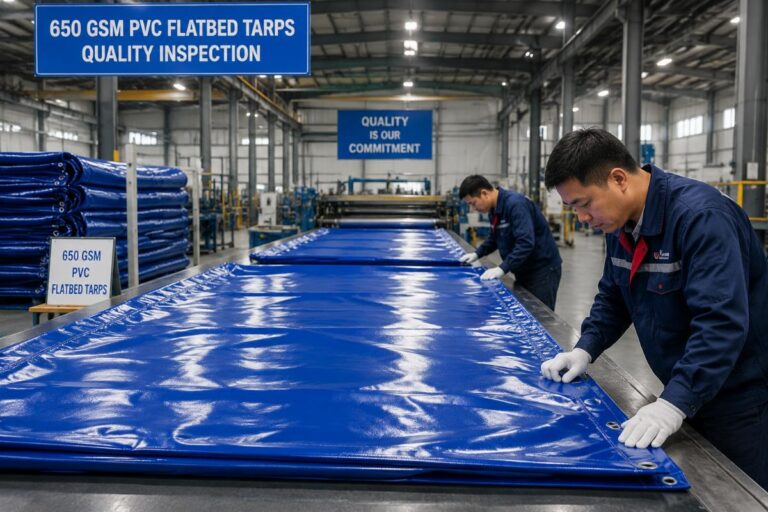
PVC tarpaulins, with their knitted polyester scrim sandwiched between calendered or coated PVC layers, offer superior hydrolysis resistance and tear strength. The continuous polymer skin prevents water ingress into the structural yarns, which is critical in regions where tarps double as temporary grain storage covers during the rainy season. PE tarpaulins, typically woven HDPE with laminated film on both sides, are lighter and cheaper but vulnerable to delamination when the laminated film peels from the woven substrate under sustained UV and moisture exposure.
| Parameter | PVC Tarpaulin | PE Tarpaulin |
|---|---|---|
| Hydrolysis Resistance | Robust | Vulnerable |
| UV Endurance (uncoated) | Standard | Noticeably reduced |
| Heat-Seal Capability | Full batch-level | Sample-level |
| Weight per Unit Area | Heavier range | Lighter range |
| Typical Use Case in Brazil | Mining, truck covers, long-term storage | Farm covers, short-term construction, event shelters |
A mining operation in Mato Grosso switched from PE to PVC after noticing that PE covers were delaminating along fold creases within a single wet season. The PVC replacement, properly formulated with anti-UV stabilizers, lasted substantially longer despite the higher upfront cost per square meter. [NEED_CITE: comparative weathering performance of PVC versus PE coated fabrics in tropical climates per material testing standards]
For buyers choosing between the two, the decision should be driven by expected service life and replacement logistics. If a cover must survive multiple seasons in full sun with minimal maintenance, PVC is the rational choice. If the tarp is a consumable item replaced annually as part of operational budgeting, PE delivers adequate performance at lower cost. A competent Tarpaulin Supplier for Brazil will stock both and advise honestly on which fits the application.
How to Verify Anti-UV Performance from China Suppliers?
Demand batch-level additive dosage records and accelerated weathering test reports—not verbal assurances—because anti-UV performance is the single most common failure point in Brazilian field deployments.
Anti-UV stabilizers in PVC and PE tarpaulins function by absorbing or quenching the free radicals generated by ultraviolet radiation before they can break polymer chains. The effectiveness depends on three variables: the type of stabilizer used, the dosage relative to the total compound weight, and the uniformity of dispersion throughout the calendered or laminated layer.
Most Chinese factories will claim their products are “anti-UV” without specifying what that means in practice. Some add minimal stabilizer just to pass a basic visual inspection after a short exposure period. Others use lower-grade stabilizers that degrade quickly and leave the polymer unprotected after the initial months of service.
The verification process should include three concrete requests:
- Additive dosage documentation: The factory should provide a record showing the type and proportion of UV stabilizer in the compound for your specific batch. [NEED_CITE: UV stabilizer dosage guidelines for flexible PVC and PE outdoor applications per coating industry references]
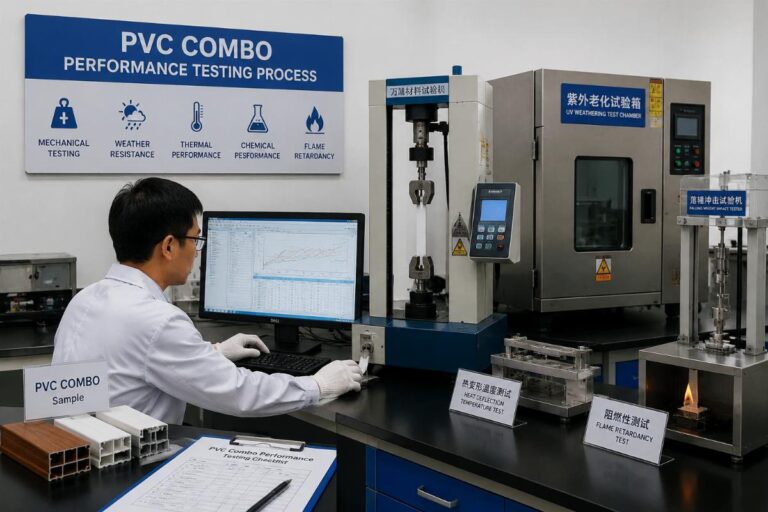
- Accelerated weathering test report: Look for results from standardized tests such as xenon-arc or QUV exposure, with clear pass/fail criteria for color retention, tensile strength retention, and surface integrity.
- Field correlation data: Reputable factories maintain records of how their products perform in actual deployments in similar climates. Ask for references from other South American buyers.
A buyer in Ceará received a shipment where the factory claimed “high anti-UV” formulation. Independent lab testing later revealed the stabilizer dosage was well below the level needed for equatorial conditions. The tarps began chalking and embrittling within months. The cost of replacing the entire shipment—freight included—dwarfed the original purchase price. [NEED_CITE: accelerated weathering test correlation with real-world tropical UV exposure per materials science literature]
When evaluating a Tarpaulin Supplier for Brazil, treat anti-UV claims as unverified until you see the supporting documentation. A factory that hesitates or deflects is signaling that their formulation control may not be as rigorous as they claim.
Factory-Direct Sourcing: MOQ, Lead Time & Cost Breakdown
Buying direct from a Chinese factory eliminates distributor margins and allows formulation customization, but requires understanding the real cost drivers: raw material volatility, MOQ flexibility, and export documentation handling.
The traditional supply chain for tarpaulins entering Brazil involves multiple intermediaries: a trading company in China, a regional agent, and a local distributor. Each layer adds margin, and none of them have direct control over production quality or formulation adjustments. Factory-direct sourcing collapses this chain, giving the buyer access to production-floor pricing and the ability to specify custom formulations.
The cost structure of a factory-direct order breaks down into several components:
- Raw material cost: PVC resin, plasticizers, UV stabilizers, and polyester scrim are commodity-priced and fluctuate with global markets. A transparent factory will quote based on current resin prices and adjust for repeat orders.
- Production cost: Calendering or coating line time, labor, and energy. This is relatively stable but varies with order complexity—custom colors and widths add setup time.
- Export handling: Packaging, palletizing, container loading, and documentation (commercial invoice, packing list, certificate of origin, fumigation certificate if applicable). A factory experienced in Brazilian imports will handle this seamlessly.
MOQ flexibility is a key differentiator. Some factories require full-container orders for custom formulations, which locks up capital and warehouse space. Others, particularly those serving diverse international markets, can accommodate smaller trial orders—single rolls or partial containers—allowing buyers to test formulation and quality before committing to volume.
Lead time depends on order size and customization level. Standard stock items ship quickly, while custom formulations and colors require production scheduling. A factory with multiple coating lines and raw material inventory can turn custom orders substantially faster than one that batches production infrequently.
A distributor in Rio Grande do Sul started with a trial order of a few rolls in a custom color and softness specification. After verifying quality and market acceptance, they scaled to full-container orders shipped on a regular schedule. The factory handled all export documentation and coordinated with the buyer’s freight forwarder for CIF or FOB terms as needed. [NEED_CITE: factory-direct sourcing advantages for customized technical textiles per international trade literature]
The lesson: a Tarpaulin Supplier for Brazil that offers MOQ flexibility, transparent cost breakdowns, and complete export documentation is positioned as a true manufacturing partner, not just a vendor.
Conclusion
Selecting a Tarpaulin Supplier for Brazil requires looking past GSM and price to evaluate formulation capability, anti-UV verification, and factory-direct logistics. Softness balance, climate-matched material selection, and documented additive control separate reliable partners from risky ones. Buyers who invest time in technical due diligence—requesting dosage records, weathering reports, and flexible MOQ terms—consistently avoid the field failures and hidden costs that plague poorly specified imports.