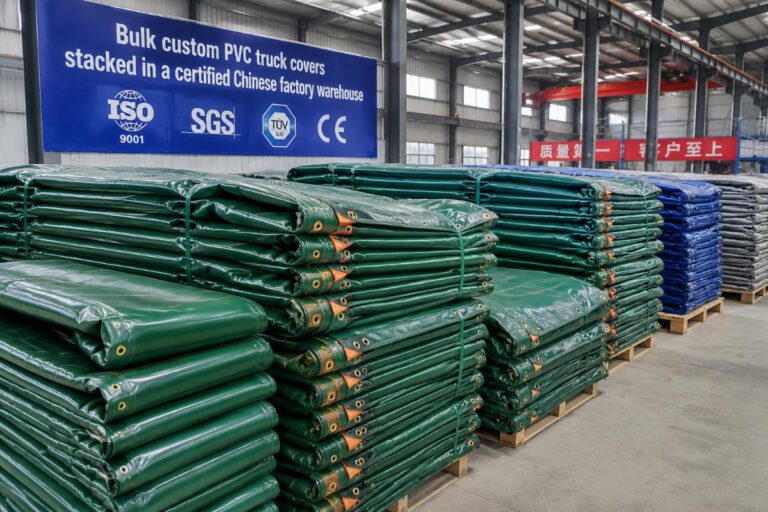
PVC Tarpaulin Manufacturer for Poland Market: 2026 Buyer Guide
Higher GSM does not guarantee longer service life in Poland’s climate. Coating formulation and base fabric weave density determine anti-UV endurance and chemical resistance far more than weight per square meter.
Selecting the best tarpaulin for Poland market requires matching PVC or PE specifications to EN 13666, REACH compliance, anti-UV grade, and road-salt chemical resistance—not just comparing GSM and waterproof ratings. A factory-floor buyer’s guide must weigh calendered versus coated PVC, verify certification documents, and lock down anti-aging parameters before shipment, otherwise container-load returns and port detention fees will erase any per-square-meter savings.
I spent years on the production floor in Boxing, Shandong, working alongside calendering lines and heat-sealing machines before moving into export coordination. A Polish outdoor-storage client once ordered a full container of 500gsm PVC truck covers. The contract only specified “waterproof and abrasion-resistant”—no anti-UV grade, no flame-retardant class, no chemical-resistance clause. Three months after arrival at Gdynia, the coating was chalking badly. Winter road salt had triggered acid-alkali corrosion, and UV exposure accelerated the breakdown. The entire container was rejected; ocean freight and port detention charges alone cost several times the original margin. Since then, every Poland-bound order starts with EN 13666, REACH, and anti-UV test reports on the table, with GSM, coating process, and colorfastness locked down item by item. [NEED_CITE: root cause analysis of PVC coating failure in cold-climate salt environments]
That rejection reshaped how I approach every Poland inquiry. Below is the specification matrix, certification checklist, and sourcing workflow I now use before a single roll leaves the factory.
What GSM and Coating Type Suit Poland’s Climate?
Poland’s temperature swing from sub-zero winters to mid-30°C summers demands a coating-process match, not just a GSM number. Calendered PVC and knife-coated PVC behave differently under thermal cycling, UV load, and chemical exposure. Choosing the wrong combination is the single most common reason for premature field failure in Central Europe. [NEED_CITE: comparative aging behavior of calendered versus knife-coated PVC films under thermal cycling]
| Parameter | Calendered PVC | Knife-Coated PVC | PE Laminated |
|---|---|---|---|
| Coating adhesion | Standard | Robust | Vulnerable |
| Anti-UV endurance | Noticeably reduced | Substantially extended | Basic |
| Flexibility at low temperature | Standard | Controlled | Vulnerable |
| Heat-seal seam strength | Standard | Robust | Noticeably reduced |
| Suitable GSM range | Mid-range | Wide range | Limited |
| Cost position | Competitive | Higher | Lowest |
A Central European agricultural buyer once specified calendered PVC at a mid-range GSM for grain-pile covers. The material performed adequately during summer, but by the second winter, seam lines cracked under repeated freeze-thaw cycles. Switching to knife-coated PVC at a comparable GSM extended service life meaningfully, because the coating bonded continuously to the base fabric rather than sitting on the surface. [NEED_CITE: freeze-thaw cycle impact on PVC tarpaulin seam integrity]
At Jinxiang, the production line covers PVC and PE tarpaulins across a full GSM spectrum, with both calendered and knife-coated options available in custom widths and colors. For Poland-bound shipments, I now recommend knife-coated PVC for any application involving prolonged outdoor exposure, and reserve calendered PVC for short-term construction covers where replacement cycles are planned.
Which Certifications Are Mandatory for Poland?
EN 13666, REACH, and flame-retardant classification are non-negotiable entry thresholds for the Poland market. Without these documents, customs clearance can be delayed, and end-buyers in transport and construction will reject shipments outright. [NEED_CITE: EN 13666 standard scope and REACH compliance requirements for flexible tarpaulin materials]
| Certification | Scope | Verification Level |
|---|---|---|
| EN 13666 | Tarpaulin performance classification (tearing strength, seam strength, dimensional stability) | Certified |
| REACH | Chemical substance registration, restricted substances in coating formulation | Certified |
| Flame-retardant class | Fire reaction rating for construction and transport applications | Certified |
| Anti-UV grade | Accelerated weathering test rating | Verifiable |
| Colorfastness | Light exposure and wash resistance rating | Verifiable |
A Polish truck-cover manufacturer once received a shipment from a supplier who provided only self-reported test data. When the buyer’s own lab ran REACH screening, restricted plasticizers were detected above threshold. The entire batch was quarantined, and re-testing costs ran into a mid-five-figure sum. The lesson: always demand third-party test reports from recognized laboratories, not factory-internal sheets. [NEED_CITE: REACH restricted substance detection in imported PVC coated fabrics]
When sourcing the best tarpaulin for Poland market, I now require the following document package before production begins: valid EN 13666 test report, REACH SVHC screening from an accredited lab, flame-retardant classification certificate, and anti-UV accelerated weathering data. Jinxiang maintains a complete export documentation library covering all these certifications, and test reports are issued per shipment batch rather than pulled from a generic archive.
How Does Road Salt Damage Tarpaulins and How to Prevent It?
Poland’s winter maintenance crews spread calcium chloride and sodium chloride on highways and urban roads. These salts create a chemical environment that ordinary PVC coatings are not formulated to withstand. The corrosion mechanism is not mechanical abrasion—it is acid-alkali attack on the plasticizer and coating resin, leading to chalking, embrittlement, and eventual coating delamination. [NEED_CITE: chemical degradation mechanism of PVC coatings under calcium chloride and sodium chloride exposure]
The failure sequence typically runs like this: salt residue settles on the tarpaulin surface during transport or storage. Moisture from rain or condensation dissolves the salt into a concentrated brine. The brine penetrates micro-pores in the coating, attacking the plasticizer bonds. Over repeated wet-dry cycles, the coating loses flexibility, develops micro-cracks, and begins to chalk. Once chalking starts, UV penetration accelerates, and the base fabric is exposed.
| Salt Exposure Condition | Coating Response | Expected Outcome |
|---|---|---|
| No chemical-resistant formulation | Vulnerable | Rapid chalking and embrittlement |
| Standard PVC formulation | Standard | Moderate degradation over one season |
| Chemically resistant coating formulation | Resistant | Substantially extended service life |
A Polish logistics fleet operator tested two batches of truck covers side by side: one with standard PVC coating, one with a chemically resistant formulation. After a single winter season, the standard batch showed visible chalking along fold lines and seam areas where salt accumulated. The resistant batch showed no measurable surface change. The cost difference in coating formulation was marginal compared to the replacement cost of premature failures across a fleet. [NEED_CITE: field performance comparison of chemically resistant versus standard PVC tarpaulin coatings in road-salt environments]
For buyers specifying the best tarpaulin for Poland market, I now include a salt-resistance clause in every contract, requiring accelerated chemical exposure test data alongside standard anti-UV and waterproof ratings. Jinxiang offers chemically resistant coating formulations across the PVC tarpaulin range, with test data available upon request.
PVC vs PE Tarpaulin: Which Wins for Poland’s Transport and Agriculture?
The choice between PVC and PE is not about which material is universally better—it is about which application scenario demands which performance profile. In Poland’s transport, agriculture, and construction sectors, each material has a clear winning zone, and mixing them up leads to either overspending or premature failure. [NEED_CITE: application-specific performance comparison of PVC versus PE tarpaulins in Central European climate conditions]
| Application Scenario | Recommended Material | Key Performance Requirement |
|---|---|---|
| Long-haul truck covers | PVC, knife-coated | Anti-UV, chemical resistance, seam strength |
| Agricultural grain pile covers | PVC or heavy-duty PE | Waterproof, anti-UV, tear resistance |
| Construction site protection | PVC, flame-retardant | Fire rating, durability, chemical resistance |
| Short-term temporary covers | PE laminated | Cost efficiency, basic waterproof |
| Pond liners and containment | PVC, reinforced | Chemical resistance, puncture resistance |
A Polish construction company switched from PE site covers to flame-retardant PVC after a fire-safety audit flagged their temporary material as non-compliant. The switch added cost per square meter, but eliminated the risk of work-stoppage penalties and insurance claim disputes. The PVC covers also lasted multiple seasons, whereas the PE covers needed replacement after each winter. [NEED_CITE: construction site fire-safety compliance requirements for temporary cover materials in Poland]
Jinxiang supplies both PVC and PE tarpaulins across the full GSM range, with the flexibility to provide material in roll form for manufacturers or finished products for direct end-users. MOQ runs from single rolls to full container loads, and custom widths and colors are available for both material families. For Poland-bound orders, I now match the material recommendation to the specific application scenario rather than defaulting to a single product line.
How to Avoid the Costly Mistakes of Shipping the Wrong Spec?
The majority of Poland-bound tarpaulin disputes trace back to specification gaps in the purchase contract, not to manufacturing defects. Locking down the right spec before production is far cheaper than resolving a rejected container after arrival. [NEED_CITE: root cause distribution of tarpaulin import disputes in Central Europe]
The workflow I now follow for every Poland order runs through four stages:
- Specification confirmation: GSM, coating type, width, color, anti-UV grade, flame-retardant class, and chemical-resistance requirements are documented in the contract with reference to EN 13666 and REACH standards.
- Pre-production sample approval: A production-representative sample is sent to the buyer for physical testing, including seam strength, flexibility at low temperature, and surface coating adhesion.
- Third-party inspection before loading: An accredited inspection agency verifies GSM, coating thickness, color consistency, and roll packaging against the confirmed spec.
- Document package verification: EN 13666 test report, REACH SVHC screening, flame-retardant certificate, and anti-UV data are compiled and sent to the buyer before the container leaves the port.
A Middle East distributor once skipped the pre-production sample stage to save time. When the container arrived, the color shade was off-spec, and the anti-UV coating was a lower grade than contracted. Resolving the dispute required a mid-five-figure expenditure in re-sorting and partial air-freight replacement. The time saved by skipping the sample was erased many times over. [NEED_CITE: cost impact of specification disputes in tarpaulin import transactions]
For buyers sourcing the best tarpaulin for Poland market, I recommend treating the specification document as the most critical part of the order, not an afterthought. Jinxiang supports this workflow with full batch-level test reports, pre-shipment sampling, and third-party inspection coordination, ensuring that every container leaving the factory matches the confirmed spec exactly.
Conclusion
Poland’s climate and regulatory environment demand a specification-driven approach to tarpaulin sourcing, not a price-per-square-meter comparison. Matching coating process to application, verifying EN 13666 and REACH compliance, accounting for road-salt chemical exposure, and locking down specs before production are the four pillars that separate successful supply relationships from costly disputes.