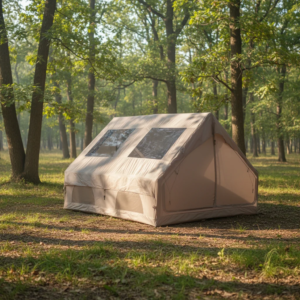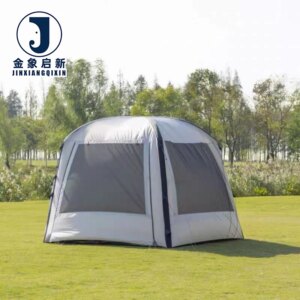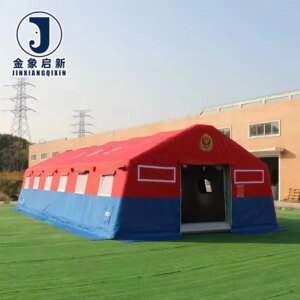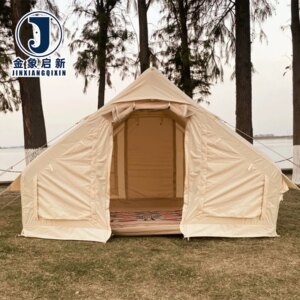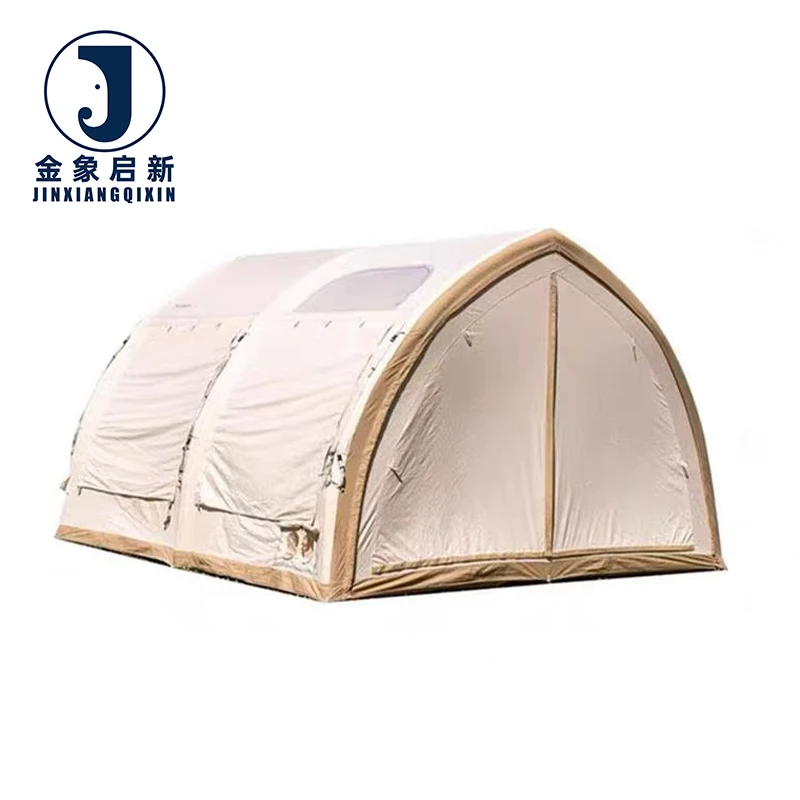
Precision Seam Integrity — 24-hour continuous inflation testing verifies every welded joint on this PVC Inflatable Tent before dispatch, eliminating field failures at the points under greatest stress.
Technical Specifications
| Parameter | Value |
|---|---|
| Product Type | Inflatable Tent |
| Core Material | PVC Tarpaulin (PVC knife-coated fabric) |
| Coating Method | Knife coated |
| Product Form | Inflatable structure with automatic opening |
| Season Rating | Four-season |
| Key Performance | Waterproof, UV-resistant, Tear-resistant |
| Flame Retardant | Grade not stated — confirm required grade for your market |
| UV Resistance | Test basis not stated — request test report to verify |
| Customization | OEM & ODM (sample customization, pattern printing) |
| Certifications | ISO9001, ISO14001, ISO45001, CE |
| Quality Control | Full-process inspection; 24-hour inflation test before shipment |
Application Suitability
| Application | Exposure & Requirement |
|---|---|
| Emergency command centers during disaster recovery | Rapid deployment, all-weather exposure, frequent relocation, structural stability under wind load |
| Temporary site offices for infrastructure projects | Prolonged outdoor exposure across four seasons, daily occupant traffic, abrasion at ground contact points |
| Equipment storage shelters in remote locations | Continuous UV and precipitation exposure, protection of high-value assets, resistance to puncture from stored machinery |
| Field maintenance workspace for transport fleets | Roadside or off-road environments, wind and dust ingress prevention, repeated inflation and deflation cycles |
Why Off-the-Shelf Tents Fail in Industrial Emergency Deployments
A tent that does not match your operational footprint costs more than the shelter itself.
When a disaster strikes a project site or a remote maintenance crew needs immediate cover, waiting for a generic-size tent to arrive — only to find it does not fit the staging area or leaves critical equipment exposed — creates compounding delays. I have seen infrastructure teams lose entire work shifts because the temporary shelter could not span the required workspace, forcing them to rig makeshift extensions that compromise weather protection. The PVC Inflatable Tent for emergency disaster relief is developed through OEM and ODM sampling so the dimensions match the site requirement before production begins. [NEED_CITE: rapid deployment shelter specifications for disaster response and industrial field operations]
Rapid Deployment Through Automatic Opening Design
The automatic opening mechanism built into this Inflatable Tent for truck and transport field operations cuts the time between arrival and full structural readiness. In emergency scenarios where minutes determine whether equipment is saved or lost, eliminating manual pole assembly and frame locking removes the most common bottleneck. The inflatable air-beam structure reaches operational rigidity once pressurised, providing immediate overhead protection for personnel and sensitive instruments.
Knife-Coated Fabric Under Continuous Field Stress
Knife coating applies the PVC compound directly onto the base fabric under controlled tension, producing a bond that resists delamination when the tent is repeatedly inflated, deflated, and folded for transport. This coating method is essential for four-season Inflatable Tent for emergency disaster relief applications where the fabric cycles through temperature extremes and mechanical flexing. The resulting membrane maintains waterproof integrity even after prolonged contact with standing water and wind-driven rain. [NEED_CITE: knife coating versus lamination adhesion performance on inflatable structures]
Understanding How Base Fabric and Coating Weight Interact
The tear resistance of this inflatable tent fabric depends on two variables working together: the denier and weave density of the base yarn, and the mass of PVC compound locked into the fabric matrix by the knife-coating process. A heavier coating fills the weave interstices more completely, improving waterproof performance and adding abrasion mass at contact points. However, tensile and tear strength originate primarily from the base fabric construction — a dense weave of high-denier yarns distributes load across more fibres before any single yarn reaches its breaking point. This is why quoting PVC Inflatable Tent material on coating weight alone gives an incomplete picture of how the fabric will behave when a gust loads the side wall or when a sharp edge presses against the ground skirt.
The Hidden Cost of Ignoring Weld Seam Verification
The most common failure point on any inflatable structure is not the fabric itself but the welded seams where panels join. When an airtight seal degrades, the tent loses pressure gradually — often slow enough that the problem goes unnoticed until a wind event collapses the structure onto stored equipment or occupying personnel. I have encountered situations where inflatable shelters passed a brief pressure check at the factory yet developed leaks within days because the weld temperature or dwell time was inconsistent across the seam length. The 24-hour continuous inflation test applied to every Inflatable Tent for emergency disaster relief before shipment catches these slow leaks by holding the structure under sustained internal pressure through a full thermal cycle. [NEED_CITE: heat welding parameters and seam integrity testing for PVC inflatable structures]
What Backs the Claim Beyond the Brochure
Production of this PVC Inflatable Tent for truck and transport applications runs on three dedicated lines with 36 sets of professional equipment, meaning capacity does not bottleneck when multiple custom orders overlap. The 10-technician R&D team handles sizing adjustments, pattern printing proofs, and sample development within days — allowing you to validate fit and finish before committing to a bulk run. Every unit undergoes full-process QA with dedicated inspection staff checking coating adhesion, dimensional accuracy, and airtight performance at each stage. ISO9001, ISO14001, ISO45001, and CE certification documentation accompanies each order for compliance submission. Samples ship quickly so procurement teams can confirm material hand-feel, colour, and inflation behaviour in real conditions before authorising production.
Documentation & Verification
- Material specification sheet stating base fabric, coating method, and waterproof performance parameters
- Pre-shipment inspection record with 24-hour inflation test results and airtight seam verification
- ISO9001, ISO14001, ISO45001, and CE certificates included per shipment
- Colour and print proof approval record for custom pattern orders
- UV-resistance and flame-retardant test reports supplied where applicable grades are specified
Fabrication, Handling & Storage
- Heat-weld all panel seams using temperature and dwell settings matched to the knife-coated PVC compound
- Store deflated tents flat or loosely rolled to prevent permanent creasing in the PVC coating layer
- Avoid dragging the PVC tarpaulin ground skirt across abrasive surfaces during deployment
- Clean with mild detergent only — solvent-based cleaners degrade the knife-coated surface bond
- Inspect welded seams after each inflation cycle for early signs of pressure loss
What to Include with Your Inquiry
Specify the intended deployment environment, including expected wind exposure, temperature range, and whether the tent will be permanently inflated or cycled between uses. Provide the required footprint dimensions and any internal clearance needs for equipment or occupancy. Indicate your market’s fire classification requirements so the correct flame-retardant grade can be sourced. If custom sizing or pattern printing is needed, note whether you require a pre-production sample for dimensional and visual approval before the bulk run.
Frequently Asked Questions
Q: How do you verify airtight seam integrity on inflatable structures before shipment?
A: Every inflatable tent undergoes a continuous 24-hour inflation test at our facility before dispatch. The structure is held under sustained internal pressure while dedicated QA staff monitor for pressure drop across the full cycle, confirming that all heat-welded seams maintain airtight performance under conditions that simulate real-world thermal variation.
Q: What customization options are available and what are the minimums?
A: OEM and ODM services cover custom sizing, colour selection, and pattern printing. Our R&D team develops samples within days for dimensional and visual approval. Minimum order quantities depend on the degree of customization — standard sizes carry lower thresholds, while fully custom footprints and printed branding require a conversation to confirm production feasibility.
Q: What UV-resistance test basis supports the fabric’s outdoor durability claim?
A: The PVC tarpaulin is specified as UV-resistant, but the exact test standard and exposure duration are not stated in the base specification. We recommend requesting the applicable UV test report for your order so the claim can be verified against your local outdoor exposure requirements and project compliance standards.
Q: Can you supply tents sized to fit specific vehicle or trailer footprints?
A: Yes. Custom sizing is a core part of the OEM and ODM capability. Provide the vehicle or trailer dimensions along with any clearance requirements for doors, ramps, or loading zones. A pre-production sample is developed for fit confirmation before the full production run is authorised.
Q: What documentation accompanies each shipment?
A: Each order ships with a material specification sheet, pre-shipment inspection record including the 24-hour inflation test result, ISO9001, ISO14001, ISO45001, and CE certificates, plus a packing list. Flame-retardant and UV test reports are included where the corresponding treatment grade has been specified on the purchase order.