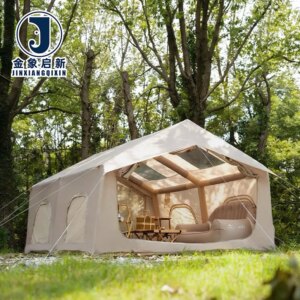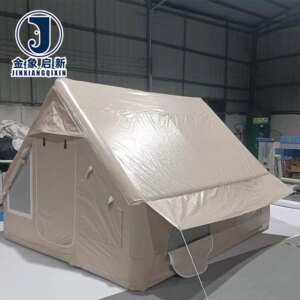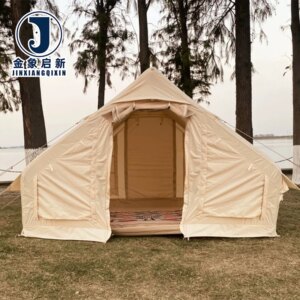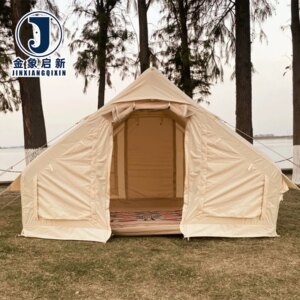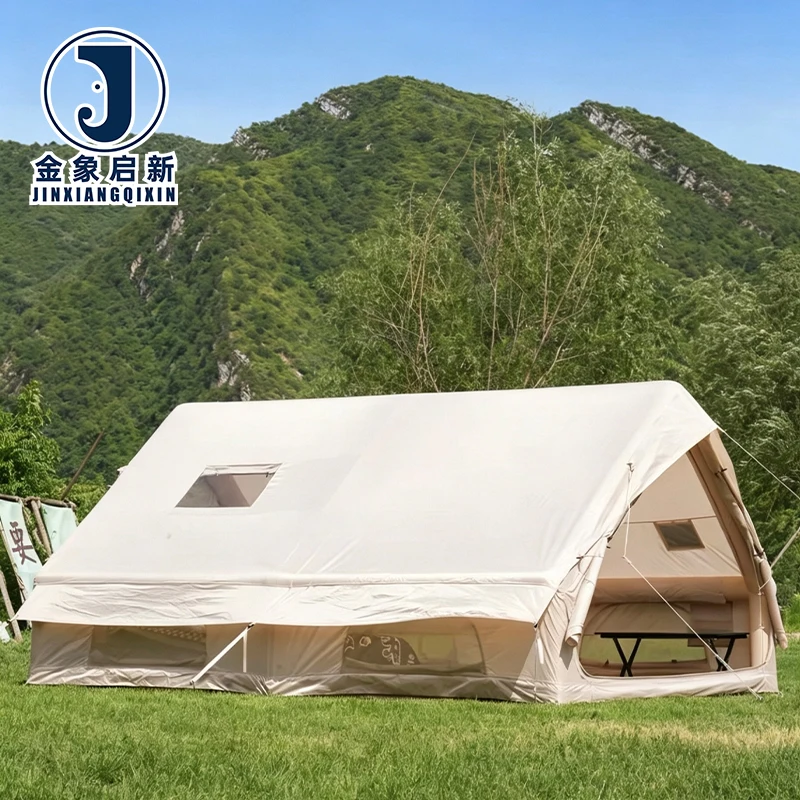
Consistent Batch Quality — Every roll of inflatable tent fabric undergoes in-process QA across our three dedicated production lines, ensuring GSM, coating weight, and colour remain uniform from first metre to last.
Technical Specifications
| Parameter | Value |
|---|---|
| Product Type | Inflatable Tent |
| Capacity | 8–10 Person |
| Core Material | PVC Tarpaulin |
| Coating Material | PVC |
| Construction | Single-layer |
| Opening Mechanism | Quick Automatic Opening |
| Season Rating | Four-Season |
| Key Features | Waterproof, UV-resistant (test basis not stated in source), tear-resistant, fire-retardant (grade not stated in source), anti-static (standard not stated in source) |
| Customization | OEM & ODM — sample customization, pattern printing, structural adjustments, material selection |
| Certifications | ISO 9001, ISO 14001, ISO 45001, CE |
Application Suitability
| Application | Exposure & Requirement |
|---|---|
| Commercial family camping equipment lines | Repeated inflation cycles, varied terrain contact, multi-season weather exposure, consumer safety expectations |
| Professional outdoor adventure packages | Transport abrasion, rapid deployment under field conditions, group occupancy loads |
| Team accommodation shelters at events | Continuous inflation over multi-day events, crowd proximity, wind uplift forces |
| Specialized event shelter systems | Custom branding requirements, frequent assembly and teardown, visible aesthetic standards |
| Four-season outdoor exposure environments | Temperature cycling, prolonged UV exposure, rain and snow load bearing |
Why Material Consistency Across Batches Matters More Than the Spec Sheet Alone
A spec sheet states intent; only batch-level verification confirms delivery.
When sourcing PVC tarpaulin for inflatable tent production, buyers frequently encounter a gap between the quoted GSM and the material that arrives on the dock. A roll that measures lighter than specified shifts the entire performance envelope — reduced tear resistance, lower inflation pressure tolerance, and shorter field life. The cost is not limited to the fabric itself; it extends to warranty claims, product returns, and the reputational damage when end users experience premature failure [NEED_CITE: tensile and tear test methods for coated fabrics per ISO 1421]. This is why pre-shipment inspection records matter as much as the initial quotation.
Coating Uniformity and Inflation Cycle Durability
An inflatable tent relies on sustained air pressure across every seam and panel. Single-layer PVC tarpaulin construction demands that the coating thickness remain uniform across the entire roll width and throughout the production run. Variations in coating weight create localized weak points where stress concentrates during inflation and deflation cycles. Our three full production lines are calibrated for repeatable coating application, and each inflatable tent fabric batch passes through dedicated QA checkpoints before reaching the finishing stage.
Seam Behaviour Under Repeated Flex and Pressure Loads
The seams on an inflatable tent endure a unique loading pattern — constant internal pressure combined with external wind flex and occupant movement. When welded seams fail before the base fabric does, it is almost always a consequence of inconsistent material composition at the weld zone. Processing across 36 sets of professional equipment allows us to maintain tight control over the thermal and pressure parameters at every joining point, reducing the incidence of delamination at the seams that buyers commonly report with unverified suppliers [NEED_CITE: weld seam peel strength testing for PVC coated fabrics].
Understanding How Base Fabric and Coating Work Together
The relationship between base fabric denier, weave density, and PVC coating weight determines how the material performs under real loads. A higher GSM reading does not automatically translate to greater tear resistance if the base fabric uses a loose weave with heavy coating fill. Conversely, a tightly woven base with moderate coating weight can deliver superior puncture resistance and dimensional stability — critical properties when an inflatable tent panel must hold shape under internal pressure and external wind load. The coating method, whether knife-over-roll or calendered, influences peel strength at the weld line and the surface texture that affects printing adhesion for branded tent panels. Fire-retardant and anti-static treatments are available in grades suited to different market requirements — confirm the specific grade and standard required for your destination market before placing a production order.
The Hidden Cost of Underspecified Fire-Retardant and Anti-Static Grades
Ordering PVC tarpaulin described as fire-retardant without confirming the specific classification can result in shipment rejection at the destination port or on-site inspection failure. Different markets enforce different standards — a grade accepted for temporary event structures in one jurisdiction may not satisfy the building material classification required in another. Anti-static properties carry the same verification burden; without a stated test standard, there is no basis for compliance documentation. Buyers who discover these gaps after production face rework costs, delayed event timelines, and potential liability exposure [NEED_CITE: DIN 4102 fire classification for building materials].
Why Procurement Teams Source Their Inflatable Tent Fabric Here
Our 10-person R&D team handles material selection, pattern printing, and structural adjustments specifically for inflatable tent applications, developing samples within days rather than weeks.
Dedicated QA/QC operates at every production stage with full inspection before shipment, catching GSM deviations and coating inconsistencies before they reach your facility.
Three full production lines and 36 sets of professional processing equipment provide the capacity to fulfil bulk orders while maintaining the roll-to-roll consistency that inflatable tent manufacturing demands.
Full documentation accompanies every dispatch — material specification sheets, test reports where applicable, and pre-shipment inspection records that your compliance team can file directly.
Documentation & Verification
- Material specification sheet stating base fabric denier, coating type, and confirmed GSM per roll
- Test reports for UV resistance and fire-retardant grades applicable to your market classification
- Pre-shipment inspection record verifying coating weight, colour consistency, and dimensional accuracy
- ISO and CE certificates supporting market access across regulated jurisdictions
- Roll packing list with batch traceability codes for post-delivery quality tracking
Fabrication, Handling & Storage
- Heat welding parameters must be adjusted to the specific PVC coating weight and single-layer construction of this inflatable tent fabric
- Store rolls horizontally on padded racks to prevent permanent creasing that weakens the coating at fold lines
- Allow cold-stored rolls to acclimatise before unrolling to avoid cracking the PVC coating at low temperatures
- Use compatible PVC adhesive for field repairs, ensuring the surface is clean and dry before application
- Plan cutting layouts to minimise cross-grain seams where inflation pressure creates the highest stress concentration
What We Need to Quote Your Custom Inflatable Tent Order
To provide an accurate specification recommendation and sample development, share your target capacity range, the inflation system you plan to integrate, and the environmental conditions the tent will face in service. Confirm the fire-retardant classification and anti-static standard required by your destination market. Specify any pattern printing, colour matching, or structural adjustments needed, along with your estimated annual volume and preferred roll width.
Frequently Asked Questions
Q: What customization options are available for the inflatable tent fabric?
A: We offer OEM and ODM services including material selection across available PVC grades, pattern printing for brand integration, structural adjustments to panel geometry, and sample customization for design validation. Our R&D team develops samples within days, allowing you to test inflation performance, seam integrity, and surface finish before committing to full production volumes.
Q: How is batch-to-batch consistency ensured across large inflatable tent fabric orders?
A: Every production run passes through dedicated QA checkpoints across our three full production lines. Coating weight, GSM verification, and colour consistency are checked against the approved sample specification. Pre-shipment inspection records document these measurements per roll, providing your quality team with traceable data before the material leaves our facility.
Q: What international certifications does the inflatable tent product carry?
A: The product is manufactured under ISO 9001, ISO 14001, and ISO 45001 certified management systems and carries CE marking. Specific fire-retardant grades and anti-static classifications are confirmed per order based on your market requirements. We provide the corresponding test reports and certification documentation to support your compliance filings.
Q: Can I request samples before placing a bulk order for inflatable tent fabric?
A: Yes. Sample development is a standard step in our sales process. Submit your application requirements, target specifications, and any custom printing or structural needs. Our R&D team produces samples for your evaluation of inflation behaviour, seam welding response, and material handling characteristics before you approve mass production.
Q: What documentation is provided to support market compliance for inflatable tents?
A: Each shipment includes a material specification sheet, test reports for applicable fire-retardant and UV-resistance grades, a pre-shipment inspection record, roll packing list with batch codes, certificate of origin, and customs support documentation. All paperwork is structured to meet the import and regulatory filing requirements of your destination market.