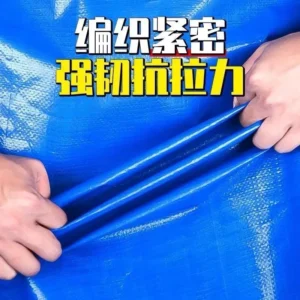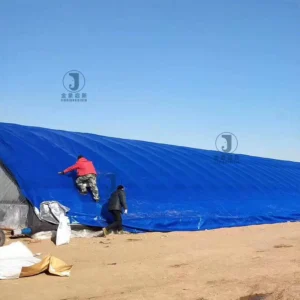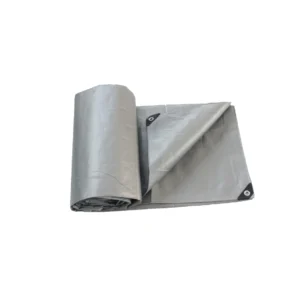
Roll-to-Roll Consistency — Every roll of PE tarpaulin for truck and transport covers is checked against the stated GSM, mesh count and colour reference before leaving the facility, so batch variation stays off the loading bay.
Technical Specifications
| Parameter | Value |
|---|---|
| Product Type | PE Tarpaulin |
| Coating Material | HDPE weaving with LDPE lamination on both sides |
| Weight Range | 50g/m² ~ 220g/m² available (confirm the grade for this item) |
| Total Thickness | 0.2–0.4 mm / 8 mil–16 mil |
| Mesh Count Options | 6×6, 6×7, 7×7, 7×8, 8×8, 9×9, 8×10, 10×10, 12×12, 14×14, 14×16 |
| Roll Widths | 6ft, 8ft, 10ft, 12ft, 2m, 4m, 6m |
| Roll Length | 100 yards, 100 meters, or custom |
| Regular Finished Sizes | 2x2m to 8x10m (and imperial equivalents) |
| Colour Options | Blue, Blue/Orange, Green, Grey, Black, Clear, Grey/Green, Orange, or custom |
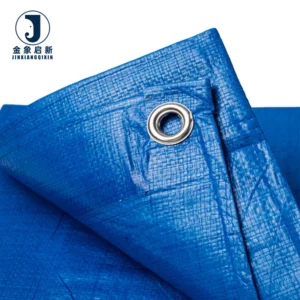
| Edge Reinforcement | PP rope in hem on all four edges |
| Eyelets | Galvanized, spaced every 3ft or 1 meter |
| Corner Reinforcement | Reinforced plastic corners |
| Waterproof Rating | Waterproof (test basis not stated in source) |
| UV Treatment | UV treatment available (test basis not stated in source) |
| Anti-Mildew | Mildew proof and anti-aging (test basis not stated in source) |
| Standards | ISO and CE certified facility |
Application Suitability
| Application | Exposure & Requirement |
|---|---|
| Flatbed and curtain-side truck loads | Rain ingress, road spray, sustained UV at highway speed, abrasion at load flex points |
| Container and intermodal freight | Salt-air moisture, stacking compression, prolonged sun on top panels |
| Boat and marine hull wraps | Constant moisture, UV reflection off water, tie-down stress at bow and stern |
| Construction scaffolding and site materials | Wind-driven rain, debris impact, daily rigging and removal cycles |
| Agricultural hay and crop staging | Ground moisture, UV degradation during open-yard storage, fungal growth in humid climates |
Why a "Generic Size" PE Tarpaulin for Truck and Transport Covers Costs More Than the Fabric Itself
A cover that does not match the trailer model creates gaps at the corners and excess material that flaps under road wind.
Fleet operators often order finished covers from a size chart rather than the exact trailer dimensions. The result is material bunching at the rear corners where abrasion concentrates, and exposed cargo edges where rain finds a path in. Over a single season of daily runs, the misfit cover fails at the hem first, then at the eyelet line, leaving the operator replacing the sheet twice a year instead of once. PE Tarpaulin for truck and transport covers must be specified against the actual trailer model — length, width, drop and tailgate clearance — not a nominal chart size. [NEED_CITE: trailer dimension variation across common European and North American fleet models]
Matching Finished Dimensions to the Trailer Model
When a transport operator orders PE tarpaulin for truck and transport covers, the first variable to lock down is the exact finished size. A 13.6 m curtain-sider requires a different cut from a 7.2 m rigid body, even if both fall under the same "large" category on a generic size chart. We work from the trailer model drawing to set length, drop height and the position of tie-down rails, so the finished cover reaches every eyelet without pulling or sagging.
Reinforcement at the Points Where Transport Stress Concentrates
The hem carries the highest tension on any truck cover because every strap load transfers through the eyelet into the rope-reinforced edge. Our PE tarpaulin sheets use a PP rope inserted into a folded hem on all four sides, heat-sealed and stitched to spread the load across a wider fabric area. Galvanized eyelets are pressed at 1 m intervals — closer spacing is available when the route involves sustained high-speed travel or heavy strap tension.
Controlling Colour Across a Mixed-Model Fleet
When a fleet replaces covers on 40 trailers, a visible shade difference between sheets parked side by side signals inconsistent sourcing to the end customer. We assign a single colour reference to the entire fleet order, then verify shade under D65 lighting during the pre-shipment inspection. Rolls allocated to the same order come from the same LDPE lamination batch, keeping the colour uniform across every finished cover. [NEED_CITE: D65 standard illuminant for industrial colour evaluation of coated and laminated fabrics]
Reading the Specs That Actually Determine Road Performance
GSM alone is often treated as the single indicator of strength, yet a 150 g/m² sheet with a 14×14 mesh count can outperform a 180 g/m² sheet woven at 8×8 when the load is exposed to cross-wind. The denser weave distributes tensile force across more yarns per centimetre, slowing tear propagation when a strap snags. Thickness, measured in mil or mm, tells you how much LDPE sits on the surface — more coating improves waterproofness and abrasion resistance at contact points, but also adds dead weight that increases fuel consumption on a full fleet. Mesh count and coating weight together define the balance between tear resistance, flexibility at low temperature and overall handling weight on the loading bay.
The Hidden Cost of Choosing the Wrong Mesh Count
A lightweight 6×6 mesh cover may pass the pull test on a calm day, yet shred at the eyelet line within weeks when exposed to motorway-speed wind load. The wider grid leaves fewer yarns to share the strap tension, and once one yarn breaks the tear runs unchecked along the weave direction. Operators who specify mesh count only by the lowest quoted price end up absorbing the replacement labour and cargo-exposure downtime that follows. [NEED_CITE: relationship between mesh count and tear propagation in woven PE tarpaulins]
Sourcing PE Tarpaulin by the Roll or as Finished Covers
Three full production lines support continuous roll output in widths from 2 m to 6 m, giving buyers the option to take PE tarpaulin in master rolls for their own cutting and welding, or as finished covers matched to individual trailer models. A dedicated R&D team handles custom width slitting, colour compounding and branded printing when fleet livery is required. Every production run passes through in-process QA and 100% pre-shipment inspection, so the roll you receive matches the mesh count, GSM and colour stated on the specification sheet. Samples for custom widths or colours are developed within days, allowing buyers to confirm fit and shade before committing to bulk.
Documentation & Verification
- Material specification sheet stating the exact GSM, mesh count and LDPE coating weight per roll
- Colour reference card matched to the specific lamination batch for that order
- Pre-shipment inspection record covering GSM verification and eyelet spacing check
- Roll packing list showing individual roll weight, width and running length
- UV and mildew treatment test report where applicable to the ordered grade
- Certificate of origin and customs documentation for export shipments
Fabrication, Handling & Storage
- Heat-seal the LDPE-coated edges at moderate temperature to avoid melting through the thin lamination layer
- Punch eyelets through the PP-rope hem only, never through unreinforced fabric, to prevent tear-out under strap load
- Store rolls vertically on a clean pallet to prevent flat spots that become permanent creases in the 0.2–0.4 mm sheet
- Unfold finished covers on a clean surface before deployment to avoid trapping grit that abrades the lamination
- Clean with mild soap and low-pressure water; solvent-based cleaners can soften the LDPE surface layer
Preparing Your PE Tarpaulin Enquiry
To receive an accurate recommendation, share the trailer model or exact finished dimensions, the typical route climate and the tie-down system in use. If your market mandates a specific UV or fire classification, state the standard so we can confirm whether the available treatment grades meet the requirement. Let us know whether you need master rolls for in-house fabrication or finished covers with hem, eyelets and reinforced corners ready to deploy.
Frequently Asked Questions
Q: How do I specify finished size to match my trailer model rather than a generic cut?
A: Provide the trailer make, model, body length, drop height and the position of your tie-down rails. We use these dimensions to generate a fitment drawing showing eyelet placement, hem drop and corner cut-outs. A sample cover is produced for on-trial fit before bulk goes to cutting.
Q: How is GSM verified on arrival and what documentation supports the quoted weight?
A: Each roll is weighed during the pre-shipment inspection and the actual GSM is recorded on the material specification sheet that travels with the shipment. You can cross-check by cutting a 1 m² sample from the roll and weighing it on a calibrated scale.
Q: What eyelet spacing and hem reinforcement options are available for high-speed transport?
A: Standard spacing is 1 m (or 3 ft) with galvanized eyelets pressed through the PP-rope reinforced hem. For high-speed motorway routes, closer spacing at 0.5 m and additional corner patches can be specified. Confirm the tie-down strap width so the eyelet inner diameter matches your hardware.
Q: How is batch colour consistency controlled across rolls in the same order?
A: All rolls allocated to a single order use LDPE from the same compounding batch. Shade is checked under D65 lighting during pre-shipment inspection, and the colour reference is printed on the specification sheet so you can verify consistency when covers are deployed side by side.
Q: What lead times and minimums apply to custom widths, colours or branded printing?
A: Custom slitting, colour runs and printed branding require a minimum roll quantity that varies with the width and print complexity. Sample development typically takes a few days; once approved, production follows the standard scheduling window. Confirm your required width, colour reference and annual volume when requesting a quote.