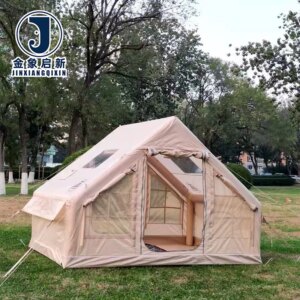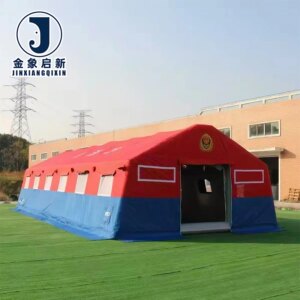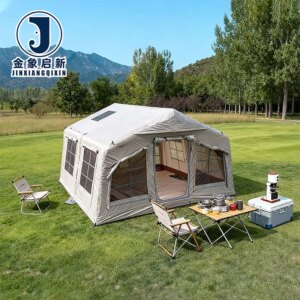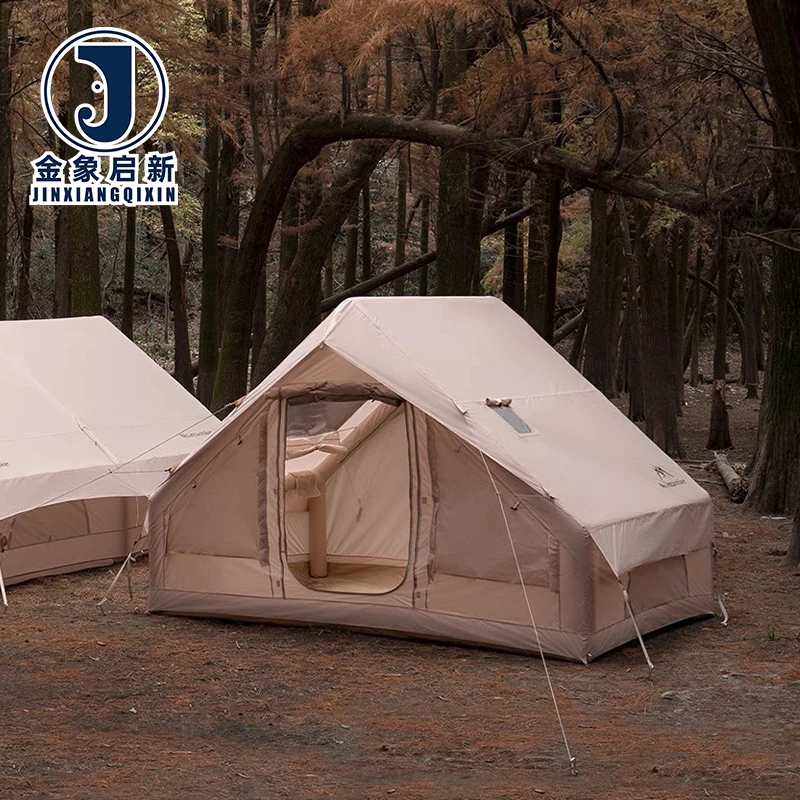
Process-Controlled PVC Inflatable Tent Manufacturing — every inflatable unit undergoes 24-hour pressure retention testing before dispatch, ensuring batch-to-batch consistency verified through full-process QA across three dedicated production lines.
Technical Specifications
| Parameter | Value |
|---|---|
| Product Type | Inflatable tent |
| Core Material | PVC tarpaulin (PVC knife-coated fabric) |
| Product Form | Inflatable structure with automatic opening mechanism |
| Capacity | 4-6 person |
| Key Performance | Waterproof, UV-resistant (test basis not stated), tear-resistant |
| Construction | Single layer |
| Customization | OEM & ODM, sample customization, pattern printing, size adjustments, color customization |
| Production Facility | 9,180 m² with 3 full production lines and 36 sets of professional equipment |
| R&D Support | 10-technician team |
| Quality System | Full-process QA/QC with 100% pre-shipment inspection |
| Certifications | ISO9001, ISO14001, ISO45001, CE |
Application Suitability
| Application | Exposure & Requirement |
|---|---|
| Temporary site offices for construction projects | Continuous outdoor exposure, wind loading, repeated setup and teardown cycles |
| Mobile exhibition spaces | High-visibility branding requirements, frequent transport between venues, quick assembly demands |
| Equipment storage shelters for outdoor events | Weather protection for sensitive gear, ground moisture contact, UV exposure during extended deployments |
| Industrial camping accommodations at remote sites | Crew comfort in uncontrolled environments, durability across multiple crew rotations, rapid deployment logistics |
| Equipment rental fleet deployments | High-frequency inflation-deflation cycles, handling by multiple end users, cross-site transport abrasion |
Why Inflatable Tents Fail at the Weld — and What a PVC Inflatable Tent Manufacturer Should Guarantee
Welded seams carry the structural load of every air-beam tent, yet most field failures originate at the seam before the fabric itself degrades.
When an inflatable shelter is deployed on a construction site or remote project camp, the air beams flex continuously under wind load and temperature-driven pressure changes. If the heat-weld parameters were set for a generic PVC grade rather than the specific knife-coated fabric in production, the bond strength at the seam falls below the tensile capacity of the surrounding material. The result is a slow leak that appears weeks after deployment — long enough to pass initial inspection but early enough to disrupt operations mid-project [NEED_CITE: tensile and tear test methods for coated fabrics per ISO 1421]. Sourcing from a PVC inflatable tent manufacturer that controls coating weight and adhesion in-house means the welding temperature, dwell time, and pressure are calibrated to the actual fabric batch, not a generic setting carried over from a different product run.
How Knife-Coated Fabric Translates to Air-Beam Reliability
PVC knife-coated fabric distributes coating material evenly across the base weave, producing a uniform thickness profile that directly supports consistent heat-weld performance. When coating thickness varies across the roll, the welder must compensate manually — a variable that introduces weak zones at seam intersections where air beams join. For a PVC inflatable tent deployed in commercial rental fleets or remote industrial camps, this uniformity determines whether the structure holds pressure through hundreds of inflation cycles or develops micro-leaks during the first season.
The Role of Stress-Point Reinforcement in Repeated Deployment Cycles
Every inflatable tent concentrates mechanical stress at junctions where air beams connect to the base and at valve mounting points. Our production process reinforces these zones with additional fabric layers bonded using the same knife-coated material, matching the thermal expansion coefficient of the primary shell. This approach prevents the delamination that occurs when reinforcement patches use a different coating chemistry. For equipment rental companies managing large fleets across multiple job sites, reinforced stress points mean fewer warranty returns and longer intervals between unit retirements [NEED_CITE: DIN 4102 fire classification for building materials].
Reading the Specification Sheet Beyond the GSM Number
GSM tells you the combined weight of base fabric and coating per square meter, but it does not reveal how that weight is distributed between yarn mass and polymer coating. A knife-coated PVC fabric achieves its tear resistance primarily through the base fabric’s denier and weave density, while the coating contributes waterproofing, UV stability, and weld integrity. Two fabrics at identical GSM can perform very differently under inflation pressure if one carries a heavier coating at the expense of base yarn count. For buyers specifying a PVC inflatable tent for industrial camping or rental fleet use, requesting the base fabric denier alongside GSM provides a more complete picture of how the material will behave under cyclic loading. Surface finish — whether glossy or matte — also influences practical outcomes: glossy surfaces shed dirt more easily during field cleaning, while matte finishes reduce glare in exhibition settings and improve ink adhesion for printed branding.
The Hidden Cost of Inconsistent Batch Performance in Rental Fleets
Rental companies deploying inflatable tents across dozens of sites simultaneously cannot afford units that behave differently from one batch to the next. When coating weight drifts between production runs, weld strength varies accordingly — meaning the same inflation pressure that one tent handles without issue may cause a seam failure in another from a different batch. This inconsistency forces rental operators to over-inspect every unit before dispatch, adding labor cost and turnaround time. Worse, a batch with lower-than-specified tear resistance may fail at a stress point during a client’s event, damaging the rental company’s reputation in ways that no single warranty claim can repair [NEED_CITE: coated fabric batch consistency standards for commercial inflatable structures].
Why Source Your PVC Inflatable Tent from Jinxiang
Our three full production lines handle PVC inflatable tent orders at volume while maintaining the process control that comes from nearly 30 years focused exclusively on coated fabric. The 10-technician R&D team develops custom sizes, colors, and pattern printing in-house, producing samples within days so you can verify fit, finish, and weld integrity before committing to a production run. Every unit undergoes 24-hour pressure retention testing — not a sample check, but a full test on every inflatable tent before it leaves the facility. Dedicated QA and QC staff monitor each production stage from coating application through seam welding using calibrated testing equipment, generating batch inspection reports that travel with your shipment. Full documentation packages including ISO9001, ISO14001, ISO45001, and CE certificates support your customs clearance and site compliance requirements without follow-up requests.
Documentation & Verification
- Material specification sheet stating GSM, base fabric denier, and coating composition per batch
- UV resistance and waterproof performance test reports accompanying each production run
- Batch inspection report with tensile strength data and inflation pressure specifications
- ISO9001, ISO14001, ISO45001, and CE certification documentation for customs and site compliance
- Pre-shipment inspection record confirming 24-hour pressure retention test results per unit
- Roll packing list with certificate of origin for international dispatch
Fabrication, Handling & Storage
- Heat-weld temperature and dwell time must match the specific PVC knife-coated fabric grade used in production
- Store rolled inflatable tents in a dry, shaded area to prevent UV degradation before first deployment
- Avoid stacking heavy items on packed units to prevent permanent creasing of the single-layer PVC shell
- Clean surfaces with mild detergent only — abrasive cleaners compromise the coated finish
- Inspect valve mounting points and reinforced stress zones before each inflation cycle
- Repair minor punctures using PVC-compatible adhesive patches matching the knife-coated material chemistry
What to Include in Your PVC Inflatable Tent Inquiry
Provide your target deployment scenario — whether rental fleet rotation, remote site accommodation, or event exhibition — along with expected inflation frequency and environmental exposure conditions. Specify any branding requirements including pattern printing, color references, and logo placement so our R&D team can develop an accurate sample. Confirm the compliance standards your destination market requires, particularly fire classification or UV performance documentation, so the correct test reports ship with your order.
Frequently Asked Questions
Q: What customization options are available for size, color, and pattern printing on inflatable tents?
A: Our 10-technician R&D team supports full OEM and ODM customization including adjusted dimensions, color matching to your reference, and pattern printing for branded deployments. We produce physical samples for your approval before mass production begins, allowing you to verify fit, color accuracy, and print quality against your project requirements.
Q: What test reports and compliance certificates ship with each inflatable tent order?
A: Every order includes a material specification sheet, batch inspection report with tensile and pressure data, and UV or waterproof test reports where applicable. ISO9001, ISO14001, ISO45001, and CE documentation are provided as standard to support customs clearance and site compliance in your destination market.
Q: How is batch-to-batch consistency controlled across large-volume inflatable tent orders?
A: Dedicated QA and QC staff monitor coating weight, seam welding parameters, and final pressure retention across every production stage. Each unit undergoes a 24-hour pressure test before packaging, and batch inspection records document material composition and performance data so every tent in your fleet meets identical standards.
Q: What is the sample development and approval process before committing to full production?
A: Submit your size, color, and printing requirements and our R&D team develops a sample within days. You evaluate the sample for dimensional accuracy, material feel, weld quality, and branding execution. Once approved, production proceeds using the same material batch and welding parameters verified during sampling.
Q: How are welded seams tested to ensure they survive repeated inflation and deflation cycles?
A: Stress points at beam junctions and valve mounts receive reinforced fabric layers bonded with matching PVC knife-coated material. Every completed inflatable tent is held under pressure for 24 hours, which reveals any seam weakness that shorter spot checks would miss, ensuring structural integrity through repeated deployment cycles.