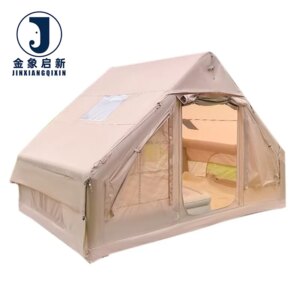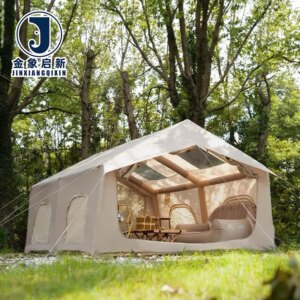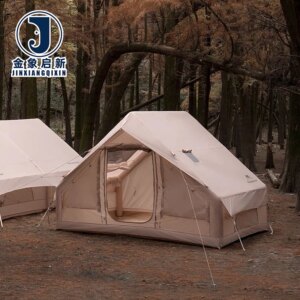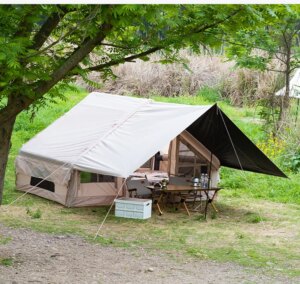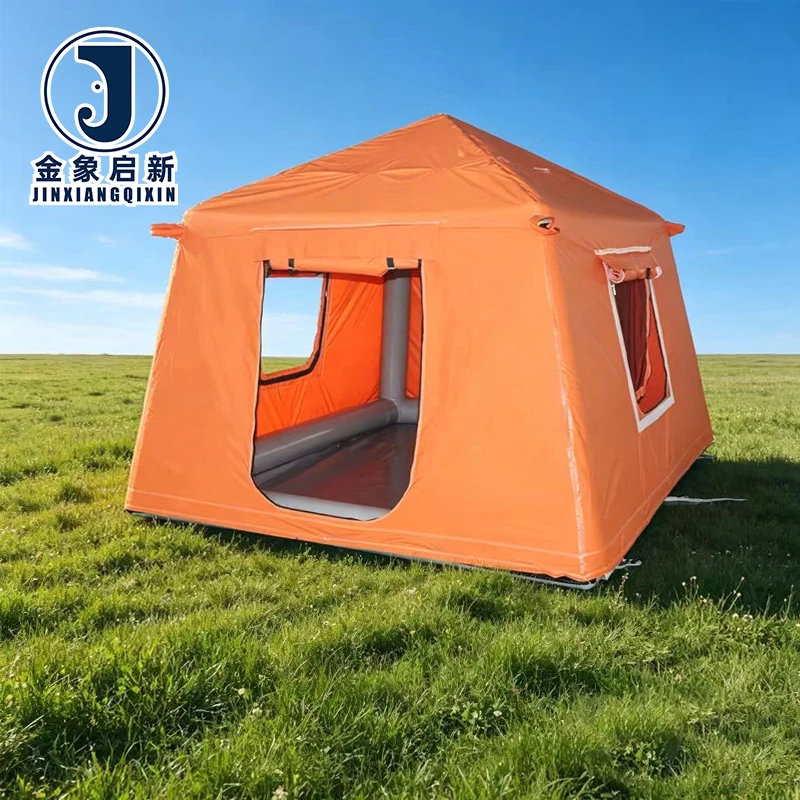
Dedicated QA at Every Stage — In-process inspection tracks colour, coating adhesion, and seam integrity from first metre to final roll of your custom inflatable tent order.
Technical Specifications
| Parameter | Value |
|---|---|
| Product Type | Inflatable Tent |
| Core Material | 420D Oxford Cloth |
| Construction | Single Layer |
| Capacity | 5-8 Person |
| Opening Mechanism | Quick Automatic Opening (inflatable) |
| Season Rating | Four-Season Design |
| Tensile Strength | ≥300 N/5 cm (test basis not stated in source) |
| Abrasion Resistance | ≥500 cycles (test basis not stated in source) |
| UV Protection | UPF 50+ (test basis not stated in source) |
| Waterproof Rating | 1000 mm water column (test basis not stated in source) |
| Seam Strength | ≥250 N (test basis not stated in source) |
| Deployment Cycle Test | 500+ cycles (source value — verify against manufacturer catalog) |
| Customization | OEM & ODM, sample customization, pattern printing |
| Certifications | ISO 9001, ISO 14001, ISO 45001, CE |
Application Suitability
| Application | Exposure & Requirement |
|---|---|
| Commercial camping and glamping operations | Repeated inflation cycles, guest turnover, seasonal UV exposure, ground moisture |
| Professional field operations and team accommodation | Rapid deployment under time pressure, varied terrain, extended outdoor exposure |
| Industrial event shelters | High foot traffic, temporary structural loads, wind-driven rain, frequent relocation |
| Outdoor equipment brand product lines | Batch-to-batch consistency, branding integration, retail-grade finish, compliance documentation |
Why Batch Colour Drift Can Ruin an Inflatable Tent Order
Consistent dye lots across every unit protect your brand reputation on the retail shelf and in the field.
Buyers sourcing inflatable tents for commercial distribution often discover that units produced weeks apart show visible shade variation when displayed side by side. The problem compounds when a replacement unit is shipped to a customer whose original tent has faded slightly — the mismatch is immediate and the complaint follows. [NEED_CITE: colour fastness standards for coated textiles in outdoor applications]
Structural Integrity Under Repeated Inflation Pressure
The 420D Oxford Cloth base fabric provides the dimensional stability an inflatable camping tent demands. When the air frame pressurises, the fabric must resist stretching at the seam lines and at curved transition points where the tube geometry changes direction. A base fabric that lacks adequate warp and weft density will deform under sustained internal pressure, causing the structure to sag or lean.
Deployment Reliability Across Commercial Use Cycles
Quick automatic opening mechanisms depend on the fabric maintaining consistent flexibility and air retention across hundreds of inflation cycles. Field operators who deploy and pack shelters daily need the material to resist crease-induced micro-cracking along fold lines. The single-layer construction keeps transport weight manageable while the coating formulation must balance air impermeability with pack-down flexibility. [NEED_CITE: fatigue resistance testing for inflatable structural fabrics]
How Base Fabric Denier and Coating Weight Interact
The 420D denier refers to the yarn weight in grams per 9,000 metres — a higher denier generally means a heavier, thicker yarn with greater individual strand strength. However, tensile performance in an inflatable tent depends equally on the weave density and the coating weight that locks the yarns in place. A loosely woven 420D fabric with a thin coating may tear more easily than a tightly woven lighter-denier fabric with a heavier, well-bonded coat. The coating also determines air retention properties, which is critical for inflatable structures where slow leaks cause visible sagging over hours of use. Specifying only the denier without reference to coating method and weight leaves the most consequential performance variable undefined.
The Hidden Cost of Skipping Seam Validation
Welded seams on inflatable structures carry the full internal air pressure at every joint. When seam strength is not verified against the rated inflation pressure, failure occurs at the most stressed junction — typically where the air tube meets the ground sheet or a cross-beam intersection. For commercial camping operators running multiple units across a season, a seam failure during high winds or heavy rain turns a shelter into a liability incident. Sourcing inflatable tent fabric without batch-specific seam strength documentation means accepting unknown risk on the single most critical failure point. [NEED_CITE: seam strength test methods for welded inflatable structures]
Why Procurement Teams Specify This Supplier
Three dedicated production lines with 36 sets of professional equipment handle bulk inflatable tent orders with capacity to maintain on-time delivery even during peak season demand. The 10-person R&D team develops custom sizing, pattern printing, and material specifications, moving from initial inquiry to finished sample within days rather than weeks. Every production stage includes dedicated QA/QC checkpoints, and a 100% pre-shipment inspection covers seam strength, air retention, and colour consistency before any order leaves the facility. ISO 9001, ISO 14001, ISO 45001, and CE certifications underpin the quality management system. [NEED_CITE: ISO management system standards for coated fabric manufacturing]
Documentation & Verification
- Material specification sheet stating 420D denier, coating type, and colour reference per order
- Test report for UV protection level and waterproof rating available per batch
- Pre-shipment inspection record covering seam strength and pressure retention
- ISO 9001, ISO 14001, ISO 45001, and CE certificates provided with shipment
- Roll or unit packing list with quantity verification before dispatch
Fabrication, Handling & Storage
- Heat-weld parameters should match the 420D Oxford coating formulation — request the recommended temperature range
- Reinforce seam junctions at tube intersections where inflation pressure concentrates stress
- Store rolled units upright in climate-controlled conditions to prevent coating crease damage
- Avoid dragging packed units across abrasive surfaces to protect the single-layer outer face
- Use mild detergent for field cleaning to preserve the UPF-rated surface coating
Preparing Your Inflatable Tent Inquiry
Provide your intended deployment environment, expected inflation cycle frequency, and the compliance standards your target market requires. Specify whether you need finished units with branded pattern printing or fabric rolls for your own fabrication line. Indicate your annual volume estimate and preferred colour references so that dye lot planning can be confirmed at the quotation stage.
Frequently Asked Questions
Q: UPF 50+ rating: what test standard applies and what does it mean for product lifespan?
A: The UPF 50+ designation is stated as a source value — the specific test standard should be confirmed for your market. This level of UV treatment is intended to reduce fabric degradation under prolonged sun exposure, supporting extended outdoor use in commercial camping and field operations. Request the applicable test report with your sample or order documentation.
Q: What custom sizes and configurations are available, and what is the MOQ for OEM/ODM inflatable tents?
A: Custom sizing, capacity configurations, and pattern printing are supported through OEM and ODM channels. The R&D team develops samples for approval before production commitment. Minimum order quantities depend on the specific configuration, colour, and printing complexity — submit your requirements for a confirmed quotation with lead time.
Q: How do you ensure colour consistency across multiple units or rolls in the same order?
A: In-process colour control monitors shade consistency throughout each production run. A 100% pre-shipment inspection includes visual colour verification across all units in an order. Dye lot planning is coordinated at the quotation stage so that your entire inflatable tent order is produced from matched material batches.
Q: What seam construction methods are used for inflatable structures, and how is seam strength verified?
A: Seams are constructed using methods matched to the 420D Oxford Cloth coating formulation. Pre-shipment inspection includes seam strength testing and pressure retention checks to confirm structural integrity under rated inflation conditions. Specific seam strength values are documented in the batch inspection record.
Q: How does the pattern printing and branding customization process work, from design to sample approval?
A: The 10-person R&D team handles pattern printing and branding from initial artwork review through sample production. A physical sample is developed within days for your approval before mass production begins. Colour matching and print positioning are confirmed on the sample unit to ensure the finished inflatable tent meets your brand specifications.