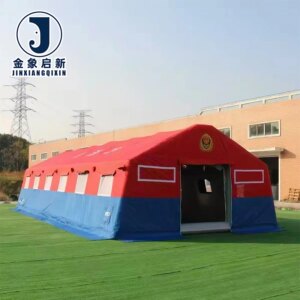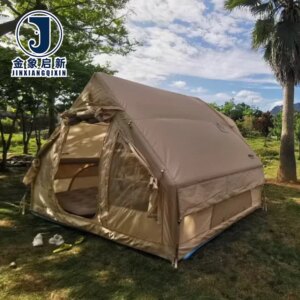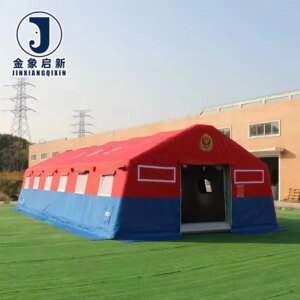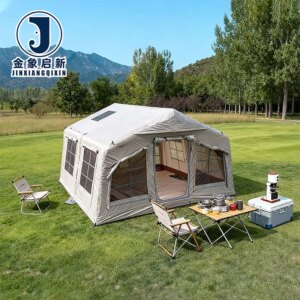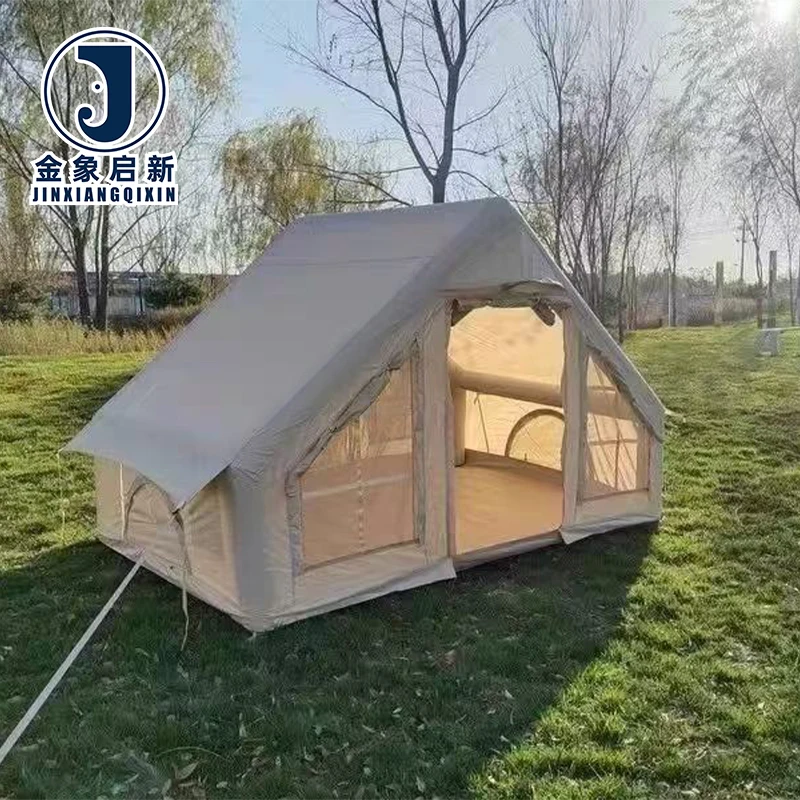
Process-Controlled Coating — PVC tarpaulin formulation managed from base fabric through final coating pass, ensuring consistent waterproof and UV-resistant performance across every inflatable tent unit produced.
Technical Specifications
| Parameter | Value |
|---|---|
| Product Type | Inflatable Tent |
| Core Material | PVC Tarpaulin |
| Layer Construction | Single layer |
| Waterproof | Yes |
| UV Treatment | UV-resistant (test basis not stated in source) |
| Tear Resistance | Tear-resistant (test basis not stated in source) |
| Flame Retardant Grade | Available in flame retardant grades — confirm the grade required for your market |
| Anti-Static | Not confirmed in source |
| Product Form | Inflatable structure with quick automatic opening |
| Customization | OEM & ODM (size adjustment, pattern printing, material thickness customization) |
| Standards | ISO 9001, ISO 14001, ISO 45001, CE |
Application Suitability
| Application | Exposure & Requirement |
|---|---|
| Emergency disaster relief shelter | Rapid deployment under severe weather, wind loading on inflatable frame, continuous UV exposure during extended field use |
| Temporary site offices at infrastructure projects | Daily foot traffic abrasion at entry points, dust ingress, temperature fluctuation across seasons |
| Emergency command posts for transport logistics | Vehicle exhaust and fuel proximity, repeated inflation/deflation cycles, low-light visibility requirement |
| Equipment storage shelters at fleet depots | Standing water and ground moisture, mechanical contact with stored machinery, long-term static loading on air beams |
| Modular welfare facilities for roadside operations | High occupant turnover, cleaning chemical contact on interior surfaces, seasonal thermal stress on single-layer membrane |
Why "Quick Automatic Opening" Only Matters When the Fabric Survives the First Inflation
An inflatable emergency shelter is only as reliable as the coated fabric holding the air beams together.
When a disaster response team unloads an inflatable tent from a truck, they expect the automatic opening mechanism to work under field pressure — not just on the factory floor. The PVC tarpaulin membrane must flex into shape without delaminating at the seams, resist puncture from debris on uneven ground, and hold internal pressure through temperature shifts. Yet many inflatable structures fail not because the inflation system is flawed, but because the coated fabric was specified for static applications and never tested under cyclic inflation stress [NEED_CITE: cyclic pressure testing methods for inflatable coated fabric structures]. The PVC Inflatable Tent for Truck and Transport is engineered with single-layer PVC tarpaulin construction that addresses the specific mechanical demands of repeated inflation and deflation across emergency and logistics deployment scenarios.
Deployment Readiness in Transport and Logistics Emergencies
When a fleet operator faces a highway incident or a logistics hub loses warehouse space to flooding, the PVC Inflatable Tent for Truck and Transport provides a shelter that inflates with a single-team operation. The quick automatic opening structure eliminates the need for pole assembly or heavy frame erection — critical when ground crews are already managing vehicle recovery or cargo protection. The single-layer PVC tarpaulin membrane keeps packed weight manageable for transport in standard service vehicles, while the waterproof coated construction protects personnel and sensitive equipment from rain, road spray, and ground moisture during extended roadside operations.
Material Integrity Under Repeated Inflation Cycles
The PVC tarpaulin used in this inflatable emergency shelter must withstand repeated stress at air beam junctions, where internal pressure concentrates and fabric flex is highest. Single-layer construction reduces the number of lamination interfaces that could separate under cyclic loading. UV-resistant treatment is specified to address prolonged outdoor exposure at construction sites and disaster zones where the shelter may remain deployed for extended periods [NEED_CITE: ISO 4892 methods for UV exposure testing of coated fabrics]. For procurement teams specifying inflatable tents across multiple deployment sites, verifying UV-resistance with test data — rather than relying on supplier claims alone — prevents premature membrane degradation that compromises structural pressure retention.
Understanding the Specification Sheet Before You Approve the Sample
The performance of any PVC inflatable tent depends on the relationship between base fabric construction and coating weight. A heavier coating does not automatically deliver higher tear resistance if the base fabric denier and weave density are insufficient to arrest tear propagation. The single-layer PVC tarpaulin in this inflatable tent balances coating adhesion with base fabric strength to maintain air beam integrity during inflation. Material thickness customization through OEM/ODM service allows buyers to specify a membrane weight appropriate to their deployment frequency — lighter for rapid-response kits that travel in vehicle compartments, heavier for semi-permanent site installations. Waterproof performance derives from the continuous PVC coating eliminating needle holes or weave gaps, while tear-resistant properties depend on base yarn tenacity and the coating’s ability to bond without creating brittle zones at weld lines. Flame retardant grades are available to meet regional compliance requirements — procurement teams should confirm the specific grade needed for their market before approving production samples [NEED_CITE: DIN 4102 and NFPA 701 fire classification frameworks for temporary structures].
The Cost of Underspecifying Inflatable Shelter Fabric
When an inflatable tent membrane is sourced on price alone, the consequences surface during deployment rather than inspection. A PVC tarpaulin that is lighter than the agreed specification may inflate successfully on the first cycle but lose pressure retention after repeated use as micro-cracks develop at beam fold points. UV-resistant claims without test backing lead to membrane embrittlement after a single season of sun exposure at a construction site, forcing full shelter replacement mid-project [NEED_CITE: field performance data on UV degradation in PVC tarpaulin inflatable structures]. Batch-to-batch colour variation across a multi-unit order becomes visible when tents are deployed side by side at a relief camp, undermining the professional appearance that logistics operators and government agencies expect. Weld seam failure at air beam junctions — the highest-stress point in any inflatable structure — typically traces back to inconsistent coating formulation rather than welding technique alone.
Why Procurement Teams Source This Inflatable Tent Here
Nearly three decades of coated fabric production provide the process depth needed to control PVC coating weight and adhesion consistency across inflatable tent production runs. Three full production lines with dedicated professional equipment support the volume required for large-scale emergency shelter deployment programmes without compromising lead time. The ten-person R&D team develops pre-production samples that allow buyers to verify material thickness, pattern printing accuracy, and inflation behaviour before committing to full order quantities. QA and QC inspection at every production stage — from base fabric intake through final inflation test — ensures that the PVC tarpaulin membrane meeting the specification sheet is the same material shipped to the deployment site. OEM and ODM customization, including size adjustment and material thickness selection, is handled within the same production facility, eliminating the coordination risk of splitting fabric supply and tent fabrication across separate vendors.
Documentation & Verification
- Material specification sheet stating core PVC tarpaulin type and layer construction per batch
- ISO 9001, ISO 14001, ISO 45001, and CE certificates available for compliance audit
- UV-resistance and tear-resistance test reports provided when grade is specified at inquiry
- Batch quality inspection record covering inflatable structure pressure retention testing
- Pre-shipment inspection report confirming size, pattern printing, and material thickness against approved sample
Fabrication, Handling & Storage
- Heat-weld air beam seams using temperature settings matched to the single-layer PVC tarpaulin thickness to avoid coating burn-through
- Store deflated inflatable tent units flat or loosely rolled to prevent permanent crease marks on the PVC tarpaulin membrane
- Avoid dragging the PVC tarpaulin base across abrasive ground during deployment to protect the waterproof coating layer
- Clean interior and exterior surfaces with neutral pH detergents compatible with PVC tarpaulin coating chemistry
- Inspect air beam weld lines after each inflation cycle for early detection of coating separation at stress points
- Allow full membrane drying before repacking to prevent mould growth on the single-layer PVC tarpaulin surface
What to Include in Your Inflatable Tent Inquiry
Provide the intended deployment environment — whether the inflatable emergency shelter will serve roadside recovery, construction site operations, or disaster relief staging — along with expected deployment frequency and duration per use. Specify any fire safety classification required by your regional authority or site safety plan, as flame retardant grades must be confirmed before production begins. Indicate whether you require custom sizing, pattern printing for organisational branding, or material thickness adjustment to match your transport and storage logistics.
Frequently Asked Questions
Q: What customization options are available for dimensions, printing, and material thickness?
A: The PVC Inflatable Tent for Truck and Transport supports full OEM and ODM customization including size adjustment to fit specific deployment footprints, pattern printing for organisational identification, and material thickness selection to balance packed weight with durability. Pre-production samples are developed by the R&D team for buyer approval before mass production begins.
Q: How can UV-resistance and tear-resistance claims be verified with test data?
A: UV-resistance and tear-resistance performance can be backed by test reports when the required grade or standard is specified at the inquiry stage. Buyers should confirm the test methods applicable to their market — such as ISO 4892 for UV exposure or ISO 1421 for tensile and tear testing — so that the correct protocols are followed during batch verification.
Q: What certifications accompany the inflatable tent and how do they support compliance?
A: The inflatable emergency shelter is produced under ISO 9001, ISO 14001, and ISO 45001 certified management systems and carries CE marking. These certifications are documented and available for compliance verification. For flame retardant requirements, buyers must specify the grade needed for their jurisdiction, and test documentation will be provided accordingly.
Q: What is the typical lead time for customized inflatable tent orders?
A: Lead time for customized PVC Inflatable Tent for Truck and Transport orders depends on the scope of OEM modifications including size changes, pattern printing complexity, and material thickness adjustments. Pre-production sample development is completed first to confirm specifications. Buyers are advised to share target delivery dates at inquiry so production scheduling can be aligned with deployment timelines.
Q: How is batch-to-batch colour and material consistency controlled across large orders?
A: Material consistency is maintained through controlled PVC tarpaulin coating processes with QA inspection at every production stage. Each batch undergoes quality checks before dispatch, and pre-shipment inspection records are provided to confirm that colour, thickness, and inflation performance match the approved sample across all units in the order.