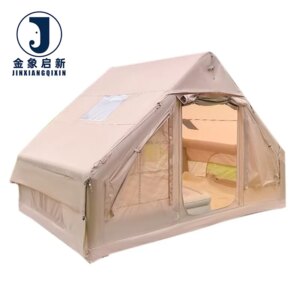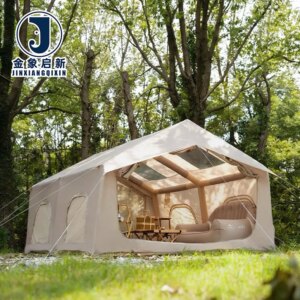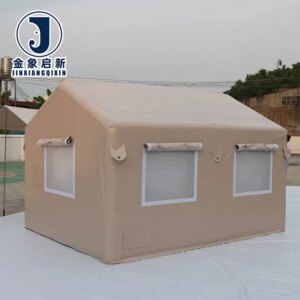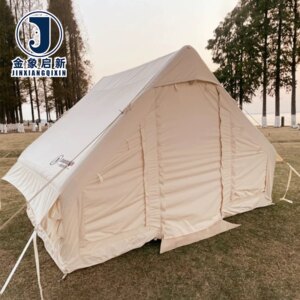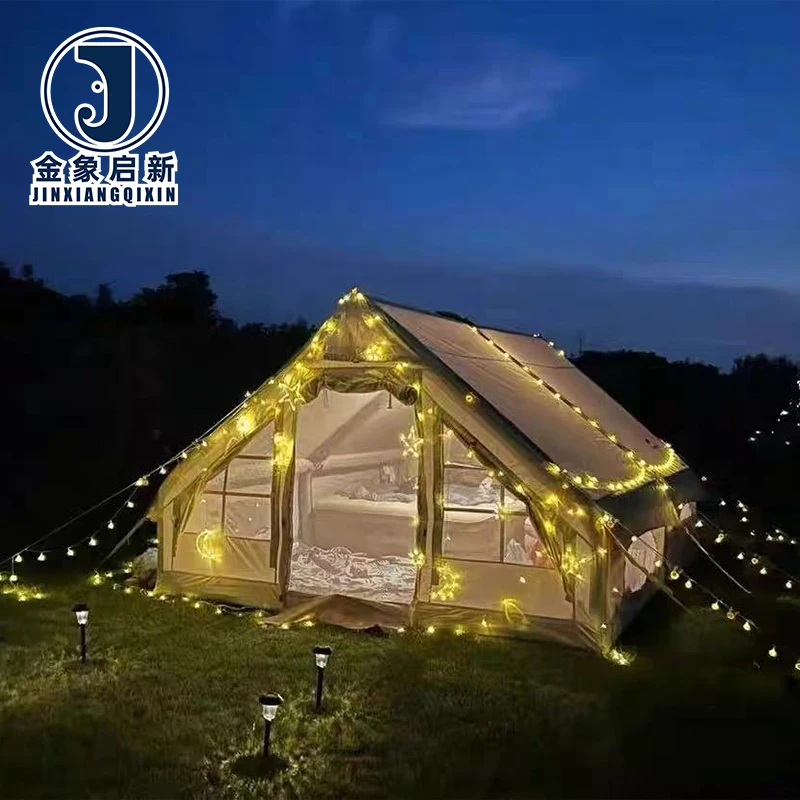
Proven Coating Control — every PVC-coated fabric roll used in our inflatable tents undergoes in-process coating weight checks across three dedicated production lines, ensuring the adhesion and waterproof integrity buyers can verify on arrival.
Technical Specifications
| Parameter | Value |
|---|---|
| Product Type | Inflatable Tent |
| Capacity | 4-6 Person |
| Core Material | PVC tarpaulin |
| Door Design | Double door |
| Waterproof Rating | Minimum 3000mm water column (source value — verify against manufacturer catalog) |
| UV Resistance | 4000 hours accelerated testing (source value — verify against manufacturer catalog) |
| Tensile Strength | ≥200N/5cm (source value — verify against manufacturer catalog) |
| Key Features | Waterproof, UV-resistant, quick automatic opening |
| Season Suitability | Summer outdoor use |
| Customization | OEM & ODM, sample customization, pattern printing available |
| Certifications | ISO9001, ISO14001, ISO45001, CE |
Application Suitability
| Application | Exposure & Requirement |
|---|---|
| Fleet operator driver rest shelters at rest stops | Road dust, repeated inflation cycles, rapid deployment by single operator |
| Roadside emergency kits for transport equipment | Compact storage in vehicle compartments, instant shelter during breakdowns or inspections |
| Remote staging and transfer yard crew shelters | Wind loading on open ground, prolonged UV exposure, ground moisture contact |
| Engineering project temporary site offices | Multi-day continuous inflation, crew traffic through double-door entry, weather protection |
| Outdoor recreation commercial rental fleets | High-frequency packing and unpacking, abrasion from transport and ground surfaces |
Why Inflatable Tent Fabric Weight Is Only Half the Specification Story
A stated GSM figure without verified coating adhesion tells you nothing about how the tent will hold air through repeated deployment cycles.
When sourcing inflatable shelters for fleet or yard operations, buyers frequently discover that the PVC tarpaulin quoted at one weight arrives feeling noticeably lighter. The Inflatable Tent for truck and transport applications demands more than a number on a data sheet — the bond between the base fabric and the coating layer determines whether seams hold under inflation pressure or delaminate at the first stress point [NEED_CITE: tensile and tear test methods for coated fabrics per ISO 1421]. We address this by running dedicated QA checkpoints at every coating stage, so the material reaching your production floor matches the specification you approved.
How Coated Fabric Construction Supports Rapid Inflation Cycles
The core of this inflatable tent relies on PVC tarpaulin produced with controlled coating weight and consistent adhesion across the base fabric. When the air bladder inflates, internal pressure distributes stress evenly across the panel surface, and the coating must resist micro-cracking at fold lines created during packing. Our material selection process accounts for the flex fatigue inherent in shelters that are deployed and stowed daily by logistics crews.
Double-Door Configuration for Operational Efficiency in the Field
The quick automatic opening mechanism paired with a double-door layout allows crew members to enter and exit without compromising internal air pressure. For fleet operators managing driver rest shelters at loading docks, this design reduces the time between arrival and a fully pressurised shelter. The PVC tarpaulin panels maintain structural rigidity once inflated, resisting wind-induced deformation on exposed yard surfaces.
Reading the Specification Sheet Beyond the Headline Numbers
The waterproof rating and UV resistance figures stated for this inflatable tent come from controlled test environments, and real-world performance depends on how the material is fabricated into the finished shelter. A minimum 3000mm water column rating indicates the coating can resist hydrostatic pressure, but seam construction and weld quality ultimately determine whether water penetrates at panel junctions. Similarly, the tensile strength value of ≥200N/5cm reflects the base fabric’s capacity under load, yet the coating-to-substrate bond strength governs how that strength translates when the tent flexes under wind pressure. Buyers should request batch-specific test data rather than relying solely on generic product family claims [NEED_CITE: hydrostatic pressure testing standards for coated technical textiles].
What Happens When Inflatable Shelter Material Is Specified Incorrectly
Selecting PVC tarpaulin based on price per roll rather than verified coating adhesion leads to shelters that lose pressure within hours of inflation. Welded seams on under-coated fabric fail at the flex points where the air bladder bends most, often before the fabric itself shows wear. In fleet operations, this means drivers arriving at rest stops to find collapsed shelters and logistics managers filing warranty claims. Batch-to-batch colour variation across multiple tents deployed side by side at a transfer yard also undermines a professional appearance, prompting costly replacements mid-contract [NEED_CITE: common failure modes in welded PVC tarpaulin seams under cyclic inflation].
Why Buyers Source This Inflatable Tent Through Our Facility
Three full production lines and 36 sets of processing equipment allow us to maintain volume output without sacrificing the coating consistency that inflatable structures demand. The 10-person R&D team handles pattern printing and sample development so that branding and dimensional requirements are locked in before bulk production begins. Every unit passes through 12 quality checkpoints, including hydrostatic pressure testing and UV aging validation, before it leaves our 9,180 square-metre facility. We develop samples within days for custom sizing, ensuring your deployment dimensions are confirmed before lead time commitment.
Documentation & Verification
- Material specification sheet stating base fabric type, coating method, and verified GSM per batch
- Hydrostatic pressure test record confirming waterproof rating for the specific production run
- UV accelerated aging report validating treatment performance for the ordered batch
- Pre-shipment inspection record with dimensional and visual checks documented per unit
- CE certificate and certificate of origin supporting import compliance in destination markets
Fabrication, Handling & Storage
- Heat-weld PVC tarpaulin panels at manufacturer-recommended temperatures to prevent coating delamination at seams
- Store rolled tent fabric vertically in climate-controlled warehousing to avoid permanent creasing across the coating surface
- Use compatible PVC adhesive for field repairs on punctures, matching the coating chemistry of the base material
- Avoid dragging packed tents across abrasive ground surfaces to protect the outer coating layer from scoring
- Inspect welded seam lines after each inflation cycle, focusing on high-flex zones near door openings and base corners
How to Scope Your Inflatable Tent Inquiry
Provide the exact deployment dimensions required for your vehicle or yard application, including any clearance constraints around parked trailers or loading bay infrastructure. Confirm whether your destination market requires specific fire classification or anti-static treatment for temporary shelter structures. Specify colour and any printed branding elements needed across the tent panels so that batch consistency can be locked at the sample approval stage.
Frequently Asked Questions
Q: How do you match tent dimensions to specific vehicle and trailer deployment scenarios?
A: We develop tent sizing against your exact deployment footprint rather than offering only generic off-the-shelf patterns. Our R&D team reviews your vehicle clearance diagrams or yard layout drawings and produces a sample for dimensional verification before bulk commitment. This ensures the inflatable tent fits the intended site without field modification.
Q: How can I verify the PVC tarpaulin GSM on arrival against what was quoted?
A: Each batch ships with a material specification sheet stating the verified GSM, and we recommend cutting a measured sample from the delivered roll to confirm weight independently. Our pre-shipment inspection records document the coating weight at multiple points across the production run, providing traceability back to the coating line.
Q: What ensures welded seam reliability during repeated inflation cycles?
A: We control heat-weld parameters based on the specific PVC tarpaulin coating formulation used in your order, preventing the common failure where seams separate before the fabric itself degrades. Every weld line is inspected at dedicated quality checkpoints, with particular attention to high-stress zones around door frames and base attachment points.
Q: What does accelerated UV testing mean for real-world roadside exposure?
A: The 4000-hour accelerated aging result indicates how the coating resists degradation under intensified UV conditions in a controlled chamber. Actual field longevity depends on installation orientation, local solar intensity, and surface maintenance. We supply the batch-specific test report so your technical team can model expected performance for your operating region.
Q: How is colour consistency maintained when multiple tents are deployed at one site?
A: We control pigment dosing at the coating stage and produce your entire order in a single production run wherever possible. Pre-shipment inspection includes side-by-side panel comparison under standardised lighting, and any roll showing visible deviation is held back before packing to ensure uniform appearance across your deployed inflatable tent fleet.