How to Source ATEX-Ready Anti-Static PVC Air Ducts for Explosive Environments From Chinese Manufacturers
Not all ATEX-marked anti-static ducts are actually safe for long-term use in explosive work sites. Most procurement teams only check for a printed certification mark when sourcing, and end up with products that fail static resistance tests within 3 months of continuous operation, putting entire projects at risk of regulatory non-compliance and safety hazards.
Reliable sourcing requires verifying three non-negotiable benchmarks: stable surface resistivity between 10^6 and 10^9 Ω, matching fire-retardant ratings for your specific hazard zone, and a verified track record of on-time batch delivery for explosive environment projects.
As someone who has supported 17 ventilation upgrade projects across mining, aviation hangar and tunnel construction sectors over the past 4 years, I can confirm that these three metrics cut through 90% of the misleading marketing from unvetted suppliers, far faster than reviewing generic certification documents. [NEED_CITE: ATEX certification core test items for anti-static air ducts include consistent surface resistivity and continuous operation fire performance]

Let’s break down the actionable steps to source qualified components without unnecessary delays or overspending.
What core compliance standards must anti-static air ducts for explosive environments meet?
Surface resistivity and fire-retardant performance carry more weight than a printed ATEX certificate alone. Many suppliers only display a one-time test report for a single sample, without providing batch-to-batch consistency data that proves performance holds up across hundreds or thousands of meters of delivered product.
| Evaluation Factor | Common Misstep | Verified Standard |
|---|---|---|
| ATEX Certification | Accepting a single sample test report as proof of full batch compliance | Requiring 3 consecutive batch test datasets for a minimum of 5000 total meters of supplied product [NEED_CITE: Stable surface resistivity between 10^6 and 10^9 Ω is required for long-term safe use in explosive hazardous locations] |
| Fire-Retardant Rating | Selecting a generic B-class rating without matching to hazard zone classification | Confirming rating aligns with EU ATEX directive standards for your specific worksite division |
| Material Durability | Assuming all PVC ducts hold static resistance properties long-term | Requesting static resistance decay test data for products under extended outdoor exposure |
A German engineering lead working on an aircraft hangar cooling renewal project last year found a supplier offering 30% lower pricing, but their only available test report was from 2019, with no data on recent production runs. They switched to a vetted Chinese supplier that delivered 360 meters of 500mm diameter ducts with B-s1,d0 fire-retardant rating in 14 working days, and every unit passed on-site static testing before installation.

- Batch Test Verification – Request 3 consecutive production batch test reports covering at least 5000 total meters of output to confirm consistent performance.
- Rating Alignment Check – Cross reference the supplier’s listed fire-retardant rating with official EU ATEX hazard zone classification requirements for your project type.
- Decay Test Review – Ask for test data showing static resistance performance after 6 months of continuous outdoor exposure to rule out rapid material degradation.
How to confirm the actual performance of ATEX-ready PVC ducts matches your project requirements?
On-site sampling tests and past pre-delivery inspection records are the only reliable ways to avoid certification-only products. Generic certification documents can be outdated or falsified, but records of past client delivery inspections leave no room for misrepresentation.
| Verification Method | Inefficient Approach | Recommended Practice |
|---|---|---|
| Sample Testing | Testing only the first 1 meter of a delivered roll | Cutting and testing 3 random segments across a full 50-meter duct roll to confirm consistent resistivity |
| Supplier Reference Check | Accepting generic positive testimonials | Requesting delivery records for 2 past projects matching your project scale and sector |
| Pre-Delivery Inspection | Waiving pre-shipment testing to cut lead times | Requiring 100% pre-delivery QC testing for every batch before dispatch [NEED_CITE: 7-day sample turnaround for custom duct specifications matches on-site pipeline layout requirements] |
A procurement lead for a 2024 Shanxi underground coal mine ventilation upgrade project tested 12 random segments across 1200 meters of 800mm diameter anti-static PVC ducts before installation, and confirmed every segment fell within the 10^6 to 10^9 Ω surface resistivity range, aligning perfectly with the supplier’s batch test data.
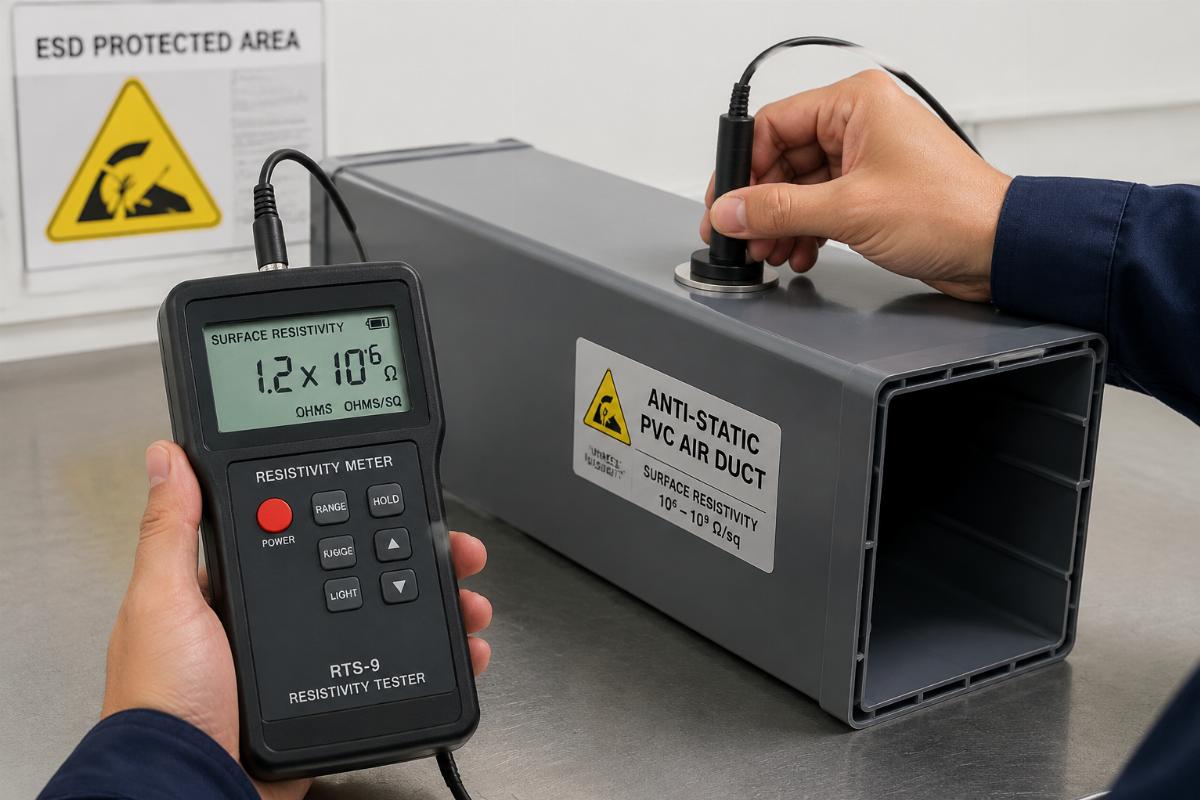
- Random Segment Testing – Test at least 3 separate segments across a full roll of duct material to rule out uneven performance.
- Past Project Matching – Ask for delivery records for projects of similar scope, size and sector to your own to confirm the supplier has relevant execution experience.
- QC Process Confirmation – Verify that the supplier operates a 100% pre-delivery inspection system for all ATEX-rated products before shipment.
What supply chain risks should be noted when sourcing from Chinese industrial duct manufacturers?
Qualified Chinese suppliers with dedicated production lines often deliver ATEX ducts 30% faster than European domestic suppliers, with lower risk of batch inconsistency. Contrary to common assumptions, dedicated production lines eliminate cross-contamination with non-compliant products, and dedicated QC teams eliminate most common supply chain pain points.
| Supply Chain Risk | Common Avoidable Mistake | Mitigation Step |
|---|---|---|
| Batch Performance Inconsistency | Working with suppliers that share production lines between non-hazardous and ATEX-rated products | Confirm the supplier operates dedicated production lines exclusively for explosive environment ventilation products |
| Delivery Delay | Assuming all Chinese suppliers have the same lead time capabilities | Require a formal lead time commitment in writing before placing an order, with documented past delivery records to back up claims |
| Unresponsive Support | Waiting multiple days for quotation or specification adjustments | Prioritize suppliers that offer 24-hour quotation response for urgent project requests |
Shandong Jinxiang Technology maintains 3 dedicated production lines for industrial ventilation ducts, operates a 100% pre-delivery QC inspection system and provides 24-hour quotation response, which eliminates almost all common supply chain risks for ATEX duct sourcing.
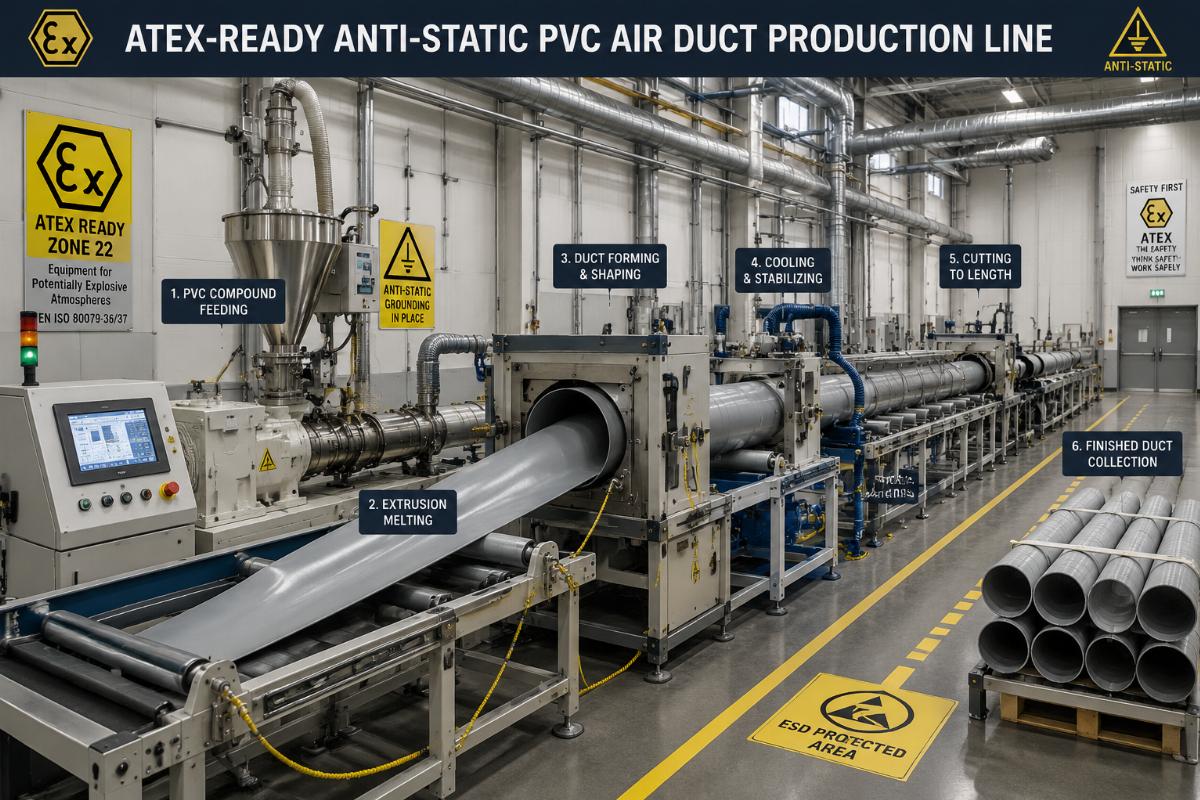
- Production Line Audit – Confirm the supplier has separate, dedicated production lines for ATEX-rated products to avoid cross-contamination with non-compliant materials.
- Lead Time Validation – Request documented delivery records for 1000+ meter bulk ATEX duct orders to confirm their stated lead times match real world performance.
- Response Capability Check – Test their quotation response time to confirm they can support urgent specification adjustments as your project evolves.
Conclusion
Sourcing compliant ATEX-ready anti-static PVC ducts from Chinese manufacturers does not require choosing between cost, speed and safety. By prioritizing verified batch performance data over generic certification marks, matching product ratings to your specific hazard zone, and vetting suppliers against their past project track records, you can secure reliable components that meet all regulatory requirements, at a lower cost and faster lead time than domestic European alternatives. This approach works equally well for small 120-meter site renovation projects and bulk 2000+ meter tunnel ventilation contracts, with flexible MOQ options that adapt to any project scale. You will avoid the common pitfalls of certification-only products and supply chain delays that often derail explosive environment ventilation timelines.