Rapid Sample Development — A dedicated 10-person R&D team can develop a custom PCA duct sample in days, letting you verify fitment and insulation performance before committing to a full production run.
Technical Specifications
| Parameter | Value |
|---|---|
| Product Type | Aviation Air Duct |
| Diameter | 12 Inch |
| Material | PVC coated fabric-reinforced layer with aluminum foil insulation |
| Temperature Range | -30°C to 150°C |
| Characteristic | Mildew resistance, water resistance, high strength and strong tension |
| Connection Method | Zipper and Velcro link for disassembly |
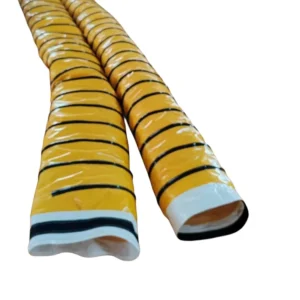
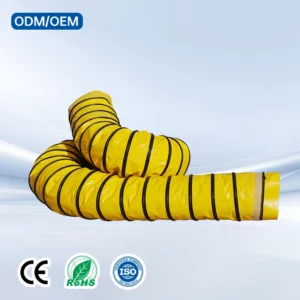
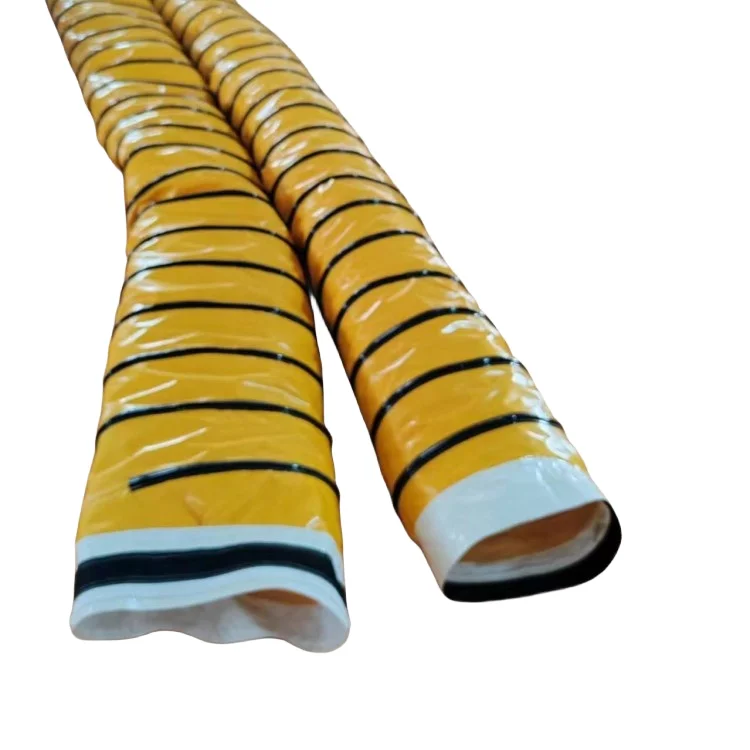
| Outer Layer | Yellow-black alternating protective coloring for high visibility |
| Standards | ISO, CE |
| Logo Customization | Support MOQ 100 |
| Pattern Customization | Support MOQ 100 |
Application Suitability
| Application | Exposure & Requirement |
|---|---|
| Airport apron ground air supply equipment | Continuous outdoor UV exposure, mechanical abrasion from ground vehicles, thermal stress from extreme temperature differentials |
| Transmitting pre-conditioned cold or warm air from PCA Unit to aircraft cabin | High airflow pressure, condensation risk, rapid deployment and teardown between aircraft turns |
| Temporary ground cooling for aircraft maintenance hangars | Dust and debris ingress, physical impact from tools and equipment, extended operational cycles |
Why PCA Hoses Fail Compliance Audits Before They Ever Reach the Apron
Compliance documentation must match the operational environment before the hose ever reaches the apron.
Ground support equipment often arrives on site with ventilation duct that lacks the specific fire-retardant or anti-static certification required by the airport authority or airline specification. The duct may be physically capable of the job, but without the correct test report, it is grounded during the first audit. This is a compliance gap, not a material failure, yet it delays aircraft turnarounds just the same. Buyers frequently assume that a general "flame retardant" claim covers all aviation requirements, when in reality different jurisdictions and airport operators mandate specific test methods and pass grades. The Aviation Air Duct aftermarket supplier must provide the exact documentation chain that the site safety officer will demand. [NEED_CITE: airport ground support equipment fire safety regulations]
Thermal Insulation and the Aluminum Foil Bubble Film Layer
The primary function of an Aircraft PCA Hose for ground support is to deliver pre-conditioned air at a stable temperature from the apron-mounted unit to the aircraft cabin interface. The PVC coated fabric base provides the structural strength and flexibility required to route the hose around ground equipment, while the aluminum foil bubble film insulation layer is responsible for maintaining the thermal integrity of the air stream. This dual-layer construction ensures that cold air generated by the PCA unit does not absorb ambient heat on a hot tarmac, and that warm air does not lose temperature in freezing conditions. The stated temperature range of -30°C to 150°C covers the operational extremes encountered across different climate zones and seasons.
Apron Safety and Rapid Deployment Between Turns
On a busy airport apron, visibility is a safety requirement. The yellow-black alternating protective coloring on the outer layer of this aviation cooling duct is designed to ensure the hose is clearly visible to ground crew and vehicle operators, reducing the risk of drive-over damage or trip hazards. The connection method — a zipper and Velcro link system — is engineered for the rapid deployment and teardown required between aircraft turns. Ground handlers can connect, disconnect, fold, and store the duct sections quickly without tools, minimizing the time the aircraft spends on the ground waiting for cabin conditioning. This is a critical factor in maintaining on-time departure schedules.
Material Construction and Temperature Range Interpretation
The material specification of PVC coated fabric-reinforced layer with aluminum foil insulation defines how this duct performs under both mechanical and thermal stress. The PVC coating provides water resistance and mildew resistance, which is essential for a product that is regularly deployed on wet tarmac and stored in humid conditions. The -30°C to 150°C temperature range indicates the operational boundaries within which the insulation layer and the PVC coating maintain their structural integrity; below -30°C the PVC may become brittle, and above 150°C the coating may soften. The 12 Inch diameter is a standard fitment for many PCA unit output couplings and aircraft belly panel interfaces, but it is always necessary to verify the specific coupling dimensions of your ground support equipment before ordering. [NEED_CITE: PCA duct temperature test methods for aviation ground equipment]
The Hidden Cost of Non-Compliant Ground Support Ducting
When a duct is supplied without the correct fire-retardant or anti-static certification for the specific airport or airline, the entire ground support unit can be taken out of service until compliant replacement ducting is sourced and delivered. This is not a minor inconvenience; it grounds expensive equipment and disrupts flight schedules. Similarly, a duct that lacks the mechanical strength to withstand repeated flexing, drive-over incidents, and the internal pressure of high-volume air flow will develop seam failures and fabric tears well before its expected service life. The cost of replacing a failed duct section is small compared to the cost of a delayed aircraft departure. Buyers must verify the specific certification requirements of their operating environment before placing an order. [NEED_CITE: cost of aircraft turnaround delays due to ground equipment failure]
Sourcing from a Specialist Coated Fabric Manufacturer
This aviation cooling duct is produced in a 9,180 m² facility with three full production lines and 36 sets of professional equipment, providing the bulk capacity required for fleet-wide ground support equipment upgrades. The 10-person R&D team handles material selection and sample development, allowing you to test a custom length or coupling configuration before full production. Dedicated QA/QC is applied at every production stage, with 100% inspection before shipment to verify seam integrity, zipper and Velcro function, and dimensional accuracy. The manufacturer holds ISO and CE certification, and can provide the documentation chain required for aviation compliance audits. Samples for custom requirements are typically developed within days.
Documentation & Verification
- Material specification sheet stating base fabric denier, PVC coating weight, and aluminum foil insulation layer composition
- Test report for fire-retardant and anti-static grades, specifying the test method and pass grade
- Pre-shipment inspection record confirming seam weld integrity and zipper/Velcro function
- ISO and CE certificates applicable to the manufacturing facility
- Roll packing list with individual duct section dimensions and weight
Fabrication, Handling & Storage
- Verify zipper and Velcro connection alignment before each deployment to prevent fabric stress at the coupling point
- Fold the duct along the same crease lines each time to avoid random stress fractures in the PVC coated fabric layer
- Store folded duct sections in a dry, shaded area to prevent UV degradation of the outer yellow-black coloring
- Clean the exterior with a mild detergent and soft brush; avoid abrasive cleaners that could damage the PVC coating
- Inspect seam welds and connection points for signs of delamination or tearing before each aircraft turn
Confirming Your Specification Before Inquiry
To ensure the duct section you receive matches your operational requirements, please be prepared to provide the specific PCA unit model and aircraft type you are servicing, the fire-retardant or anti-static certification required by your airport authority or airline, and the total length and quantity of duct sections needed. If you require a custom diameter, length, or coupling end configuration, specify this in your initial inquiry along with any pattern or logo customization requirements and the applicable MOQ.
Frequently Asked Questions
Q: What fire-retardant and anti-static certifications are available for aviation apron use?
A: The duct can be manufactured with fire-retardant and anti-static treatments, but the specific test method and pass grade required vary by airport authority and airline. You must confirm the exact certification standard your site requires (e.g., a specific NFPA, UL, or regional aviation authority standard) so the correct material grade and supporting test report can be supplied with the shipment.
Q: How is the duct connected to the PCA unit and aircraft cabin interface?
A: This 12 Inch flexible duct uses a zipper and Velcro link system for connection. This allows for tool-free, rapid deployment and teardown between aircraft turns. The coupling ends should be verified against the specific output flange of your PCA unit and the input coupling on the aircraft belly panel to ensure a secure, airtight fit.
Q: Can the duct be supplied in custom lengths or with specific coupling ends?
A: Yes, the duct can be manufactured in custom lengths to suit your specific ground support equipment layout. Custom coupling ends, logo application, and pattern customization are also available, subject to a minimum order quantity of 100 units. Provide your exact dimensional and connection requirements in your initial inquiry.
Q: What documentation ships with each duct section for site compliance audits?
A: Each shipment includes a material specification sheet, a pre-shipment inspection record, and the relevant ISO and CE certificates for the manufacturing facility. If a specific fire-retardant or anti-static grade has been ordered, the corresponding test report stating the test method and result will also be included.
Q: How should the duct be stored and folded between deployments to extend service life?
A: The duct should be folded along consistent crease lines and stored in a dry, shaded environment away from direct sunlight and chemical exposure. Avoid placing heavy objects on top of stored sections, as this can cause permanent creasing or damage to the aluminum foil insulation layer and the PVC coated fabric.