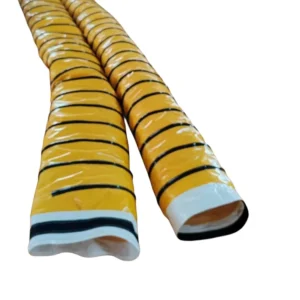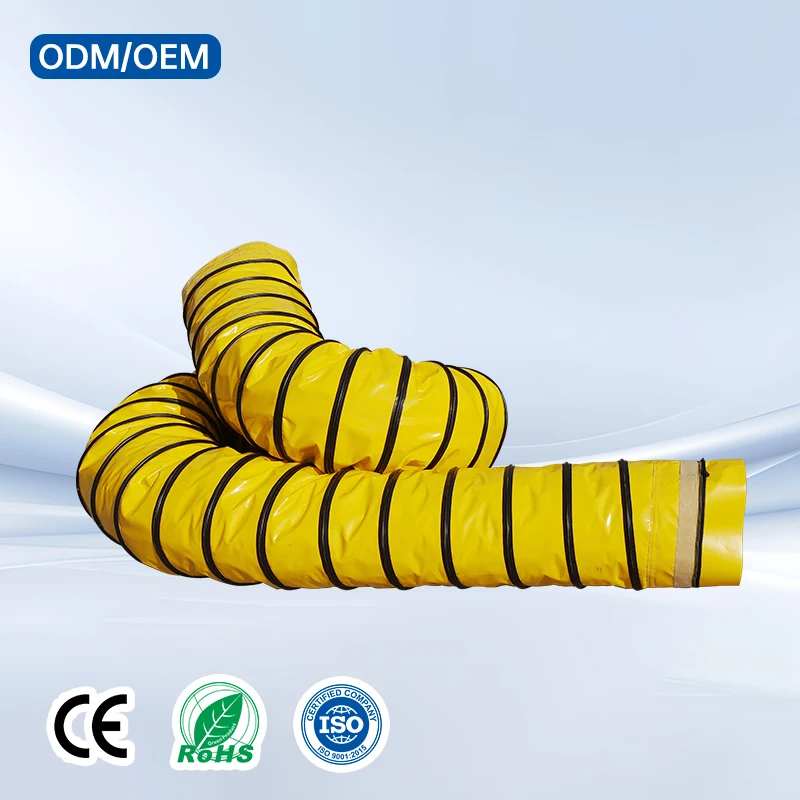
Coated Fabric Process Control — Three production lines with dedicated QA at every coating and fabrication stage ensure the PCA hose insulation layers and connectors meet aviation ground support requirements before dispatch.
Technical Specifications
| Parameter | Value |
|---|---|
| Product Type | Aircraft PCA Hose |
| Coating Material | PVC coated cloth with fabric-reinforced layer |
| Insulation Layer | Built-in aluminum foil bubble film |
| Outer Layer | Yellow-black alternating protective coloring |
| Temperature Range | -30°C to 150°C |
| Connection Method | Zipper and Velcro link |
| Characteristic | Mildew resistance, water resistance, high strength |
| Logo Customization | Support MOQ 100 |
| Pattern Customization | Support MOQ 100 |
| Standards | ISO, CE (company level) |
| Fire-Retardant / Anti-Static | Available in compliant grades — confirm the certification required for your apron operation |
Application Suitability
| Application | Exposure & Requirement |
|---|---|
| Narrow-body aircraft PCA connection | Frequent deployment and retrieval on concrete apron, bending stress at joints, outdoor weather between flights |
| Wide-body aircraft ground air supply | Extended hose runs requiring consistent airflow, exposure to jet blast debris and fuel spillage zones |
| Mobile air conditioning unit integration | Vibration from GSE vehicle movement, thermal cycling from cold air transmission in hot apron environments |
| MRO apron duct replacement | Compliance verification for fire-retardant and anti-static standards, compatibility with existing flange interfaces |
Why Your Ground Crew Needs More Than a Duct Specification Sheet
Request full compliance documentation before the hose leaves the factory, not after it fails the apron safety audit.
Airport ground support teams routinely receive ventilation ducting that looks correct on the packing list but arrives without the fire-retardant or anti-static test report the site safety officer requires. The duct goes into storage, the aircraft turnaround window closes, and the maintenance contractor scrambles to source a compliant replacement at short notice [NEED_CITE: aviation ground support equipment compliance documentation requirements]. A flexible Aircraft PCA Hose must carry paperwork that matches the physical product — coating composition, temperature rating, and insulation layer construction verified before dispatch, not promised after the fact.
Connecting the PCA Unit to the Cabin Without Airflow Loss
The primary function of an Aircraft PCA Hose in airport ground operations is transmitting pre-conditioned air from the stationary or mobile PCA unit to the aircraft cabin interface. Every joint, bend, and connection point represents a potential leak path where conditioned air escapes before reaching the cabin. The zipper and Velcro connection system on this duct allows ground handlers to achieve a sealed joint rapidly during tight turnaround schedules, then disconnect and fold the hose for compact storage between flights.
Visibility and Safety on the Active Apron
Ground handling crews work around moving aircraft, tugs, and fuel trucks where a dark-coloured duct lying on the tarmac becomes a trip hazard or gets run over. The yellow-black alternating outer colouring provides high-visibility contrast against grey concrete, making the Aircraft PCA Hose visible to vehicle operators and ramp personnel during both daylight and apron floodlight conditions. This visual marking also helps maintenance teams identify hose sections quickly during multi-aircraft servicing operations.
Understanding Temperature Range and Insulation Construction
The stated -30°C to 150°C operating range reflects the combined performance of the PVC-coated fabric-reinforced outer layer and the built-in aluminum foil bubble film insulation. Pre-conditioned air from a PCA unit can arrive at temperatures significantly different from ambient apron conditions — cold air on a hot summer ramp or warm air during winter operations. The insulation layer reduces thermal transfer between the air stream and the external environment, maintaining delivery temperature while protecting the outer fabric from thermal degradation [NEED_CITE: thermal insulation performance standards for flexible air ducts in ground support applications]. The aluminum foil layer additionally acts as a vapour barrier, preventing condensation from forming on the outer surface when cold air flows through the duct in humid conditions.
What Happens When the Connector Fails Before the Hose Does
The highest mechanical stress on any flexible duct occurs at the connection points, where repeated assembly and disassembly concentrates wear. Ground crews report zipper teeth separation and Velcro delamination as common failure modes on PCA hoses that have seen continuous apron service. When the connector fails, the duct cannot maintain a sealed joint, conditioned air escapes at the connection, and the hose must be pulled from service — often with the fabric body itself still in good condition [NEED_CITE: flexible duct connector failure modes in repeated deployment cycles]. Verifying zipper gauge and Velcro shear strength against your expected connection cycles per day helps match the hose specification to your actual operational tempo.
Why Procurement Teams Source This Hose Here
Deep coating process control across three production lines means the PVC layer weight and adhesion to the base fabric remain consistent from roll to roll, so hose sections cut from different batches behave identically during heat welding.
A 10-person R&D team handles custom inner diameter sizing, flange compatibility, and OEM branding development, producing samples within days rather than weeks for apron fleet trials.
Dedicated QA inspection at every production stage — coating, insulation lamination, zipper attachment, final assembly — catches seam alignment and insulation continuity issues before the hose reaches packing.
Pre-shipment inspection records document each hose against the order specification, giving procurement teams a verification trail when the product arrives at the airport stores.
Documentation & Verification
- Material specification sheet stating PVC coating composition, base fabric construction, and aluminum foil insulation layer details
- Fire-retardant and anti-static test reports applicable to aviation apron standards — confirm required grade before order
- Pre-shipment inspection record covering seam integrity, insulation continuity, and zipper/Velcro connector function
- Temperature range validation data confirming -30°C to 150°C operating envelope
- Certificate of origin and customs documentation for international airport equipment procurement
Fabrication, Handling & Storage
- Heat weld seams at manufacturer-recommended temperature to maintain PVC coating adhesion at the fabric-reinforced layer joints
- Inspect zipper teeth alignment and Velcro bond strength after each apron deployment cycle to catch early connector wear
- Fold the hose along existing crease lines rather than random crumpling to avoid stressing the aluminum foil insulation layer
- Store coiled sections in a dry, ventilated area to leverage the mildew-resistant PVC coating and prevent moisture trapping
- Clean outer yellow-black surface with mild detergent only — solvent cleaners may degrade the PVC coating finish
- Verify inner diameter and flange dimensions against target aircraft model interface drawings before installation
What We Need to Quote Your PCA Hose Requirement
Provide the target aircraft models and PCA unit outlet specifications so we can confirm inner diameter, length, and flange compatibility. State the fire-retardant and anti-static certification standards required by your airport authority or ground handling contract. Indicate whether you need OEM branding, high-visibility colour variations, or standard yellow-black outer layer.
Frequently Asked Questions
Q: Which fire-retardant and anti-static standards apply to PCA hoses on airport aprons?
A: Requirements vary by airport authority and national aviation regulations. Common references include fire classification standards for ground support equipment materials and anti-static specifications for equipment operating near fuel handling zones. Request the specific test standards your site safety officer requires, and we will supply matching test reports with the shipment documentation.
Q: Can the inner diameter and length be customized for specific PCA units and aircraft?
A: Yes. We develop custom-sized hoses based on your PCA unit outlet dimensions and the aircraft cabin air conditioning interface specifications. Provide the target aircraft models and ground equipment details, and our R&D team will produce a sample hose for fitment verification before full production begins.
Q: How does the temperature rating perform under extreme apron conditions?
A: The -30°C to 150°C range covers the operational envelope from winter cold-soak conditions to hot apron environments with direct solar loading. The aluminum foil bubble film insulation layer maintains thermal separation between the pre-conditioned air stream and external ambient temperature during transmission.
Q: What is the durability of the zipper and Velcro joints under high-pressure airflow?
A: Connection durability depends on deployment frequency and handling practices. The zipper and Velcro system is designed for repeated assembly and disassembly cycles typical of aircraft turnaround operations. We recommend inspecting connector condition at regular intervals matched to your daily connection cycle count.
Q: Is OEM branding and custom colour available for fleet identification?
A: Logo and pattern customization are supported with a minimum order of 100 units. The standard yellow-black alternating outer colouring provides high visibility, and alternative colour schemes can be developed for fleet identification or operator branding requirements.