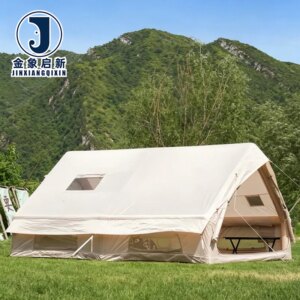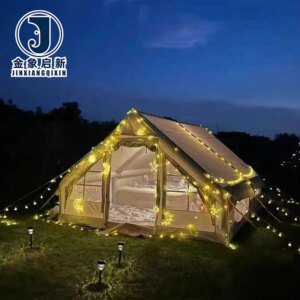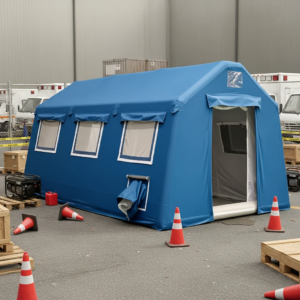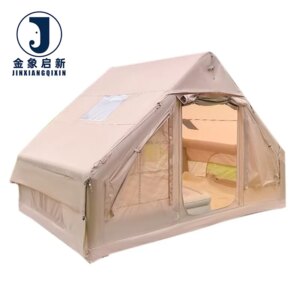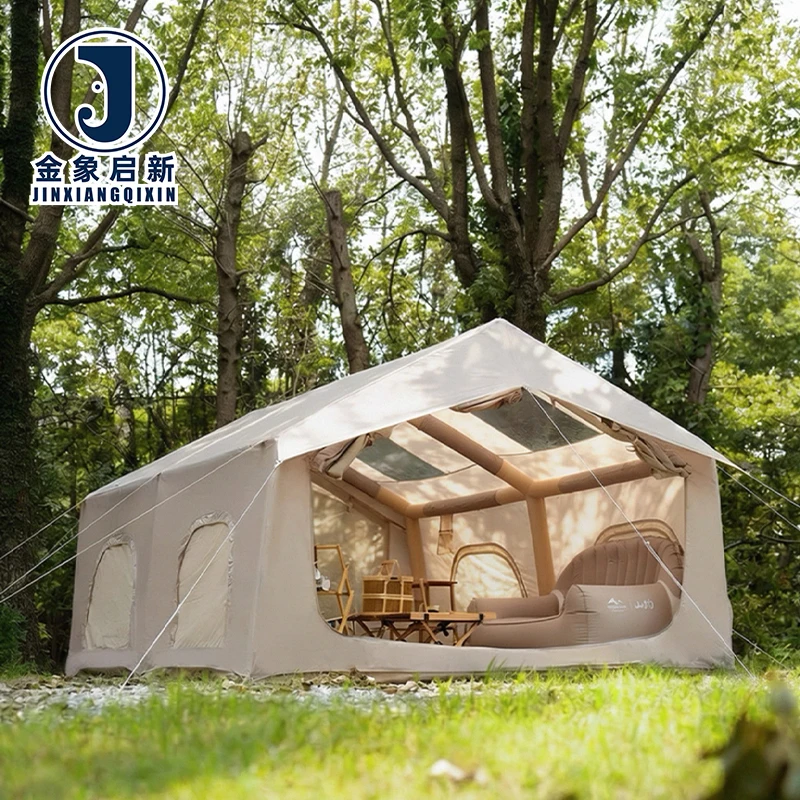
Proven coating control — Nearly 30 years focused on PVC tarpaulin formulation, delivering verified GSM consistency and adhesion strength for inflatable tent structures deployed across emergency and industrial sites.
Technical Specifications
| Parameter | Value |
|---|---|
| Product Type | Inflatable Tent |
| Core Material | PVC Tarpaulin |
| Key Performance | UV Resistant (test basis not stated in source), Waterproof, Tear-Resistant, Foldable |
| Product Forms | Quick Automatic Opening, Four-Season Design, Single Layer Construction, Extended Type |
| Flame Retardant | Available upon request — confirm the grade required for your market |
| Anti-Static | Available upon request — confirm surface resistance or standard for your application |
| Customization Service | OEM & ODM (sample customization, pattern printing) |
| Quality Control System | Strict full-process quality inspection with dedicated QA & QC staff on site |
| Standards | ISO9001, ISO14001, ISO45001, CE |
Application Suitability
| Application | Exposure & Requirement |
|---|---|
| Emergency disaster relief shelters | Rapid deployment, all-weather exposure, compliance with relief agency safety standards |
| Temporary site offices at construction projects | Prolonged outdoor UV exposure, wind load, frequent relocation |
| Mobile storage shelters for logistics operations | Abrasion from equipment handling, moisture ingress prevention, large span coverage |
| Rapid deployment field facilities | Single-layer transport efficiency, quick inflation mechanism, four-season temperature variance |
Why "Flame Retardant" Means Nothing Without a Grade Behind It
Inflatable tent fabric specified without a stated fire classification leaves compliance entirely to chance.
When emergency relief organizations or construction contractors procure inflatable tent structures, the safety specification sheet often lists "flame retardant" as a blanket feature. [NEED_CITE: fire safety classification standards for temporary structures and tents]. Without a cited grade—whether NFPA 701, DIN 4102 B1, or a regional building material standard—there is no way to confirm the fabric will pass a site inspection. Inflatable Tent aftermarket supplier documentation frequently omits this detail, forcing buyers to seek independent testing after delivery, delaying project timelines and adding unbudgeted costs to emergency response operations.
Deployment Speed Dictated by Fabric Behaviour
The quick automatic opening mechanism relies on the PVC tarpaulin maintaining consistent flexibility across temperature ranges. If the coating formulation becomes brittle in cold conditions or overly soft in high heat, the inflation cycle extends or the structure fails to achieve full rigidity. Sourcing an Inflatable Tent aftermarket supplier that provides material data referencing the specific temperature boundaries of the coating allows project planners to match the fabric to the deployment climate rather than relying on generic four-season claims.
Single Layer Construction and Transport Logistics
Emergency response logistics demand that shelters occupy minimal cargo volume while providing adequate weather protection. The single layer construction of this inflatable tent balances tear-resistant performance with foldable packing density, enabling more units per container compared to multi-wall alternatives. [NEED_CITE: volumetric efficiency of single-layer versus insulated temporary shelters in disaster logistics]. Procurement teams evaluating an Inflatable Tent aftermarket supplier should request the folded dimensions and weight per unit to calculate container loading accurately before committing to bulk orders.
Reading the Specification Sheet Beyond Marketing Claims
UV resistance and waterproof performance are standard expectations for PVC tarpaulin, yet the test basis for these claims determines their reliability in the field. A fabric may resist water penetration under static conditions but fail at welded seams when subjected to wind-driven rain over extended exposure. Similarly, UV resistance without a stated test standard—such as hours under xenon arc exposure per ISO 4892—provides no benchmark for comparing batches or predicting service life in high-sun regions. Evaluating the base fabric denier, weave density, and coating weight together, rather than GSM alone, gives a clearer picture of how the material will perform when inflated under load and exposed to sustained environmental stress.
The Cost of Ordering on Incomplete Specifications
Buyers who approve inflatable tent fabric based on a quoted GSM without requesting a roll-by-roll weight verification report risk receiving material lighter than agreed. [NEED_CITE: incidence of GSM discrepancy in coated fabric shipments and its effect on tensile performance]. A shortfall in coating weight reduces the material’s tear resistance and compromises the waterproof barrier at stress points where the inflatable structure flexes. Colour variation between rolls within the same order becomes visible once multiple tents are deployed side by side at a single site, undermining the professional appearance required for commercial and institutional projects.
Why Procurement Teams Source Here
This inflatable tent fabric is produced in a 9,180 square meter facility running 3 full production lines, providing the capacity to fulfil large-scale deployment orders without fragmenting production across external workshops. The 10-technician R&D team handles OEM and ODM sample development, including pattern printing and custom sizing, with samples typically ready within a short turnaround. Dedicated QA and QC staff conduct full-process inspection at every stage, concluding with a 100 percent pre-shipment check. The manufacturing process maintains control over coating weight and adhesion, addressing the common failure point where seams separate before the fabric itself degrades. ISO9001, ISO14001, ISO45001, and CE certifications are maintained and documentation is provided with each shipment.
Documentation & Verification
- Material specification sheet confirming PVC base fabric, coating type, and performance parameters for each inflatable tent order
- UV and flame retardant test reports referenced to the specific batch and order number where applicable
- Pre-shipment inspection record signed by dedicated QA and QC staff confirming weight and visual checks
- ISO9001, ISO14001, ISO45001, and CE certificates included in the shipping documentation package
- Roll packing list detailing individual roll dimensions and net weight for customs and receiving verification
Fabrication, Handling & Storage
- Heat welding parameters must match the PVC coating formulation to prevent seam failure at inflation stress points
- Store folded tents in dry conditions to prevent moisture entrapment between the waterproof PVC layers
- Avoid compressing packed units beyond recommended stacking height to preserve the quick automatic opening mechanism function
- Use compatible PVC adhesive for field repairs on tear-resistant fabric to maintain coating bond integrity
- Clean surfaces with neutral pH agents to protect the UV resistant coating treatment from chemical degradation
What to Include in Your Inquiry
Provide the intended deployment environment, including typical temperature range and exposure duration, so the correct PVC formulation can be recommended. Specify any fire safety classification required by local regulations or the procuring agency to determine whether a flame retardant grade must be applied. Indicate whether you require roll stock for your own fabrication line or fully finished inflatable tent units with custom sizing and pattern printing.
Frequently Asked Questions
Q: How can I verify the UV resistance claims with supporting documentation?
A: Request the test report referenced to your specific order number. The report should cite the test standard used, such as xenon arc exposure hours, and confirm the result applies to the batch being shipped. Without this documentation, UV resistance remains an unverifiable claim that cannot be used for compliance or project specification purposes.
Q: What flame retardant grades are available and how do I match my market requirements?
A: Flame retardant treatment is available upon request, and the applicable grade depends on your target market’s fire safety regulations for temporary structures. Communicate the specific standard your project requires—whether NFPA 701, DIN 4102, or a local building code—so the correct formulation can be applied and documented before production begins.
Q: How is colour consistency maintained across large-volume inflatable tent orders?
A: Batch colour control is managed through the coating process with dedicated QA and QC inspection at each production stage. Pre-shipment inspection verifies colour uniformity across all rolls in the order. For projects where multiple tents will be deployed adjacent to each other, requesting a colour reference sample before full production ensures alignment with project expectations.
Q: What customization options exist for size, printing, and opening mechanisms?
A: The OEM and ODM service covers custom sizing, pattern printing, and modifications to the quick automatic opening mechanism. The 10-technician R&D team develops samples based on your specifications, and sample approval is required before bulk production proceeds. Provide detailed drawings or reference samples to accelerate the development cycle.
Q: How is quality consistency ensured across bulk orders of inflatable tent fabric?
A: Every production stage includes inspection by dedicated QA and QC staff, with a 100 percent pre-shipment check covering weight, visual defects, and coating adhesion. Manufacturing records and test data are retained per order, enabling full batch traceability. ISO9001 and ISO14001 certified processes govern the production workflow from raw material receipt through dispatch.