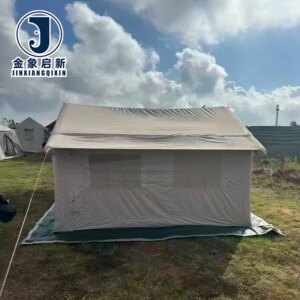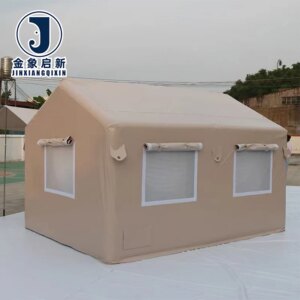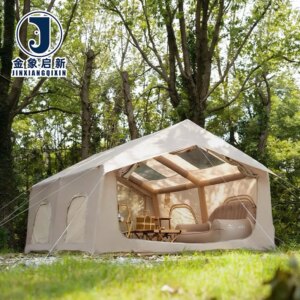
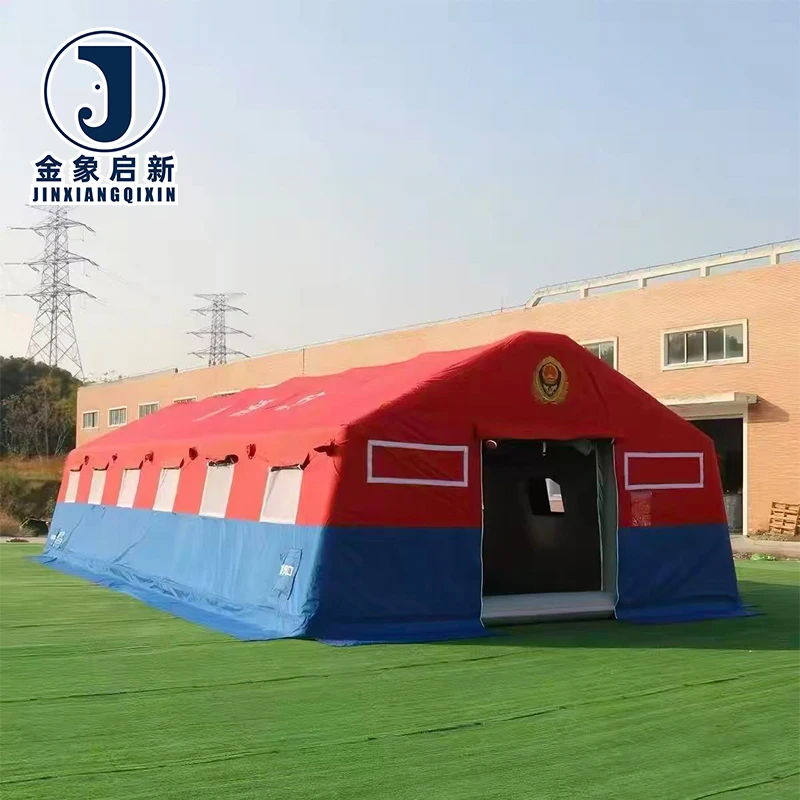
Rapid Automatic Opening — engineered with industrial-grade PVC tarpaulin and quick-deploy inflation systems, this inflatable tent supports transport fleets and field crews needing reliable temporary shelter without extended setup downtime.
Technical Specifications
| Parameter | Value |
|---|---|
| Product Type | Inflatable Tent |
| Core Material | PVC tarpaulin |
| Waterproof Rating | 3000mm |
| Construction | Single Layer Construction |
| Season Rating | Four-Season Design |
| Opening Mechanism | Quick Automatic Opening |
| Customization Service | OEM & ODM (sample customization, pattern printing) |
| Standards | ISO9001, ISO14001, ISO45001, CE |
Application Suitability
| Application | Exposure & Requirement |
|---|---|
| Logistics and transport fleet staging areas | Rapid-deploy temporary warehousing, load protection from moisture and wind during staging operations |
| Construction site field offices | Quick-setup workspace under weather exposure, equipment storage requiring waterproof protection |
| Disaster relief command posts | Emergency deployment in adverse conditions, personnel and supply shelter with minimal ground preparation |
| Mobile environmental monitoring stations | Four-season structural integrity across temperature variations, equipment protection from ingress |
Why Inflatable PVC Tent for transport and fleet deployment Requires More Than a Waterproof Claim
A waterproof rating only matters when the seams, valves, and fabric perform as a single tested system.
Transport and logistics operators frequently source inflatable shelters based on headline specifications, only to discover during field deployment that seam welds leak under wind-driven rain or inflation valves fail in cold conditions. The cost is not just the replacement shelter — it is the operational downtime, the exposed cargo, and the crew standing in weather while a solution is improvised. Sourcing teams need documentation that ties the waterproof rating to the specific batch, confirms valve integrity under pressure cycling, and verifies seam weld strength against the inflation load [NEED_CITE: seam weld integrity testing for inflatable structures].
Rapid Deployment Architecture for Fleet Operations
Transport fleets operating across multiple job sites require temporary shelters that deploy without specialized crews or heavy ground anchors. The quick automatic opening mechanism on this Inflatable PVC Tent for transport and fleet deployment reduces the interval between arrival and operational readiness, allowing drivers and site coordinators to focus on load management rather than shelter assembly. Single layer construction balances structural rigidity with pack weight, keeping transport volume within standard fleet storage allocations.
Four-Season PVC Tarpaulin Under Field Stress
The 3000mm waterproof PVC tarpaulin addresses the primary failure mode in temporary field shelters: moisture ingress at stress points where fabric flexes against inflation pressure. Four-season design maintains material pliability across temperature extremes, preventing the brittle cracking that compromises lighter-grade fabrics in cold-weather deployments [NEED_CITE: PVC tarpaulin low-temperature flexibility testing standards]. Construction crews and disaster response teams deploying in shoulder seasons or variable climates benefit from a single shelter specification that does not require seasonal swap-outs.
How Single Layer Construction Balances Weight and Weather Protection
Single layer PVC tarpaulin construction eliminates the delamination risk inherent in multi-layer bonded fabrics, where adhesive failure at the ply interface becomes the weakest point under repeated inflation and deflation cycles. The 3000mm waterproof rating depends on coating continuity across the entire fabric surface — a single-layer approach allows direct visual and instrumental inspection of coating uniformity without hidden interfaces. For fleet operators loading multiple shelters per vehicle, the reduced pack weight of single-layer construction compounds across units, freeing payload capacity for tools and equipment. Base fabric denier and weave density determine how the coating distributes mechanical load; higher denier yarns resist puncture from ground debris, while tighter weave counts prevent coating penetration gaps that lead to micro-leaks under hydrostatic pressure. Surface finish — glossy or matte — affects both field cleaning protocols and pattern printing adhesion for fleet branding applications.
The Cost of Underspecifying Inflatable Shelters for Fleet Use
When logistics operators source inflatable shelters based on price rather than application-matched specifications, the consequences surface during the first significant weather event. Seams that pass static pressure tests may fail under cyclic wind loading, where repeated flexing fatigues the weld zone faster than the parent fabric. Inflation valves rated for moderate temperature ranges can seize in cold conditions, converting a five-minute deployment into a thirty-minute troubleshooting exercise with cargo exposed [NEED_CITE: inflation valve performance under thermal cycling]. Batch-to-batch variation in coating weight creates inconsistent waterproof performance across a fleet’s shelter inventory, meaning some units leak while others hold — a problem that only emerges when shelters are deployed side by side.
Sourcing Certainty for Transport and Logistics Procurement
Production runs are supported by three full production lines and 36 sets of professional processing equipment, allowing batch consistency across multi-unit fleet orders without extended lead compromises. The 10-technician R&D team handles OEM and ODM requirements including pattern printing for fleet identification and dimensional adjustments for non-standard load profiles. Pre-shipment inspection covers seam welding integrity and inflation valve function on every unit, documented per batch rather than sampled. ISO9001, ISO14001, ISO45001, and CE certifications are maintained and available for compliance submissions required by transport authorities or site access protocols. Sample development proceeds within days for custom sizing or branding requirements, allowing procurement teams to validate fit and finish before committing to full production runs.
Documentation & Verification
- Waterproof test report confirming 3000mm rating for the specific production batch
- CE certification documentation matched to tent model and batch number
- Pre-shipment inspection record covering seam weld and valve function
- Material specification sheet stating base fabric denier and PVC coating formulation
- ISO and ISO45001 compliance certificates for site access submissions
Fabrication, Handling & Storage
- Heat welding parameters must match single layer PVC tarpaulin thickness to avoid scorching or incomplete fusion
- Inflation valves require protective caps during transport to prevent debris ingress and thread damage
- Folded shelters should be stored flat to prevent permanent crease marks in PVC coating
- Cold-weather deployment requires gradual inflation to allow fabric to reach ambient pliability
- Cleaning with mild detergent preserves waterproof coating; solvent-based cleaners degrade PVC surface
- Field puncture repairs require compatible PVC patch material and adhesive matched to coating formulation
Specification and Deployment Requirements for Inquiry
Procurement teams should provide the intended deployment environment, including typical wind loading and temperature range, to confirm four-season suitability. Specify required unit dimensions, quantity per order, and whether pattern printing for fleet branding is needed. Confirm target market compliance requirements, including any site-specific certifications beyond standard CE documentation.
Frequently Asked Questions
Q: How is the 3000mm waterproof rating tested and documented per batch?
A: Each production batch undergoes hydrostatic pressure testing on fabric samples and finished seam welds, with results recorded in a batch-specific test report. This documentation accompanies shipment and can be matched to unit serial numbers for traceability across fleet deployments.
Q: What size and branding customization is available for fleet-specific deployments?
A: OEM and ODM services cover dimensional adjustments to fit specific load profiles or site footprints, along with pattern printing for fleet identification, logos, or safety markings. Sample units are produced for approval before full batch manufacturing proceeds.
Q: How does the four-season PVC tarpaulin perform under UV and temperature extremes?
A: Four-season design maintains structural integrity across temperature variations, with PVC formulation selected to resist embrittlement in cold conditions and softening under heat load. Confirm the specific UV exposure duration and thermal range for your deployment region to validate suitability.
Q: What pre-shipment inspection covers seam welding and inflation system integrity?
A: Every unit undergoes inflation testing and seam inspection before dispatch, with results documented per batch. Inspection records cover weld continuity, valve function under pressure cycling, and coating uniformity across the fabric surface.
Q: What is the lead time and minimum order for custom-sized inflatable tents?
A: Lead times vary based on customization complexity and order volume. Sample development typically completes within days for dimensional and branding validation. Contact the production team with specific quantity and customization requirements for scheduling confirmation.