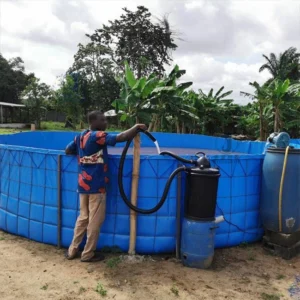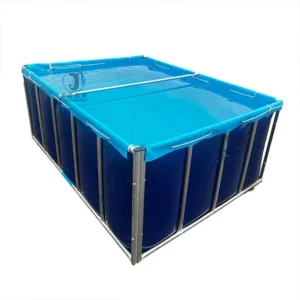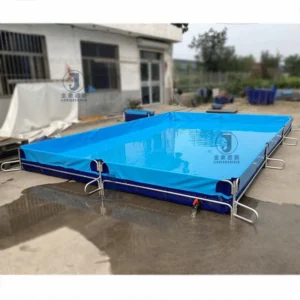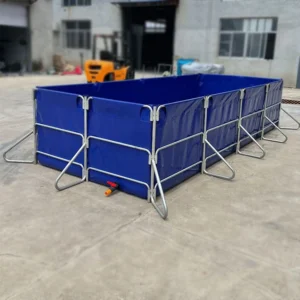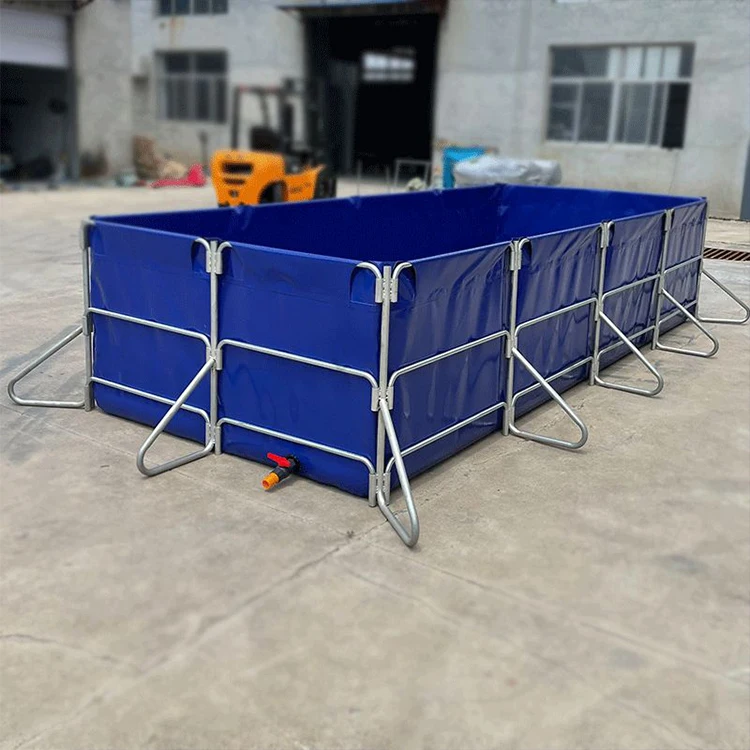
Precision-Cut Shapes — Every circular and rectangular liner is heat-welded to the exact pond dimensions you specify, eliminating on-site trimming and reducing seam stress at the water line.
Technical Specifications
| Parameter | Value |
|---|---|
| Product Type | PVC Tarpaulin Fish Pond Liner |
| Coating Material | PVC |
| Shape Options | Circular / Rectangular |
| Feature | Foldable |
| Application | Fish Tank / Aquaculture Pond |
| Weight (GSM) | Not stated in source |
| Base Fabric Denier | Not stated in source |
| UV Treatment | Available — confirm the grade required for your market |
| Flame Retardant Grade | Available — confirm the grade required for your market |
| Color | Available in custom colours — confirm reference per order |
| Standards | ISO, CE (per company profile) |
Application Suitability
| Application | Exposure & Requirement |
|---|---|
| Aquaculture grow-out ponds | Permanent water contact, soil chemistry, puncture risk from substrate |
| Hatchery and nursery tanks | Frequent draining and refilling, hygiene cleaning, UV exposure outdoors |
| Portable and seasonal enclosures | Repeated folding and unfolding, transport abrasion, rapid deployment |
| Agricultural water containment | Mixed livestock and fish use, extended sun exposure, edge anchor stress |
Why Liner Seam Integrity Matters More Than Fabric Weight Alone
A pond liner that fails at the weld before the fabric does is not a material problem — it is a fabrication problem.
Most pond liner leaks do not start in the middle of the sheet. They appear at the seams, at the corners, and wherever water pressure concentrates against a join that was not heat-welded under controlled tension [NEED_CITE: tensile and tear test methods for coated fabrics per ISO 1421]. For aquaculture operators running hundreds of ponds, a single seam failure can drain a breeding cycle and lose an entire stock. The PVC tarpaulin fish pond liner you specify must be welded with the same attention to peel strength that transport-grade side curtains demand, because the hydrostatic load on a filled pond pushes outward and downward with relentless consistency.
Shape Configurations That Match Your Farm Layout
Circular liners distribute water pressure evenly toward the centre, reducing stress at the edges and making them well-suited to above-ground frame tanks. Rectangular liners maximise surface area in excavated or bunded ponds where straight runs of fabric can be anchored along the perimeter. Both configurations are available as a PVC tarpaulin fish pond liner cut and welded to your exact dimensions, so the material arrives on-site ready to deploy without field trimming.
Foldability That Survives Repeated Transport
A liner that cannot be folded without cracking at the crease is a liability for any operation that rotates ponds seasonally or ships enclosures to remote farm sites. The PVC-coated fabric used here retains flexibility across temperature ranges encountered during transport and on-site unfolding [NEED_CITE: low-temperature flexibility test basis for PVC coated fabrics]. The foldable design means a liner sized for a large pond can be shipped in a compact bundle, reducing freight volume and making manual handling on the farm practical without mechanical aids.
Reading Beyond the Quoted GSM
GSM tells you how much material is in each square metre, but it does not tell you how that weight is distributed between the base fabric and the coating layers. A PVC tarpaulin fish pond liner with a high GSM achieved through heavy coating but a low-denier base fabric may resist puncture initially yet tear easily once a small cut propagates under water load. Conversely, a tighter weave with moderate coating weight delivers better tear propagation resistance and superior weld peel strength. Asking for the base fabric denier and coating weight separately — not just the total GSM — gives you a clearer picture of how the liner will perform when filled to capacity and subjected to seasonal temperature swings.
The Hidden Cost of Underweight Material on Arrival
Quoted GSM that does not match the material received is one of the most common complaints in coated fabric procurement. A liner that arrives lighter than specified will be thinner at the coating, more prone to puncture from sharp substrate stones, and less capable of holding a heat-welded seam under sustained hydrostatic pressure [NEED_CITE: GSM verification methods for coated tarpaulin at point of delivery]. For an aquaculture operation that has already excavated the pond, positioned the liner, and filled it with water and stock, discovering the shortfall means either accepting reduced service life or draining the pond, removing the liner, and waiting for a replacement — a cycle that costs far more than the price difference between correct and underweight material.
Why Procurement Teams Source This Liner Here
Three full production lines and thirty-six sets of professional equipment handle bulk liner orders with consistent on-time delivery, so your pond installation schedule is not held back by factory delays.
A ten-person R&D team develops custom-sized samples within days, letting you verify material weight, flexibility, and weld quality before committing to the full production run.
Dedicated QA and QC at every production stage includes inspection of seam integrity, dimensional accuracy, and coating weight against your specification before the liner leaves the facility.
Full documentation accompanies every shipment — material specification sheets, pre-shipment inspection records, and certificates of origin — so your receiving team can verify the liner against the purchase order without delay.
Documentation & Verification
- Material specification sheet stating GSM, base fabric denier, and coating weight for the liner grade supplied
- Pre-shipment inspection record confirming seam integrity and dimensional accuracy before dispatch
- Custom sizing drawings showing circular or rectangular dimensions matched to your pond excavation or tank frame
- UV and flame-retardant test reports where applicable treatments are specified on the order
- Certificate of origin and customs documentation for international shipment clearance
Fabrication, Handling & Storage
- Heat-weld seams at recommended temperature and dwell time to match the PVC coating thickness on the liner grade supplied
- Reinforce corner welds on rectangular liners where hydrostatic pressure concentrates during filling and draining cycles
- Fold the liner with coating faces outward to minimise crease marks on the water-contact surface during storage
- Store rolls or folded bundles off the ground and away from direct sunlight until deployment to preserve coating flexibility
- Use compatible PVC adhesive patches for field repairs, matching the coating chemistry of the liner material
- Allow the liner to acclimatise on-site before unfolding in cold conditions to prevent stiff-coating cracks
What to Include in Your Enquiry
Specify the pond dimensions — diameter or length and width, plus depth — so the liner can be cut and welded to fit without field trimming. Indicate whether the installation is above ground on a frame or excavated into soil, as substrate conditions affect the puncture resistance requirement. Confirm any UV exposure expectations for outdoor ponds so the appropriate treatment level can be quoted.
Frequently Asked Questions
Q: How do I confirm the liner GSM matches what was quoted?
A: Request the material specification sheet that states GSM, base fabric denier, and coating weight separately. On arrival, you can weigh a cut sample of known area and compare it against the stated value. Our pre-shipment inspection record also documents weight verification before dispatch.
Q: Can liners be made in non-standard circular or rectangular sizes?
A: Yes. Both circular and rectangular liners are cut and heat-welded to the exact dimensions you provide. Minimum order quantities depend on the total fabric area required. Submit your pond drawings and we will confirm sizing feasibility and lead time.
Q: How are seams reinforced against water pressure?
A: Seams are heat-welded under controlled tension to achieve peel strength that matches or exceeds the fabric itself. On rectangular liners, corner joins receive additional weld passes to handle the concentrated hydrostatic pressure that occurs at full capacity.
Q: Is anti-UV treatment necessary for outdoor pond installations?
A: Outdoor ponds exposed to direct sunlight across seasons benefit from UV-treated fabric to slow coating degradation. Confirm the UV treatment grade required for your climate zone and installation duration so the appropriate formulation can be quoted.
Q: What is the process for deploying a foldable liner on-site?
A: The liner is shipped folded in a compact bundle. On-site, unfold it starting from the centre outward, allow the PVC to acclimatise in cold weather before full deployment, and secure the reinforced edge hems to the pond perimeter. Field repairs use compatible PVC patches.