Technical Specifications
| Parameter | Value |
|---|---|
| Product Type | Truck Cover |
| Configuration | 1PC / 2PC / 3PC |
| Base Fabric | RipSTOP |
| Material Weight Options | 12oz, 14oz, 15oz, 18oz |
| Drop Length | 8′ Drops |
| Coating Material | PVC / Vinyl |
| Water Resistance | Waterproof |
| Surface Treatment | Anti-Mildew |
| Durability Features | Abrasion-Resistant, Anti-Pull |
| Customization | Density adjustable to fit various truck sizes |
| UV Treatment | Available in UV treated grades — confirm the grade required for your route |
| Flame Retardant | Available in flame retardant grades — confirm the grade required for your market |
Application Suitability
| Application | Exposure & Requirement |
|---|---|
| Flatbed Semi-Truck Cargo Covering | Constant road vibration, wind uplift at highway speeds, tie-down strap abrasion |
| Lumber Transport Protection | Splinter and edge puncture risk, uneven load profiles, repeated folding at corners |
| Heavy-Duty Freight Weather Protection | Rain ingress at seams, snow load on flat surfaces, ice adhesion in cold climates |
| Road-Exposed Load Securement | UV degradation from direct sunlight, diesel exhaust residue, contact with steel and aggregate cargo |
Why a Generic PVC Truck Cover for Flatbed Transport Fails at the Edges
A cover that fits the load eliminates edge exposure and reduces tie-down adjustment time.
When a PVC truck cover for flatbed transport is cut to a standard size rather than the specific trailer model, the excess fabric flaps at speed and the shortfall leaves cargo exposed at the corners. Fleet operators deal with this mismatch on every load, adjusting straps and adding bungees to compensate for a cover that was never dimensioned for their deck. The result is premature wear at the hem where the fabric folds over itself, and cargo damage claims when water finds the gap [NEED_CITE: edge exposure and cargo damage rates in flatbed transport].
Dimensioning to the Trailer Deck, Not the Catalog
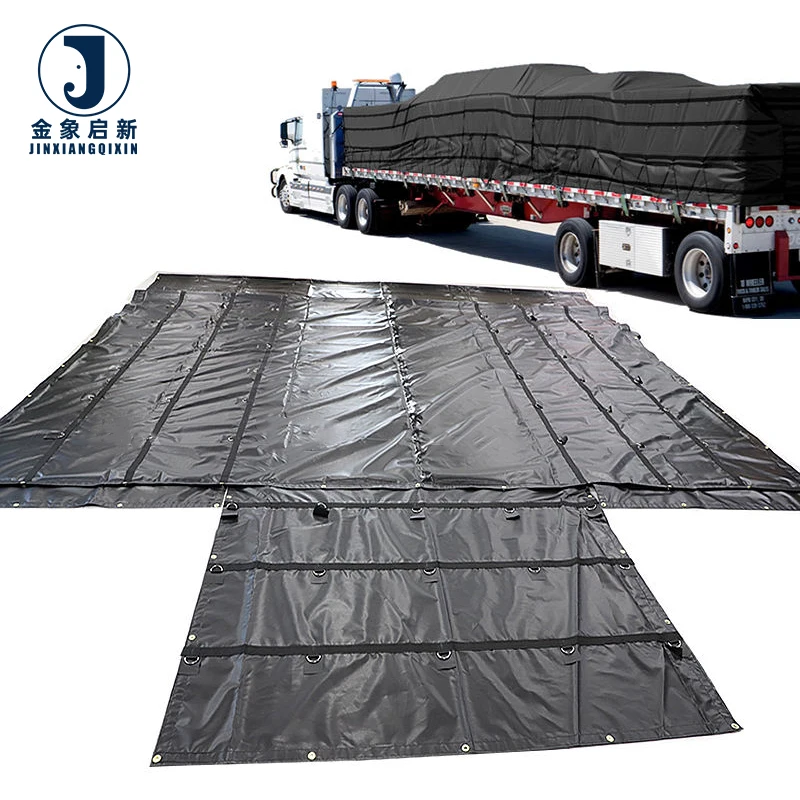
Every flatbed and step-deck trailer has a specific deck length, width and side rail height. Our PVC truck cover for flatbed transport is configured in 1PC, 2PC or 3PC sections to match how your fleet actually splits loads. A three-piece configuration lets you uncover only the rear section for a partial drop, while a single-piece cover suits full-deck lumber loads where the tarp stays in place from origin to destination. The 8′ drop length reaches past the deck edge to protect the cargo face from road spray.
RipSTOP Base Fabric Under Road Vibration
The RipSTOP weave in the base fabric creates a grid that arrests tear propagation when the cover snags on a splintered lumber edge or a protruding steel band. Anti-pull reinforcement at the attachment points handles the cyclic loading from road vibration without the fabric pulling away from the hem. This is critical for long-haul routes where the cover flexes thousands of times per trip [NEED_CITE: tear propagation in woven vs. non-woven base fabrics for transport covers].
Reading the Weight and Weave Together
The 12oz, 14oz, 15oz and 18oz weight options refer to the combined mass of the RipSTOP base fabric and the PVC coating per unit area. A heavier coating adds abrasion resistance at the tie-down points where straps press the fabric against rough cargo, but it also increases the effort required to fold and stow the cover between loads. The base fabric denier and weave density determine how the cover handles puncture from sharp lumber edges, independent of the coating weight. Selecting the right grade means matching both the weave and the coating thickness to the cargo profile and the frequency of handling.
The Cost of a Cover That Does Not Fit the Flex Point
When a PVC truck cover for flatbed transport is too short for the deck, operators stretch it past its intended drop line. This puts the welded seam under constant tension at the exact point where the load flexes over bumps. The seam fails before the fabric does, and the repair is never as strong as the original weld. Covers that are too long bunch at the tie-down points, creating fold lines that crack the PVC coating over repeated freeze-thaw cycles [NEED_CITE: weld seam failure location relative to load flex points].
Sourcing From a Facility That Controls the Coating Line
Our coating operation runs three full production lines with 36 sets of professional equipment, giving us direct control over PVC adhesion to the RipSTOP base fabric. The 10-person R&D team develops cut-to-size samples within days so you can verify fitment on your specific trailer model before committing to a production run. Every cover passes through dedicated QA/QC at each stage, with 100% inspection before dispatch to confirm drop length, piece count and hem reinforcement match your order. This process discipline is what separates a cover that fits from one that merely arrives.
Documentation & Verification
- Material specification sheet stating base fabric type, coating weight and oz rating for each tarp grade
- Pre-shipment inspection record confirming drop length, piece count and eyelet placement match the order
- Test report for UV and flame-retardant grades where applicable to your market requirements
- Roll packing list with individual cover identification for mixed configuration orders
Fabrication, Handling & Storage
- Heat-weld seams at manufacturer-recommended temperature to maintain PVC adhesion to the RipSTOP base
- Reinforce eyelet zones with additional PVC patches to distribute tie-down strap load across the weave
- Store folded covers dry; the anti-mildew treatment protects against humidity but not standing water inside folds
- Avoid dragging the 18oz grade over aggregate surfaces to preserve the abrasion-resistant coating face
- Clean with mild detergent only; solvent-based cleaners degrade the PVC coating bond over time
What We Need to Quote Your Fleet Accurately
Send us the trailer make, model and deck dimensions along with the cargo type you haul most frequently. If your routes cross jurisdictions with specific fire classification requirements for transport covers, include the standard reference so we can match the flame retardant grade. Let us know whether you need a mixed container of 1PC, 2PC and 3PC configurations or a single setup across the fleet.
Frequently Asked Questions
Q: How do I specify the exact tarp size for my flatbed trailer model and drop length?
A: Provide the trailer make, model, deck length and width, and the required drop distance from deck edge to the lowest point you need covered. We configure each PVC truck cover for flatbed transport to those dimensions and send a cut-to-size sample for fitment verification on your actual trailer before bulk production begins.
Q: What is the difference between 14oz and 18oz RipSTOP for lumber hauling?
A: The 18oz grade carries a heavier PVC coating for greater abrasion resistance against rough lumber edges and steel banding, suited to long-haul routes with frequent tie-down adjustment. The 14oz grade reduces weight and fold bulk for operators who handle the cover multiple times per day on regional routes.
Q: How are welded seams reinforced at the tie-down and flex points?
A: Seams at high-stress zones receive additional PVC patches that distribute the strap load across a wider area of the RipSTOP base fabric. This prevents the concentrated pull from lifting the coating away from the weave at the exact point where the load flexes during transit.
Q: Can I order a mixed batch of 1PC, 2PC and 3PC tarps in one container?
A: Yes. We consolidate mixed configurations into a single shipment with each cover individually identified on the packing list. Provide the quantity per configuration and the trailer dimensions for each, and we will confirm the loading plan and production schedule for your approval.
Q: How do you verify weight on arrival so the tarp matches what I ordered?
A: Every production run includes a material specification sheet stating the oz rating for the specific grade ordered. Our pre-shipment inspection record documents the verified weight, and we can provide roll-level weight data for your receiving team to cross-check against the stated specification on arrival.